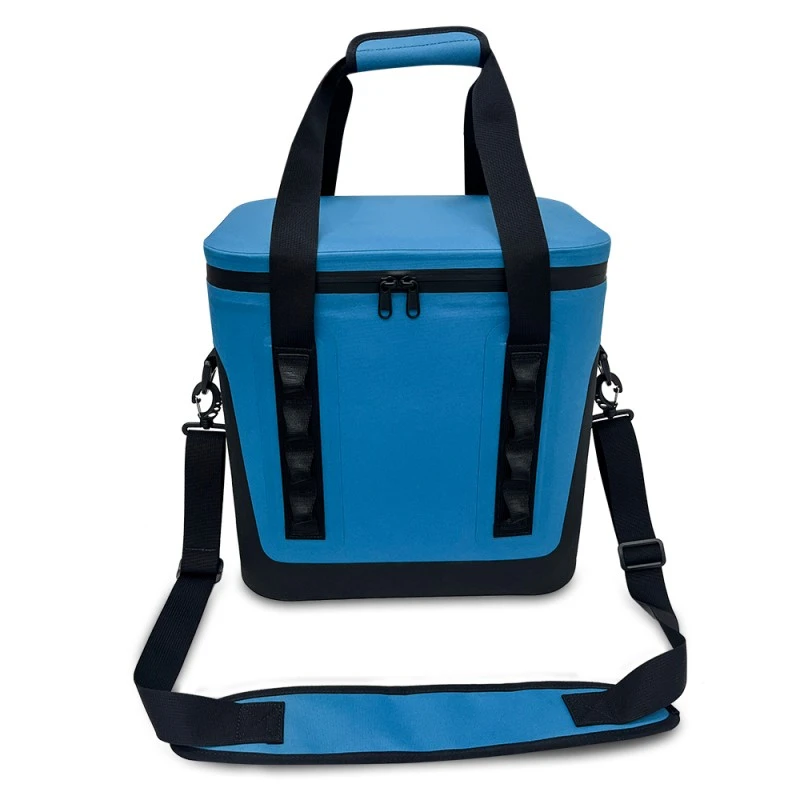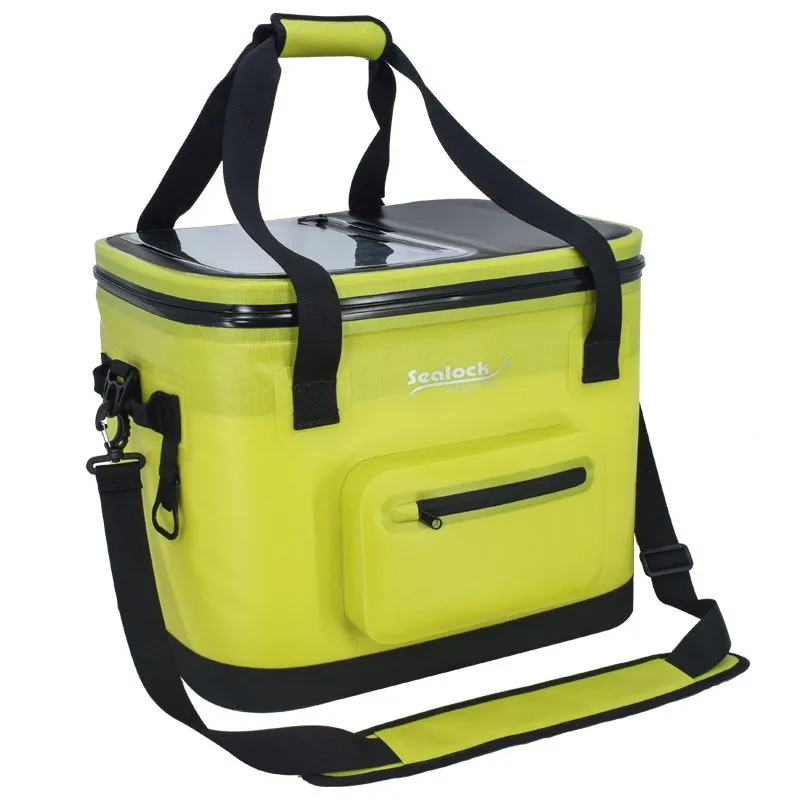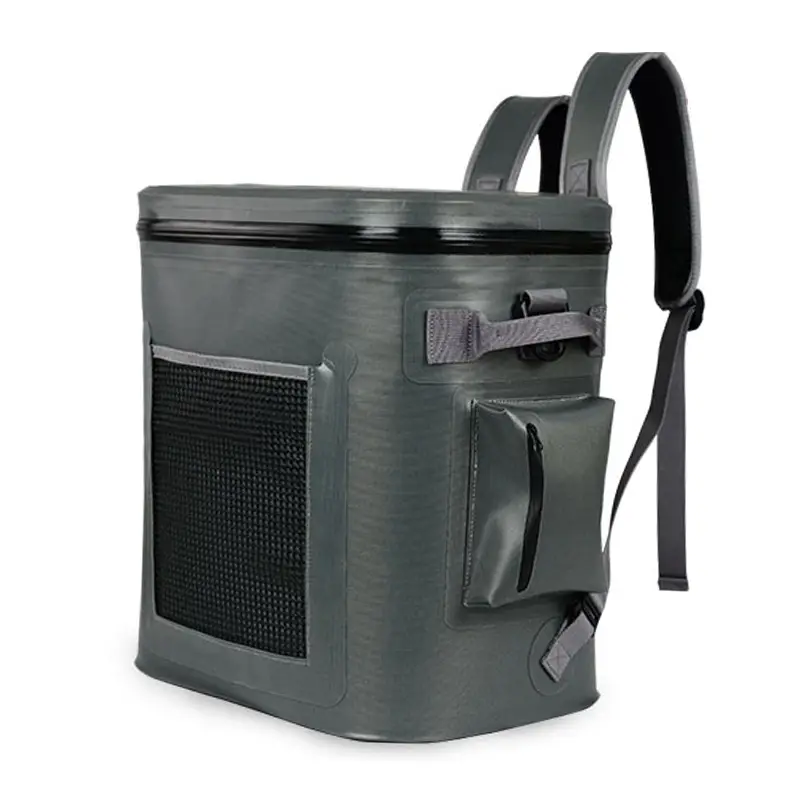
Soft Cooler Backpack Buying Guide

2026-08-27 0 Leave me a message
Most cooler backpack listings say the same four things: insulated, leakproof, waterproof, keeps ice for X hours. Almost none of them say how any of it was measured. This guide is about reading past that — which specifications actually predict performance, which claims deserve suspicion, and how to match a bag to what you will really do with it. It is written from the manufacturing side by Sealock (YiFuLong Outdoor Gear Co., Ltd.), which means it includes the things factories know and listings rarely mention.


First, Set Realistic Expectations

A soft cooler backpack is a portability-first product. As one buying guide puts it plainly: soft cooler bags are not substitutes for refrigeration or long-haul ice retention — they're engineered for portability first, performance second, and most people need reliable 4–8 hour cooling, not 24-hour sub-zero hold. The trade against a hard cooler is explicit: hard-sided models reach multi-day retention but weigh 30–40 lb empty, while most soft coolers hover in the 2- to 4-pound range.

Understanding that trade prevents the most common disappointment: buying a soft cooler and expecting hard-cooler numbers.

The single most useful thing to know before you buy: published ice-retention figures are usually optimistic. An independent gear-testing outlet states it directly: most of the claimed ice retention times feel quite inflated, perhaps due to extremely favourable testing conditions — storing the cooler inside with the lid closed in cool temperatures, for example — and you can expect approximately half the claimed ice retention time in real-world use. Another guide reports that lab claims often exceed real-world results by 2–3x. Notably, one major brand declines to publish hour claims at all, because many factors affect it and testing conditions often differ from real-life situations. Halve the number on the listing and you will be about right.


The Specifications That Actually Predict Performance

1. Insulation: thickness and cell structure

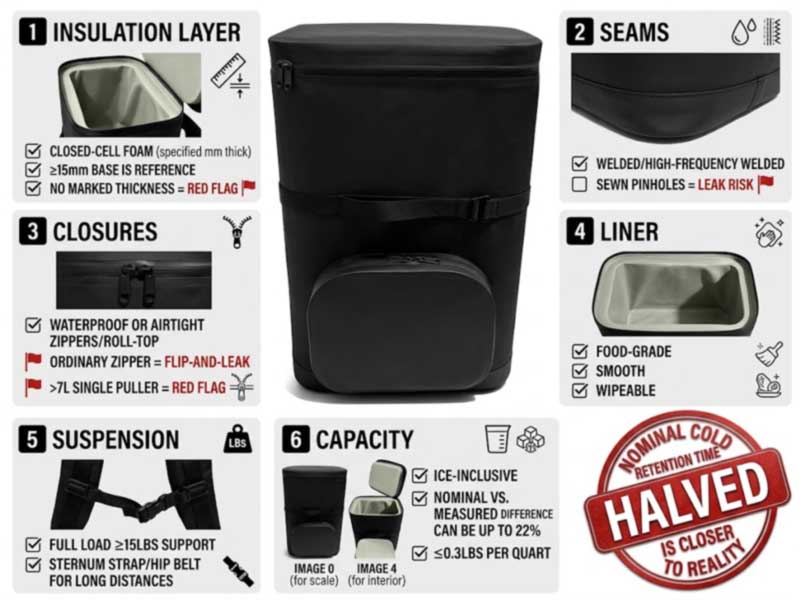
This is the number that matters most and the one most often omitted. Buying guidance is specific: insulation thickness and type — 15 mm or more of closed-cell PE foam is baseline, and avoid "multi-layer" claims without stated R-value or independent cold-retention test data. A reflective foil layer adds real benefit for very little bulk.

What to do: find the stated foam thickness in millimetres and confirm it is closed-cell. If neither is stated, that is itself information — one guide lists no stated insulation thickness as its first red flag.

2. Seams: welded, not sewn

This is the specification that separates a genuinely leakproof bag from a hopeful one, and it is easy to verify. As one reviewer puts it: welded or high-frequency welded seams are superior to stitched seams because stitch holes create pathways for water to escape — check the specification for "welded seams" or "one-piece liner" before trusting a leak-proof claim.

3. Closure: the ceiling on everything

A cooler is only as sealed as its opening. A standard zipper leaks the moment the bag tips and lets warm air in on every opening; a waterproof or airtight zipper, or a roll-top, seals properly. Heat gets in through the walls, through the opening when you unzip it, and through any gaps in the zipper or lid — which is why the best insulated cooler bags combine thick foam insulation with a tight closure. Another guide flags a single-slider zipper on a bag larger than 7L as a red flag.

4. Liner: food-grade and cleanable

The liner touches your food. Look for a stated food-grade material and a smooth, welded surface that wipes clean — a stitched fabric liner traps residue in its seams. Guides list a PVC or non-certified liner among their red flags for this reason. Every Sealock insulated bag uses a food-grade inner liner across the range.

5. Carry system: rated for the loaded weight

A loaded cooler is heavy, and cheap harnesses fail at the strap junction. One guide sets a concrete threshold: a shoulder strap system rated for 15 lbs or more of loaded weight, alongside welded seams and water-resistant zippers, as a non-negotiable. For anything you carry a distance, look for a sternum strap, and a waist belt on larger capacities.

6. Capacity: check the real number

Two traps here. First, capacity claims can be optimistic — one analysis of recurring complaints found misleading capacity claims, with up to 22% discrepancy between stated and measured volume. Second, and more important: a cooler's volume includes the ice. Standard practice is roughly two parts ice to one part contents, so a 24L cooler is not 24L of food. A useful sanity check on efficiency: for soft coolers, aim for 0.3 lbs or less per quart of stated capacity.

six specification checks for buying a soft cooler backpack: insulation, seams, closure, liner, harness and capacity

Match the Bag to What You Actually Do

The right cooler backpack is a different product for different uses. Start from the activity rather than the spec sheet:

Your use Prioritise Read more
Family picnics, park, everyday Easy access, wipe-clean liner, comfortable straps; 24-hour class is ample Picnic cooler backpacks
Beach days Sand-shedding welded body, sealed closure, reinforced base, sun-stable shell Beach cooler backpacks
Multi-day camping Thickest insulation you will carry; plan re-icing Camping cooler backpacks
Hiking with elevation Low empty weight, waist belt, smaller capacity Hiking cooler backpacks
Kayaking, boating IPX7/IPX8 immersion sealing, buoyancy, lash points Kayak cooler backpacks
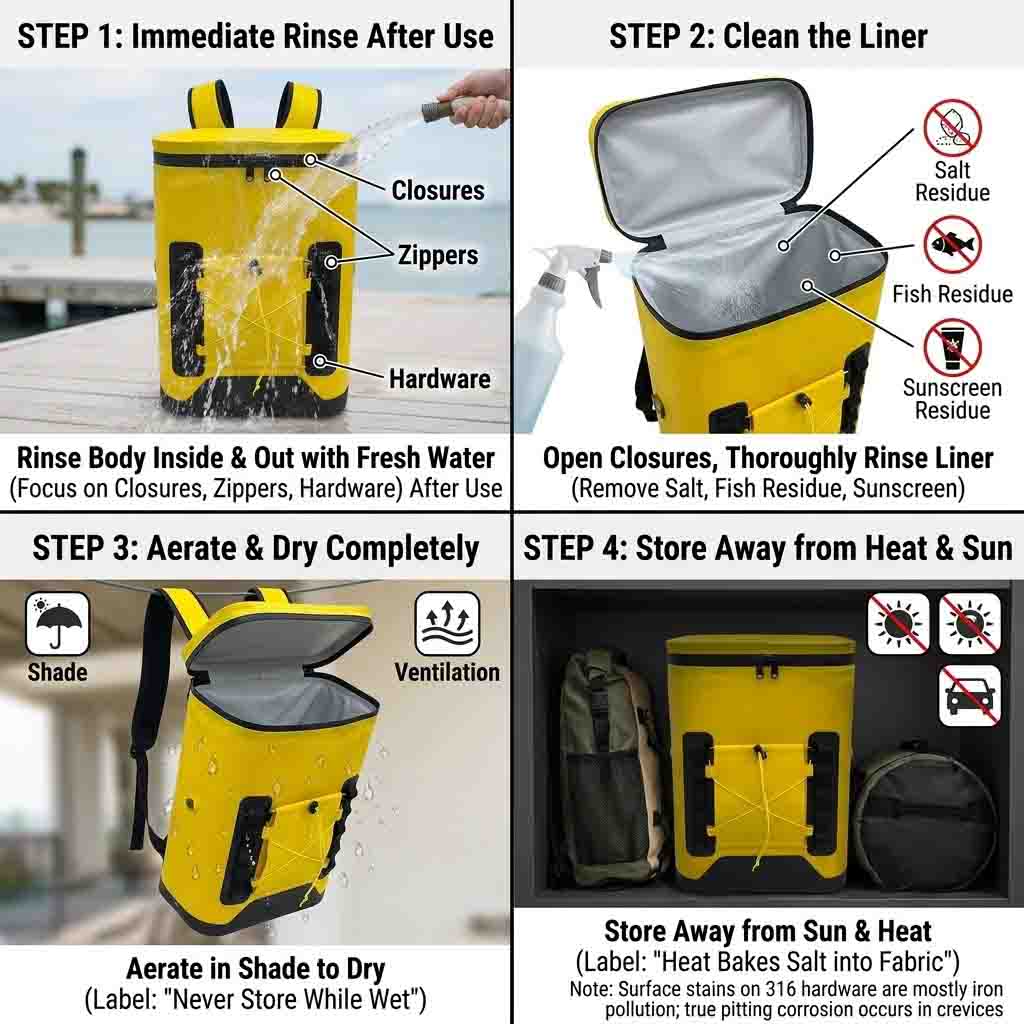
Fishing Leakproof containment, easy-rinse liner, corrosion-resistant hardware Fishing cooler backpacks
Air travel Carry-on dimensions, leakproof build, low weight Travel cooler backpacks
Saltwater / marine 316 stainless or polymer hardware, rinse-clean shell Marine cooler backpacks

Decoding the Claims

The claim What to ask What good looks like
"Keeps ice 48 hours" Tested how? Opened how often? At what ambient? A stated test basis — and expect roughly half in real use
"Leakproof" Welded or stitched? Sealed when tipped upside down? Welded body and liner, sealed closure in any orientation
"Waterproof" To what IPX level, and validated how? A stated IPX rating with immersion testing behind it
"Heavy-duty" What denier, and reinforced where? Stated fabric denier plus reinforcement at base and wear points
"Premium insulation" What material, closed-cell, how many mm? Named foam type and a thickness in millimetres
"36 cans" With or without ice? Honest capacity, ideally with internal dimensions

The underlying principle is worth internalising: look for testing that tracks how long food stays below 40°F, not vague "keeps items cold" language. And for buyers comparing suppliers rather than shopping retail, one sourcing guide frames it well: a cooler bag is easier to buy when you stop asking "which one feels premium?" and start asking "which one passes the same test under the same conditions?"

Test It Yourself

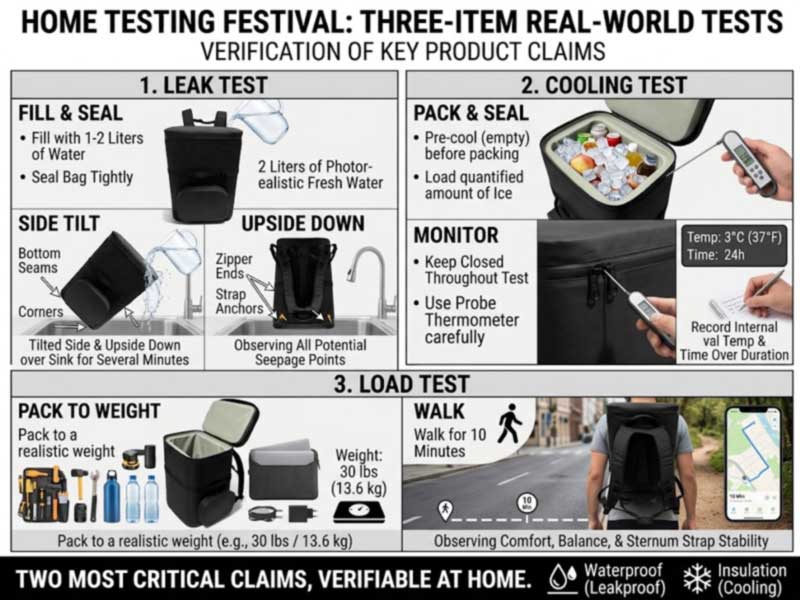
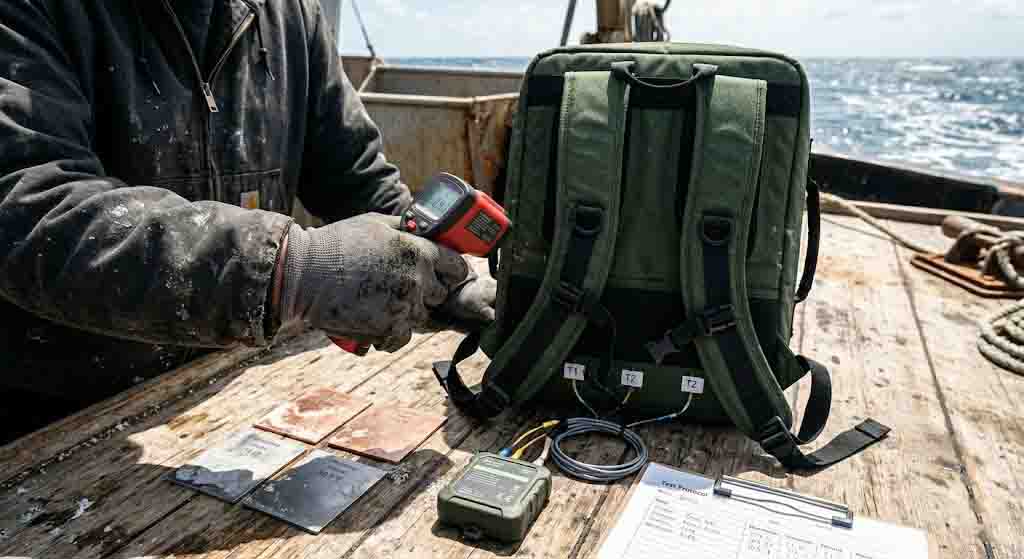
You do not need a laboratory to verify the two claims that matter most. Independent testers use straightforward methods worth copying — leak tests such as upside-down shake tests and prolonged storage checks, and for thermal performance, even a simple digital probe thermometer and a standardised approach gives you a real answer.

  • Leak test: seal a litre or two of water inside, then lay the bag on its side and upside down over a sink for several minutes. Watch the bottom seam, the corners, the zipper ends and the strap anchors.
  • Cold test: pre-chill the bag, load it with a known amount of ice, keep it closed, and check contents temperature against the clock. Test in conditions like the ones you will use it in.
  • Carry test: load it to a realistic weight and walk with it. Comfort problems appear at about ten minutes, not ten seconds.
Get more from any cooler: pre-chill the bag before loading, use block ice for longevity and cubes to fill gaps, aim for roughly twice as much ice as contents, fill the empty space, keep it out of the sun and off hot ground, and open it as little as possible — every opening costs cold. These habits routinely make more difference than the gap between two mid-range bags.


Where the Money Goes

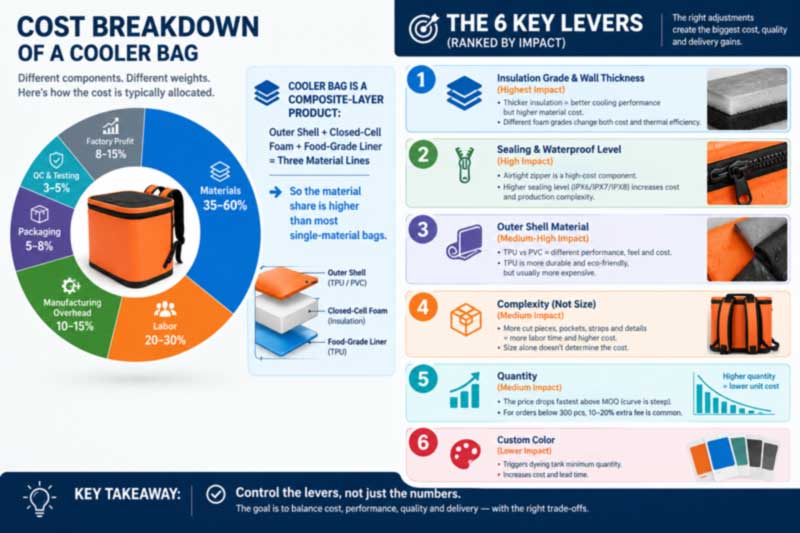
Price tracks construction rather than branding. As one guide observes: price correlates strongly with insulation quality and zipper grade — not brand name. On a soft cooler backpack, the three components that genuinely cost money are the insulation (type and thickness), the closure (an airtight or waterproof zipper is a genuinely expensive component), and the construction method (welding requires machinery and process control that stitching does not).

That gives a practical rule: if two bags are priced far apart, look at those three things before assuming the difference is branding. And if a bag is cheap and claims welded seams, an airtight zipper and 48-hour retention, at least one of those claims is doing work it cannot support.

Sealock Cooler Backpacks, With Their Real Specifications

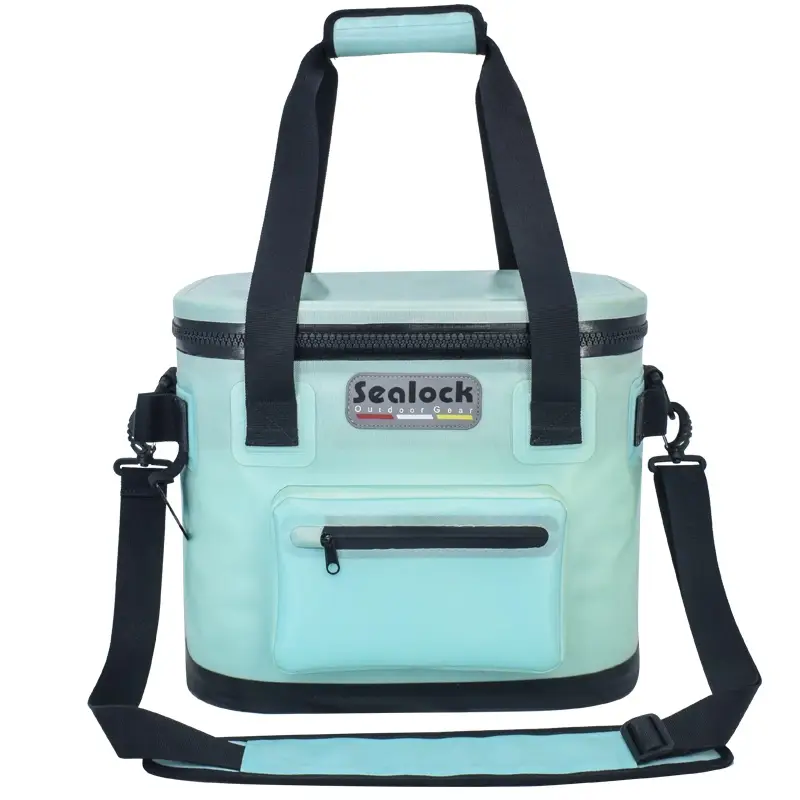
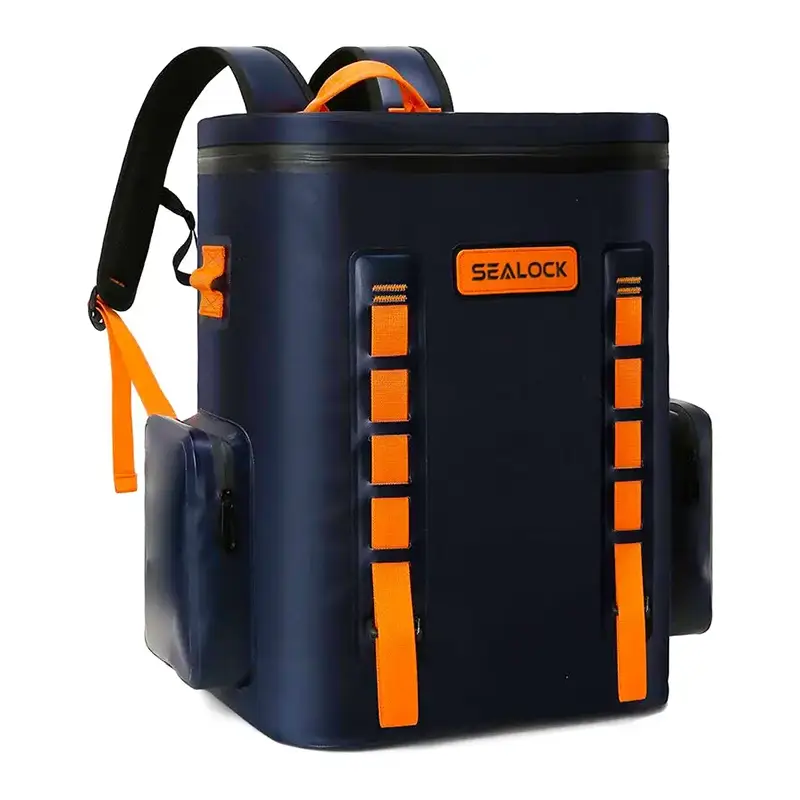
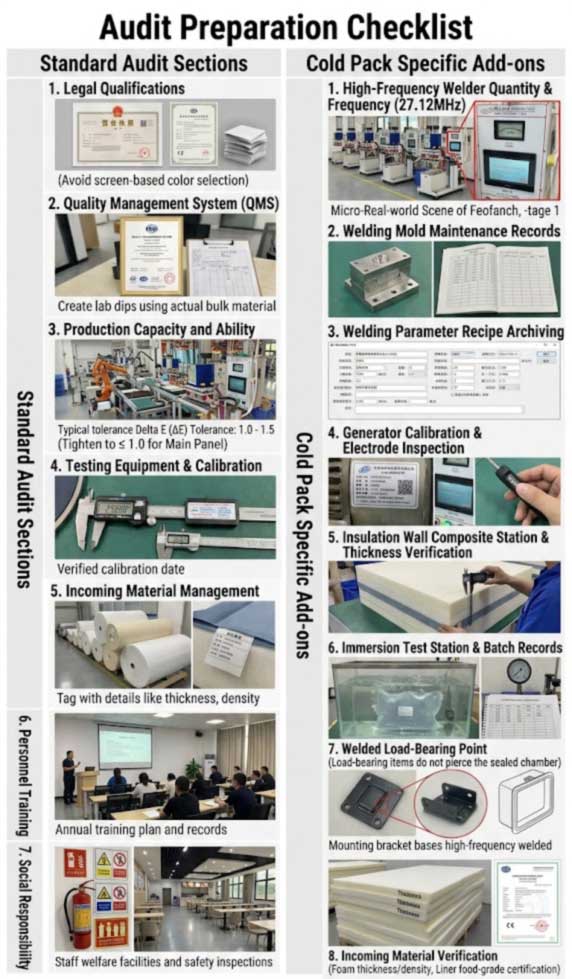
Sealock welds insulated cooler bags at 27.12 MHz across three factories in Dongguan, China and Ho Chi Minh City, Vietnam, with food-grade inner liners across the entire range and immersion testing on sealed builds. Stated honestly, by class rather than by rank:

Image Model Real specification Best for Link
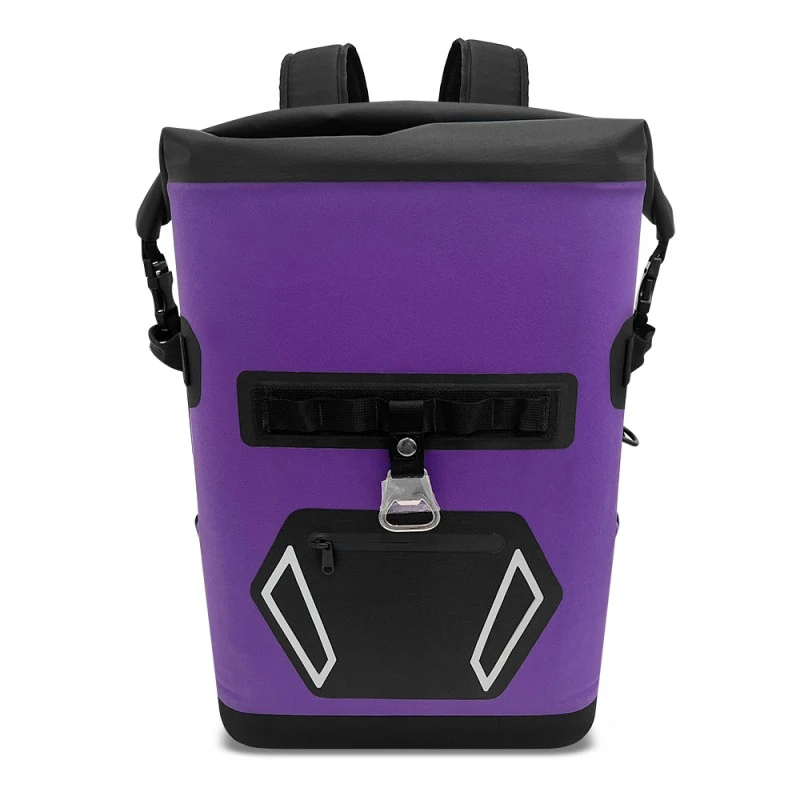
22L IPX7 cooler backpack SL-I280 22L IPX7 Cooler Backpack (SL-I280) 50 mm closed-cell XPE, welded, airtight zipper, IPX7, 48 hr+ class Water sports, demanding conditions View
28L airtight-zipper insulated backpack cooler SL-I274 28L Airtight-Zipper Backpack Cooler (SL-I274) 840D TPU, 3 cm EVA core, welded, airtight zipper, up to 48 hr, 2 kg Group outings, longer trips View
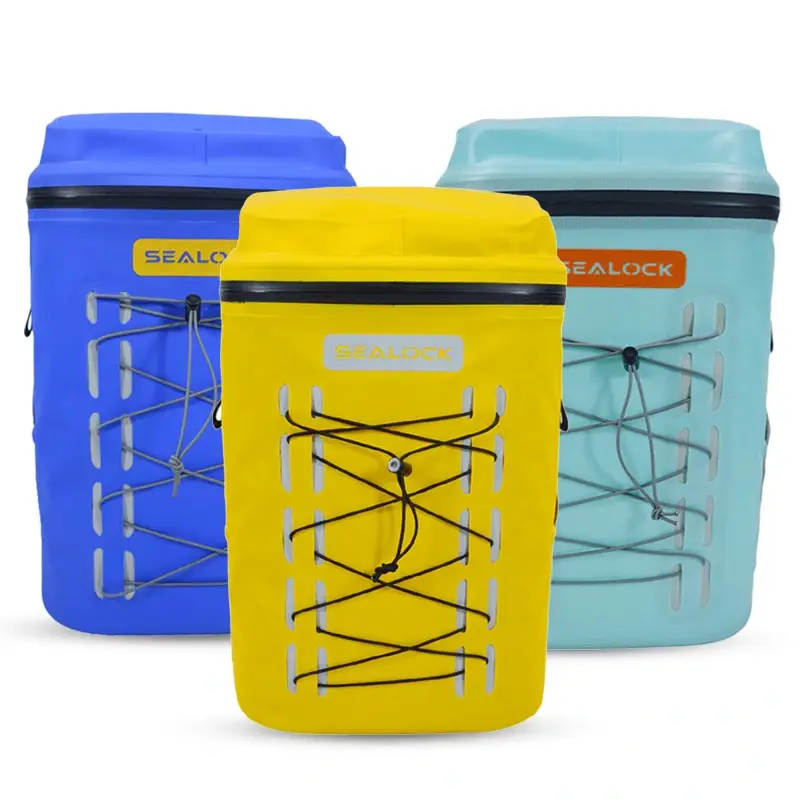
45L roll-top backpack cooler SL-I270 45L Roll-Top Backpack Cooler (SL-I270) 600D TPU, 3 cm EVA foam, welded roll-top, up to 36 hr, 2.2 kg Big loads, boating, no zipper to foul View
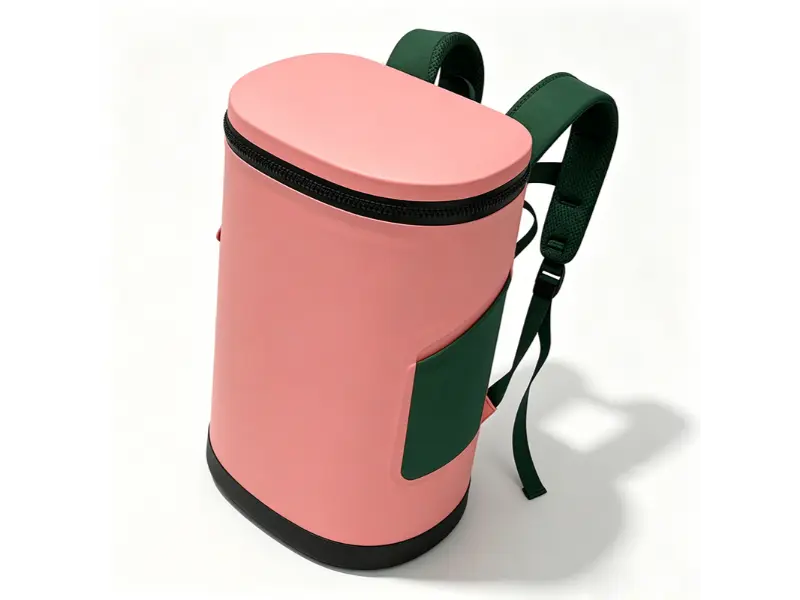
Barrel insulated cooler backpack SL-I309 Barrel Cooler Backpack (SL-I309) ~18L, closed-cell EPE, welded, ~24–36 hr, 1.3 kg — water-resistant, not submersible Day trips, hiking, lightest carry View
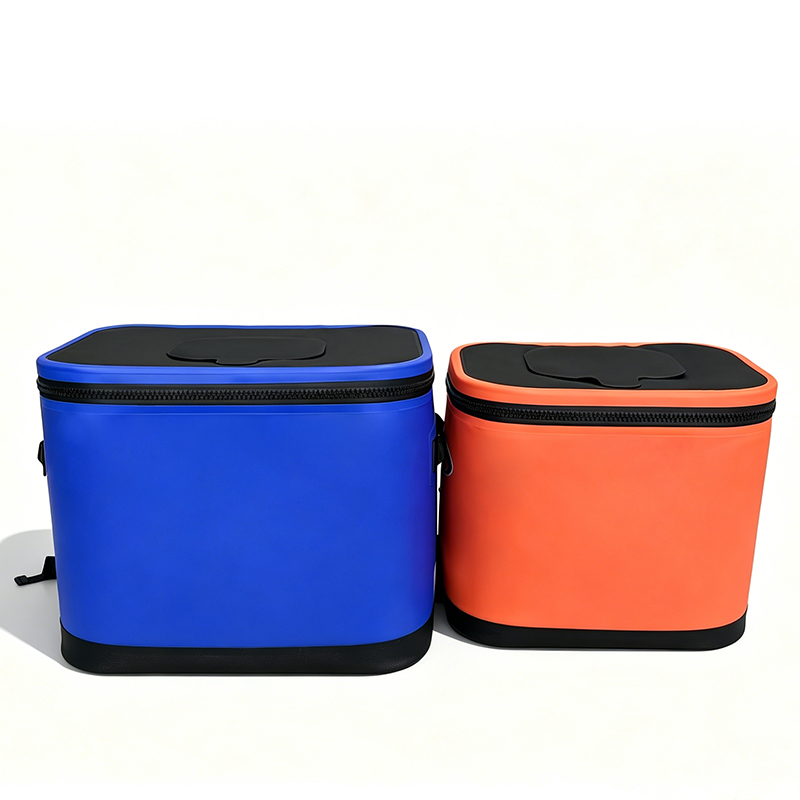
Insulated soft cooler backpack with molded lid SL-E050B Insulated Cooler Backpack, molded lid (SL-E050B) ~25L, closed-cell EPE, welded, ~24 hr, 1.4 kg, two sizes Everyday, picnics, fast access View
Insulated leakproof cooler backpack SL-I075A Insulated Leakproof Cooler Backpack (SL-I075A) 840D PVC tarpaulin, EPE foam, PEVA film liner, 36-can Value everyday use View

Note that the cold-hold classes above differ, and deliberately so — a 24-hour day pack and a 48-hour sealed build are different products for different trips, not better and worse versions of one.

three at-home tests for a soft cooler backpack: leak test, ice retention test and loaded carry test

For Brands and Wholesale Buyers

If you are specifying rather than shopping, the same criteria become a brief: the insulation tier and wall thickness that set your advertised cold-hold, the IPX seal level and closure, the shell material and denier, the food-grade liner and its market compliance testing, and the harness for the loaded weight. Beyond colour and logo, Sealock develops ground-up from a sketch, sample or performance target, with demanding briefs welcome — complex welded structures, premium insulation up to VIP vacuum panels and aerogel, and IPX6–IPX8 seal levels are all in scope, validated by immersion and cold-hold testing before production so the figures you advertise are backed. See OEM Soft Cooler Backpacks: What You Can Customize Beyond Logo & Color and Soft Cooler Backpack Supplier: MOQ, Lead Times & FOB Sourcing Explained.

MOQ / lead time 300 pcs per design; samples 7–15 days; production 30–45 days; FOB Guangdong
Origin China or Vietnam on the same specification
Certifications ISO9001, BSCI, SMETA P4, GRS, HIGG, SCAN

FAQ: Buying a Soft Cooler Backpack

Q: How long do soft cooler backpacks really keep ice?

A: Less than the listing says. Independent testing suggests you can expect roughly half the claimed retention in real-world use, because manufacturer tests often run in cool rooms with the bag unopened, and some guides report lab claims exceeding real results by two to three times. Most everyday use realistically needs 4–8 hours, and mid-tier packs manage far longer if pre-chilled and kept shut.

Q: What is the single most important specification?

A: Insulation — the foam type and its thickness in millimetres. Closed-cell foam at 15 mm or more is the baseline for serious performance, and any "multi-layer insulation" claim with no stated thickness or test data should be treated with caution. A listing that will not state the thickness is telling you something.

Q: How do I know if a cooler backpack is genuinely leakproof?

A: Check that the seams are welded rather than stitched — stitch holes are pathways for water — and that the closure seals when the bag is tipped, which a standard zipper does not. Then test it: seal a litre of water inside and lay it on its side and upside down over a sink for a few minutes.

Q: Is a bigger cooler backpack better?

A: Usually not. A cooler's stated volume includes the ice — roughly two parts ice to one part contents is standard — and empty space actually accelerates warming, so an oversized bag performs worse and carries heavier. Be aware too that measured volume can differ from stated volume by a fifth or more, so check internal dimensions where they are given.

Q: Are expensive cooler backpacks worth it?

A: It depends what you are paying for. Price correlates most strongly with insulation quality and zipper grade rather than brand name, and welded construction costs more to produce than stitching. If a premium price buys thicker closed-cell foam, a genuinely sealed closure and welded seams, it is buying performance; if it buys a logo, it is not.

Q: Can I use a soft cooler backpack for medicine or vaccines?

A: No. Consumer cooler bags are not certified for medical or pharmaceutical cold-chain compliance and should be used for consumer-grade perishables only. Temperature-sensitive medication needs purpose-built, validated cold-chain equipment and professional guidance.

Sourcing or specifying cooler backpacks? Sealock (YiFuLong Outdoor Gear Co., Ltd.) welds insulated cooler backpacks at 27.12 MHz in China and Vietnam — stated foam thicknesses, welded seams, food-grade liners and IPX ratings validated by immersion testing rather than asserted. Tell the team your use case and market, and they will spec a build and back it with test data.

Email: info@sealock.com.hk  |  Phone: +86-13632981825  |  Browse the soft cooler range

Performance figures, benchmarks and testing observations cited here reflect publicly available consumer-guide, gear-testing and industry sources as of mid-2026; real-world results vary widely with ambient temperature, pre-chilling, load, opening frequency and product. Soft cooler bags are not validated cold-chain equipment and should not be relied on for medical or pharmaceutical storage.

Related News
Leave me a message
X
We use cookies to offer you a better browsing experience, analyze site traffic and personalize content. By using this site, you agree to our use of cookies.Privacy Policy