News

Hiking Cooler Backpacks: Lightweight Insulation for the Ascent

2026-08-13 0 Leave me a message
Every other cooler use lets you ignore weight. Hiking does not. On a trail with elevation, cold retention and carry weight pull in opposite directions — cold-hold is bought with wall thickness, wall thickness is bulk, and every kilogram is paid for again on every metre of ascent. Worse, the contents of a cooler are the densest thing in anyone's pack: ice and water weigh more per litre than almost anything else you carry. This guide works through that trade honestly — the real weight limits, where a cooler backpack sits against them, and how to specify one that earns its place on a climb. Sealock (YiFuLong Outdoor Gear Co., Ltd.) builds welded insulated cooler backpacks across the weight and cold-hold range.


The Weight Limits Are Real, and Lower Than You Think

Start with the numbers hikers actually work to. The standard guidance from outdoor retail is clear: a loaded backpacking pack should not weigh more than about 20 percent of your body weight — if you weigh 150 pounds, your pack should not exceed 30 pounds — and a loaded day hiking pack should not weigh more than about 10 percent of your body weight.

That day-hike figure is not a marketing rule of thumb; there is measurement behind it. A cross-sectional study of long-distance hikers found a progressive increase in plantar force as backpack load increased — compared with no pack, static forefoot pressure rose 5.41% at a 10% body-weight load and 8.73% at 20%, with total foot pressure up 5.04% and 9.61%, concluding that carrying a backpack exceeding approximately 10% of body weight leads to a clear, load-dependent increase in plantar pressure, providing biomechanical support for recommendations limiting backpack load to around 10% of body weight. Some practitioners are more permissive — aim first to get your total load into that fifteen to twenty percent body weight window when possible, then make sure the weight rides tight to your spine and on your hips — but the direction is the same: less is better, and the trend line is measurable in your feet.

Now do the cooler arithmetic

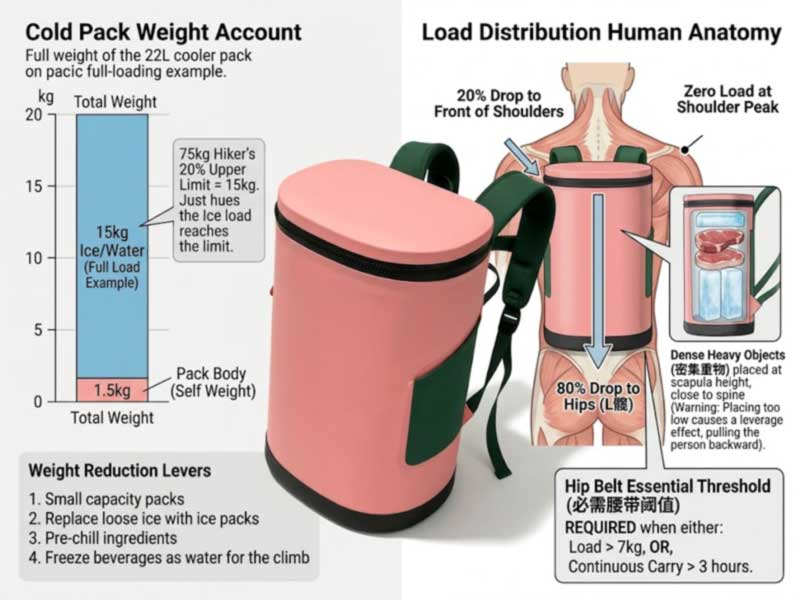
Here is the part most cooler marketing skips. Water is dense: roughly two and a quarter pounds per quart. A cooler packed to the standard two-parts-ice-to-one-part-contents ratio is mostly water by weight. Take a 22L cooler backpack loaded two-thirds with ice — that is around 15 litres of ice and meltwater, roughly 15 kg (33 lb), before you add the bag itself, food, or anything else in your kit.

For a 75 kg hiker, the 20% backpacking ceiling is 15 kg. The ice alone hits it. This is the honest reality of hiking with a cooler, and it leads to conclusions worth stating plainly:

  • Smaller capacity is usually the right answer on a trail. An 18–22L cooler carried sensibly beats a 45L cooler carried miserably. Capacity you cannot lift up a mountain is not capacity.
  • Ice packs beat loose ice for hiking. Sealed packs deliver cold at a controlled weight and leave no sloshing meltwater to carry home.
  • Pre-chilled contents reduce the ice you need. Cold food needs less coolant than warm food, and coolant is the weight.
  • Frozen drinks do double duty — coolant on the way up, drinking water at the top, and weight you have consumed rather than carried down.
The lightweight-insulation trade, stated honestly: a thicker wall holds cold longer but adds bulk and weight; a thinner wall carries better but gives up hours. For hiking, the right answer is usually a thinner closed-cell wall with a smarter load, not a 50 mm expedition wall hauled up a col. A day hike does not need 48-hour cold-hold — it needs enough cold for six to ten hours in a package you will actually carry.


Carry Weight Is Not Just Total Weight — It Is Where It Sits

Two packs of identical weight can feel completely different, and for a cooler — a dense, concentrated load — the difference is amplified. The ergonomics are well established.

The load belongs on your hips

The rule practitioners and labs agree on: a properly fitting backpack should comfortably transfer approximately 80 percent of its weight to your hips and lower body, 20 percent to the front of your shoulders, and exactly zero to the top of your shoulders — the aim being to carry most of the load on the strong bones and muscles of your lower body rather than the easily fatigued muscles of your shoulders and torso. Gear testers describe the same 80/20 rule — 80 percent of the weight on your hips, 20 percent on your shoulders, and other guidance places the band at roughly 60–80%, with military-derived guidance around 70%, on the hips.

The design consequence for a cooler backpack is direct: a waist belt is not a feature, it is a requirement once the bag is loaded. Industry spec guidance sets the threshold explicitly — hiking and all-day-wear daypacks need a hip belt as standard spec once load passes roughly 7 kg or wear time passes 3 hours, and a properly tensioned hip belt can shift up to roughly one-third of the vertical load off the spine and shoulders onto the hips. A loaded cooler passes 7 kg almost immediately. A cooler backpack sold for hiking without a waist belt is under-specified.

Dense weight goes high and close to the spine

Where the mass sits inside the pack matters as much as the harness. The loading principle: your densest items should sit against your back at shoulder-blade level, between the shoulder straps and hip belt, bringing the centre of gravity closer to your spine so chest straps and load lifters can pull the mass tightly against your back. The mistake to avoid is the intuitive one — absolutely avoid the bottom of the pack for heavy items; placed too low they create a lever effect that pulls you backward. Practitioners quantify the target: roughly 60–70% of the pack's total weight should be concentrated in the upper-middle section, right between your shoulder blades and close to your back.

For a cooler backpack this is a genuine design consideration, because the cold chamber is the dense load and its position is fixed by the bag's shape. A tall, narrow cooler that holds its mass high and close to the back carries better than a wide, low-slung one of the same volume — and compression straps matter, since a pack swaying side to side usually means the load lifters or side compression straps are too loose, and cinching them pulls the load into a compact, stable block. A part-full cooler with nothing to compress it sloshes and swings.

cooler backpack weight math against hiking load limits and 80/20 hip-to-shoulder load distribution

Specifying a Hiking Cooler Backpack

Read the physics above and the specification follows. For hiking, the priorities invert compared with camping or fishing.

Requirement For hiking, specify Why
Insulation tier Closed-cell EPE, moderate wall — 24-hour class A day hike needs hours, not days; thicker walls are weight you carry up
Empty weight As low as the cold-hold target allows Every gram of bag is a gram not available for contents
Capacity ~15–22L for most day hikes Contents are the weight; larger capacity mostly buys a heavier carry
Harness Padded straps + sternum + waist belt Loads over ~7 kg need the hip belt; 80% of weight should ride on hips
Shape Taller and narrower, mass held high and close to the back Keeps the centre of gravity near the spine
Compression Side compression straps Stops a part-full load shifting and swaying on uneven ground
Leakproofing Welded body and liner Meltwater against your back on a climb is miserable and unsafe on rock
Shell Durable coated fabric; reinforced base Trail abrasion, resting the pack on rock and scree

For the insulation tiers themselves, see Insulated Cooler Backpack Manufacturer: EPE Foam & Cold-Retention Design; for the foam, liner and capacity decisions together, see Custom Insulated Cooler Backpacks: Spec Your Foam, Liner & Capacity.

Sealock's Cooler Backpacks by Carry Weight

Sealock welds insulated cooler bags at 27.12 MHz across three factories in Dongguan, China and Ho Chi Minh City, Vietnam, with food-grade inner liners across the entire range. For hiking, empty weight is the number that matters most — here are real builds ordered lightest first, with their cold-hold stated honestly:

Image Model Empty weight / capacity Hiking fit Link
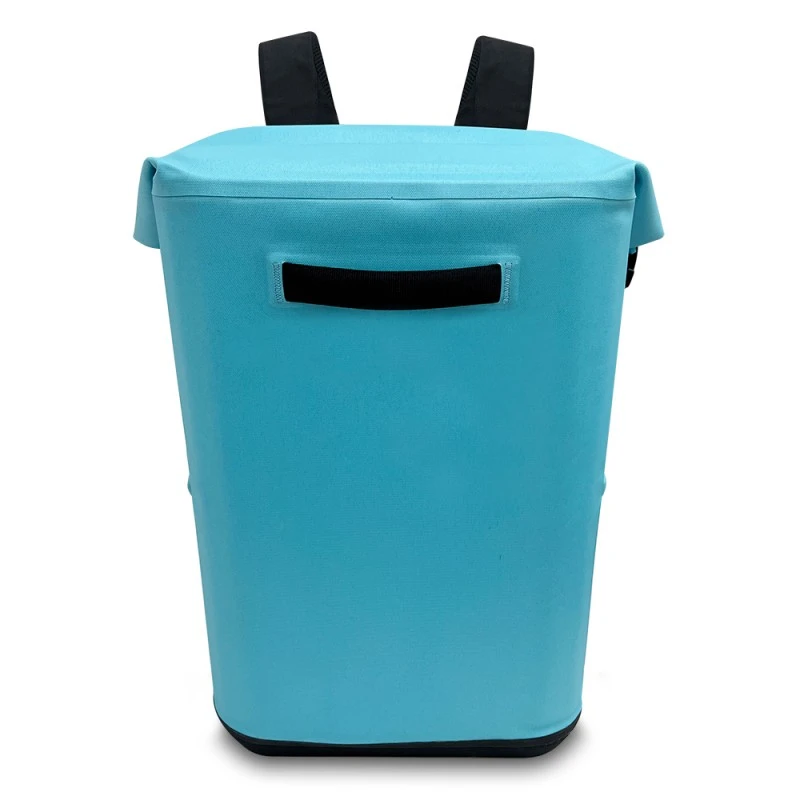
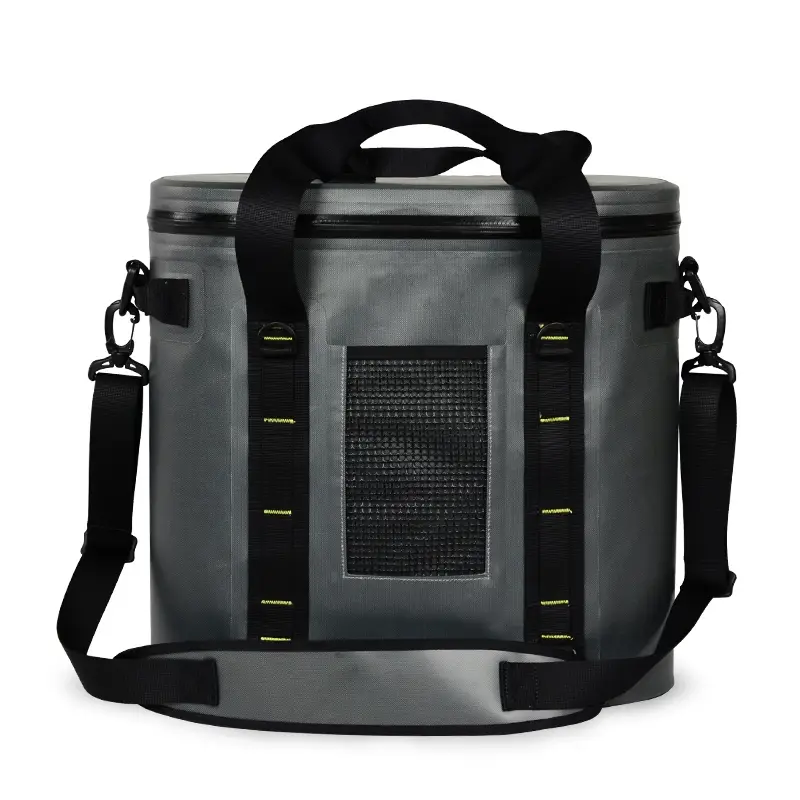
Barrel insulated cooler backpack SL-I309 Barrel Cooler Backpack (SL-I309) ~1.3 kg / ~18L, ~24–36 hr The trail pick: lightest build with a full sternum and waist strap, tall barrel shape holding mass close to the back, reinforced base View
Insulated soft cooler backpack with molded lid SL-E050B Insulated Cooler Backpack, molded lid (SL-E050B) ~1.4 kg / ~25L, ~24 hr Light day-hike option in two sizes; molded lid gives fast access at a rest stop — note padded straps, so best kept under heavier loads View
Lightweight waterproof cooler backpack SL-I272 Lightweight Waterproof Cooler Backpack (SL-I272) Lightweight TPU build, 30 × 21.5 × 47.5 cm Tall, narrow profile with a folding closure — the minimal-weight choice for shorter walks View
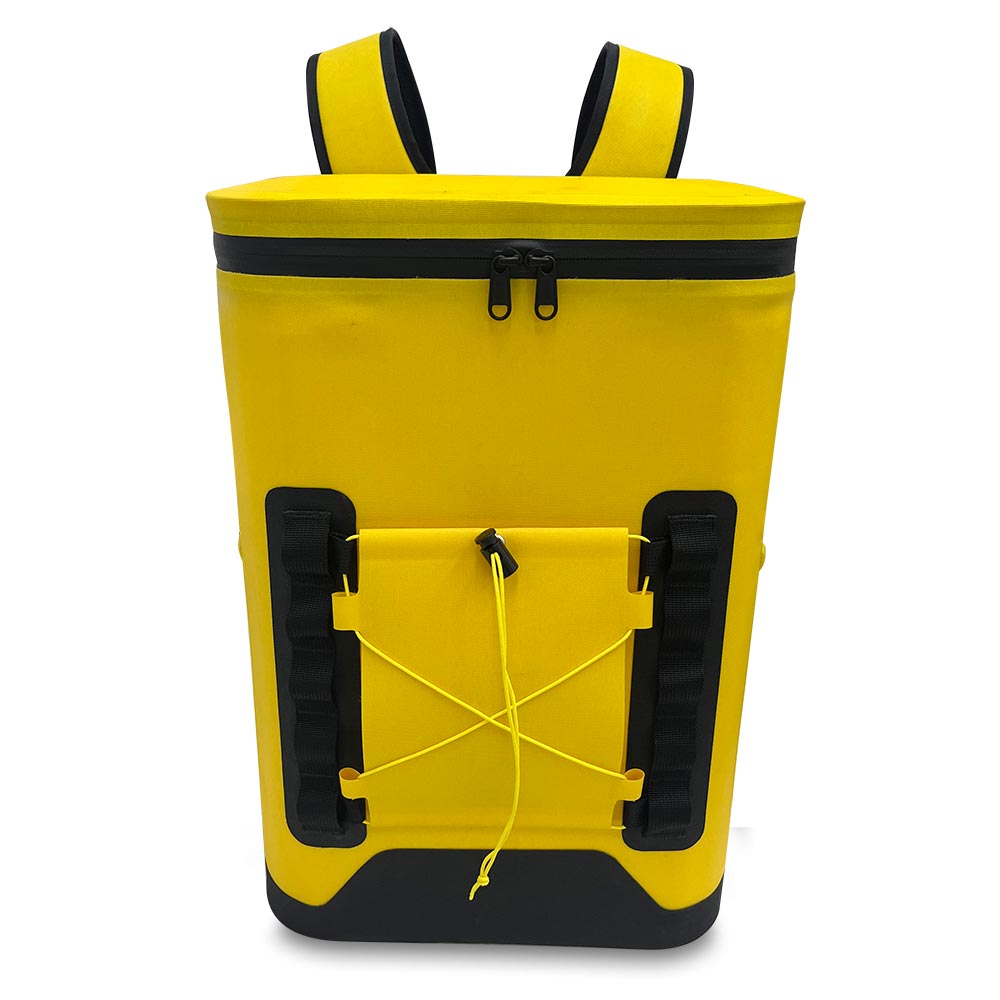
28L airtight-zipper insulated backpack cooler SL-I274 28L Airtight-Zipper Backpack Cooler (SL-I274) ~2 kg / 28L, up to 48 hr Step up in cold-hold and capacity with an ergonomic padded harness — suits shorter approaches where longer cold matters more than grams View
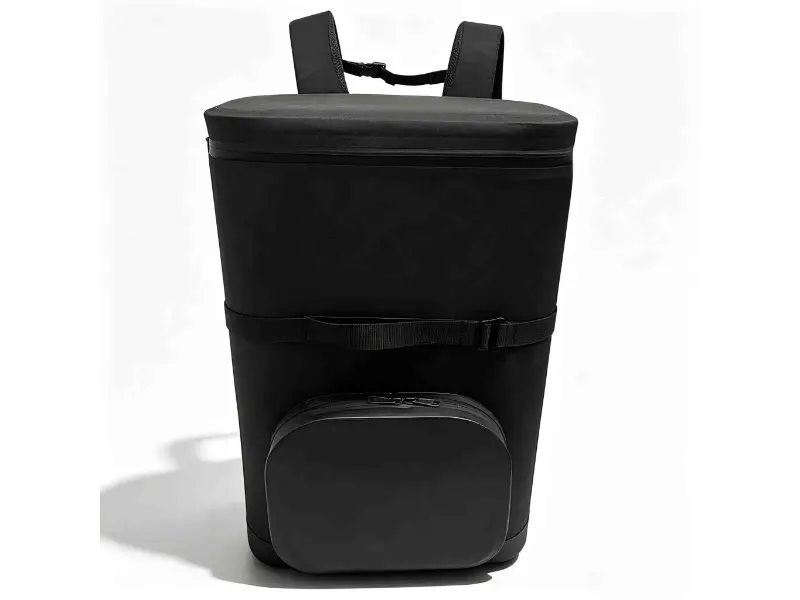
22L IPX7 cooler backpack SL-I280 22L IPX7 Cooler Backpack (SL-I280) ~2.1 kg / 22L, 48 hr+, 50 mm XPE Heaviest wall here — the choice when a wet, multi-day or exposed route justifies carrying the insulation, with full sternum and waist harness and IPX7 sealing View

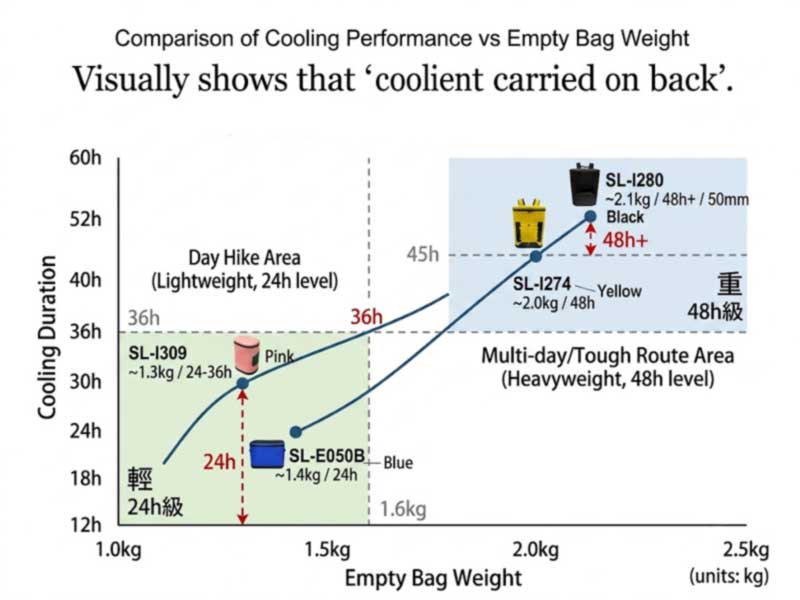
The pattern is the trade in product form: the SL-I309 at ~1.3 kg gives up cold-hold hours to save nearly a kilogram against the SL-I280, which buys 48-hour-plus performance and immersion sealing with a 50 mm wall you carry up the hill. Neither is better — they answer different routes. What matters is choosing deliberately rather than defaulting to the biggest number on the page.

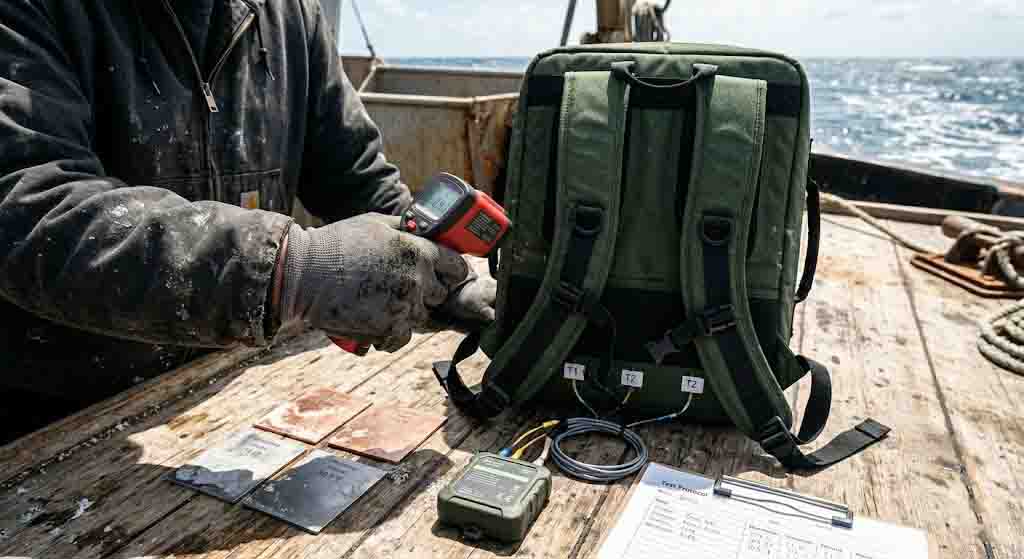
cooler backpack empty weight versus cold-hold trade-off chart for hiking selection

For Brands: Developing a Hiking Cooler Backpack

Hiking is the brief where every gram is argued over, and a demanding brief is welcome. Beyond colour and logo, Sealock develops ground-up from a sketch, sample or performance target: the insulation tier and wall thickness tuned to a stated cold-hold at a stated weight, lighter shell deniers where abrasion allows with reinforcement only at wear points, a taller narrower pattern that holds the load high and close to the back, a harness with sternum and waist straps engineered for the loaded weight, side compression straps to stabilise a part-full load, welded leakproof containment so meltwater never reaches the wearer's back, and premium insulation options — PU, VIP vacuum panels, EPP, aerogel — where a brand wants more cold-hold per millimetre of wall rather than per gram. Each build is proven by cold-hold and immersion testing before production, so an advertised figure reflects a real test. Ground-up work runs longer at sampling, so book against the season. See OEM Soft Cooler Backpacks: What You Can Customize Beyond Logo & Color and Custom Soft Cooler Backpacks: Materials, Sizes & Branding Options.

Worth noting for a hiking range specifically: vacuum panels and aerogel are the levers that break the usual weight-versus-cold-hold trade, delivering more insulation per millimetre than foam. They cost more and add rigidity, but for a premium lightweight hiking cooler they are the technically interesting option.

MOQ / lead time 300 pcs per design; samples 7–15 days; production 30–45 days; FOB Guangdong
Origin China or Vietnam on the same specification
Certifications ISO9001, BSCI, SMETA P4, GRS, HIGG, SCAN

FAQ: Hiking Cooler Backpacks

Q: How heavy should a loaded cooler backpack be for hiking?

A: Work to the standard limits: a loaded day-hike pack should stay around 10% of body weight, and a backpacking load under about 20%. Research on long-distance hikers found loads above roughly 10% of body weight produce a clear, measurable increase in plantar pressure, which is the biomechanical basis for that guidance. For a 75 kg hiker that is about 7.5 kg on a day hike — which a fully iced cooler exceeds easily.

Q: Why is a cooler backpack so heavy compared with a normal daypack?

A: Because the contents are ice and water, which are far denser than clothing or food. Water runs about 2.25 lb per quart, so a 22L cooler loaded two-thirds with ice carries roughly 15 kg of coolant alone — before the bag, food or the rest of your kit. On a trail, capacity is weight, which is why smaller coolers and sealed ice packs usually make more sense than loose ice.

Q: Does a hiking cooler backpack need a waist belt?

A: Yes. Industry spec guidance puts a hip belt as standard once a pack passes roughly 7 kg loaded or is worn more than 3 hours, and a loaded cooler passes 7 kg almost immediately. A properly tensioned hip belt shifts a substantial share of the vertical load off the shoulders and spine — ideally around 80% of the weight should ride on the hips, with none on the tops of the shoulders.

Q: How should I pack a cooler backpack for a climb?

A: Keep the dense mass high and close to your back, at shoulder-blade level rather than low in the pack — heavy items placed too low create a lever effect that pulls you backward. Roughly 60–70% of pack weight should sit in that upper-middle zone. Then cinch the side compression straps so a part-full cooler cannot shift or sway on uneven ground.

Q: Should I choose thicker insulation or a lighter bag for hiking?

A: For day hikes, lighter. A 24-hour-class closed-cell wall covers a full day out, and the weight saved against a 48-hour expedition wall is weight you do not haul up the ascent. Reserve the thick, high-density builds for wet, exposed or multi-day routes where the extra cold-hold genuinely earns its carry. Vacuum panels and aerogel are the premium way to get more cold per millimetre without the foam bulk.

Q: Ice or ice packs for hiking?

A: Ice packs, in most cases. They deliver cold at a controlled, known weight, they do not leave sloshing meltwater to carry, and pre-chilling your contents reduces how much coolant you need at all. Frozen drink bottles are the exception worth carrying — they are coolant on the way up and drinking water at the top.

Sourcing hiking cooler backpacks? Sealock (YiFuLong Outdoor Gear Co., Ltd.) welds insulated cooler backpacks at 27.12 MHz in China and Vietnam, from light 24-hour-class trail builds to 48-hour sealed packs, with cold-hold validated by testing. Tell the team your target weight, cold-hold and route profile, and they will spec the wall, pattern and harness to match.

Email: info@sealock.com.hk  |  Phone: +86-13632981825  |  Browse the soft cooler range

Load guidance, biomechanical findings and ergonomic figures cited here reflect publicly available outdoor-industry and peer-reviewed sources as of mid-2026; appropriate load varies with fitness, experience, terrain and individual health. Weight calculations here are approximate illustrations. This is general guidance, not medical or fitness advice.

Related News
Leave me a message
X
We use cookies to offer you a better browsing experience, analyze site traffic and personalize content. By using this site, you agree to our use of cookies.Privacy Policy
RejectAccept