News

Camping Cooler Backpacks: Multi-Day Cold Retention on the Trail

2026-08-12 0 Leave me a message
Multi-day camping is the hardest thing you can ask a cooler to do. A beach day needs eight hours of cold; a three-night trip needs seventy-two, without a power source, in whatever the weather does, with someone opening the bag every time they want a drink. And on a backpack, every extra hour of cold-hold is paid for in wall thickness and weight you carry. This guide is about how multi-day cold actually works — what the bag contributes, what the ice strategy contributes, and where the honest limits of a soft cooler backpack sit. Sealock (YiFuLong Outdoor Gear Co., Ltd.) builds welded insulated cooler backpacks across the cold-hold range.


The Honest Starting Point: What a Soft Cooler Can and Cannot Do

Start with realistic expectations, because a specification that oversells gets returned. The general performance split is well documented: a well-packed hard-sided cooler with thick insulation can keep food cold for 3 to 4 days, sometimes longer if you minimise openings and keep it shaded, while soft-sided or thin-walled coolers may only last 1 to 2 days.

That is the industry-wide picture, and it is why insulation tier matters more for camping than for any other use. A thin-walled EPE day pack is a 24-hour-class product — excellent for a single overnight, not a three-night trip. A thick high-density wall (up to 50 mm of XPE) reaches the 48-hour class and, packed properly, stretches further. Premium panels — PU, VIP vacuum, EPP, aerogel — go further again. For a multi-day camping range, specifying at the 48-hour end is not luxury; it is the entry requirement. The material engineering behind those tiers is covered in Insulated Cooler Backpack Manufacturer: EPE Foam & Cold-Retention Design.

There is also a weight reality on the trail: cold-hold is bought with wall thickness, and wall thickness is bulk and weight on your back. A backpack cooler is a compromise product by nature — it trades some absolute cold-hold for the ability to carry it hands-free to a site a hard cooler will never reach. Understanding that trade honestly is what makes it the right tool rather than a disappointing one.

The Two-Cooler System: The Single Biggest Multi-Day Trick

Before any packing technique, there is a structural strategy that experienced campers rate above all others, and it directly addresses the reason multi-day cold fails. Use two separate coolers: the food cooler is your "vault," staying closed as much as possible with frozen meats and perishables, while the drink cooler holds water, soda and snacks and gets opened dozens of times a day — separating the two protects the ice in your food cooler from constant exposure to warm air.

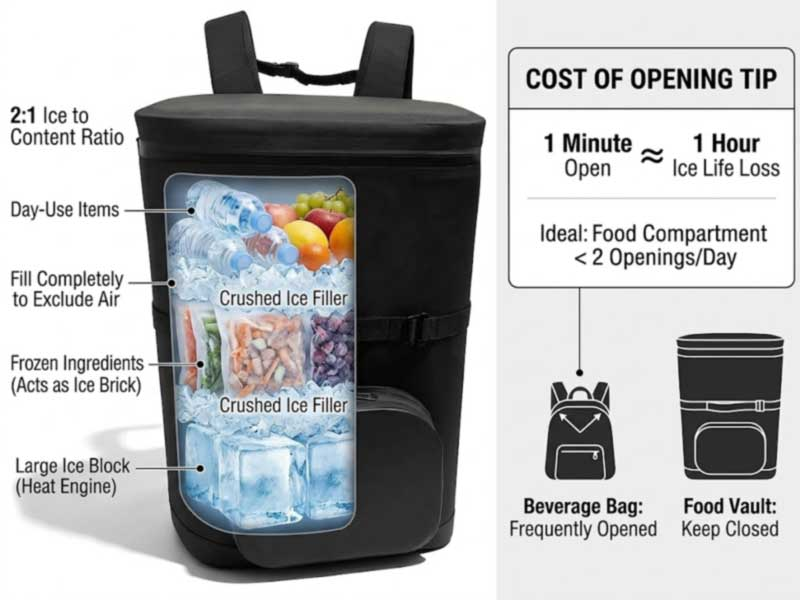
The arithmetic behind it is brutal: opening the lid frequently is the biggest mistake — every minute the lid is open can cost one hour of ice life, and best practice is to open the food cooler as rarely as possible, ideally no more than twice a day. No wall thickness compensates for a bag opened thirty times.

Where the backpack fits in a two-cooler system: for camping, a cooler backpack is often the better drinks and day-trip cooler — the one you actually carry to the lake, open frequently and refill — while a larger cooler stays at camp as the food vault. Alternatively, on a hike-in trip where you carry everything, run the backpack as the sealed vault and keep the day's drinks in a separate light bag so the cold chamber stays shut. Either way, the principle holds: separate what gets opened from what must stay cold.


Ice Strategy: The Bag Is Only Half the System

For multi-day cold, how you load matters as much as what you load it into.

Block ice is the engine, cubes are the filler

The layering principle is consistent across sources: for a multi-day trip, place large blocks of ice at the bottom of the cooler to serve as the "thermal engine," and use cubed ice only to fill the small gaps between food items. Homemade blocks work well and solve a second problem — freeze water in square containers or gallon jugs; keeping the water inside a jug also prevents food getting soggy as the ice melts. There is a bonus for camping specifically: after the ice melts in the bottles or jugs, you have safe drinking water.

Freeze everything you can

Meats, stews and gallon jugs of water should be frozen solid before they go in, acting as supplemental ice blocks; items that cannot be frozen, such as eggs or greens, should be chilled to at least 38°F first — never put room-temperature items into a long-term cooler. The standard ratio still applies: aim for about twice as much ice as food by volume, and frozen foods count toward the ice ratio.

Keep the meltwater

The instinct to drain is wrong for camping, and the sources are emphatic that this is a myth: cold water helps insulate the remaining ice blocks — air is a poor insulator — so keep the cold water in the cooler unless it is a food-safety risk, and draining it forces the remaining ice to work overtime. A leakproof welded bag is what makes keeping it practical, since the water stays where it belongs.

Fill the gaps and block the radiant heat

Air space is the enemy — your cooler should be like a loaded freezer, not an empty fridge, because air warms faster than ice. And for a campsite in sun, a cheap upgrade: a reflective cover wrapped around the cooler reflects radiant heat. Shade and getting the bag off hot ground do the same job for free.

Dry Ice: Powerful, and the One Thing You Must Not Do With a Sealed Bag

Dry ice is the strongest tool for multi-day camping and it comes with a hard safety rule that matters especially for airtight coolers. The upside first: dry ice is frozen carbon dioxide at about −109.3°F, far colder than water ice, and it sublimates directly from solid to gas — it keeps items frozen solid and leaves no watery mess. Practically, dry ice keeps provisions frozen for one to two full days, long enough for a backcountry trip, with a rule of thumb of one 10-inch block per 15 inches of cooler length.

Safety: never use dry ice in a sealed airtight cooler. Dry ice sublimates into carbon dioxide gas, and that gas must escape. The guidance is unambiguous: never seal the cooler airtight — dry ice releases gas that needs to vent, and ensure your cooler has a way to vent the gas, or the pressure could damage the lid. An airtight-zipper or fully sealed roll-top cooler is designed to be gas-tight, which makes it the wrong container for dry ice unless it is deliberately left partly open to vent. Other handling rules: always wrap dry ice in several layers of newspaper, keep it from direct contact with food since it can freeze food you did not intend to freeze, like lettuce or eggs, and note that it can burn skin on contact. Placement controls the effect — put dry ice on top to freeze food, since cold air sinks, or on the bottom under a barrier layer to keep food cold but not frozen. Best results come from combining: dry ice keeps the cooler ultra-cold, but regular ice extends cold life after the dry ice disappears.


Food Safety on a Multi-Day Trip

Beyond day two, cold retention stops being about convenience. When camping for a week you are not just keeping drinks cold, you are preventing foodborne illness — bacteria thrive in the "Danger Zone" between 40°F and 140°F, and the practical advice is not to guess: place a wireless cooler thermometer inside your food vault so you can check the internal temperature without opening the lid. For a brand, this is worth reflecting in honest product claims: a cooler rated for 48 hours should be described that way, not stretched into a multi-day food-safety promise it cannot keep.

multi-day cooler backpack packing layers with block ice base and the cost of opening the cooler

What to Specify in a Camping Cooler Backpack

Requirement What to look for Why it matters camping
Insulation tier Thick high-density closed-cell wall (up to 50 mm) for multi-day; EPE 24-hour class for overnights Soft coolers realistically run 1–2 days; the wall is what extends that
Closure Airtight or tightly sealing, quick to reseal fully Every opening costs cold; a poor reseal bleeds it continuously
Leakproofing Welded body and liner Lets you keep the cold meltwater, which insulates the remaining ice
Harness Sternum and waist straps on larger capacities A loaded multi-day cooler is heavy; the load must transfer to the hips
Base Reinforced Campsite ground is rough, and the base takes the ice weight
Capacity Sized for food plus roughly twice its volume in ice The 2:1 ratio means much of the litre count is coolant
Shell Durable coated fabric, lighter colours for sun Trail abrasion and multi-day sun exposure

Sealock's Camping Cooler Backpacks

Sealock welds insulated cooler bags at 27.12 MHz across three factories in Dongguan, China and Ho Chi Minh City, Vietnam, with food-grade inner liners across the entire range. Real cooler backpacks for camping, chosen by fit rather than rank — note the cold-hold class is stated honestly for each:

Image Model Cold-hold class Camping fit Link
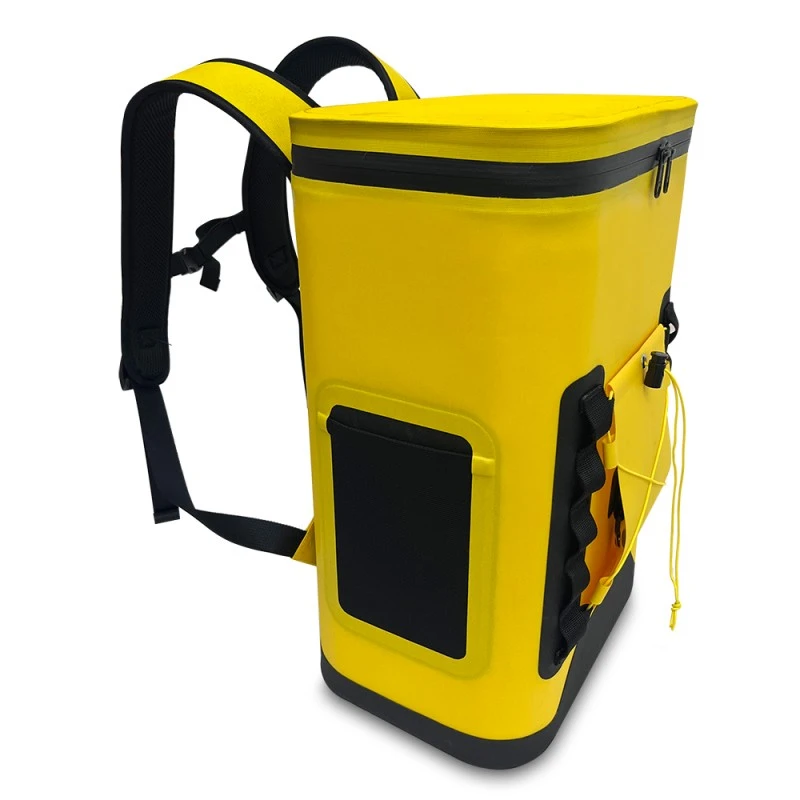
22L IPX7 cooler backpack SL-I280 22L IPX7 Cooler Backpack (SL-I280) 48 hr+, 50 mm high-density XPE The multi-day option: thickest wall, airtight zipper, full sternum and waist harness for a loaded carry View
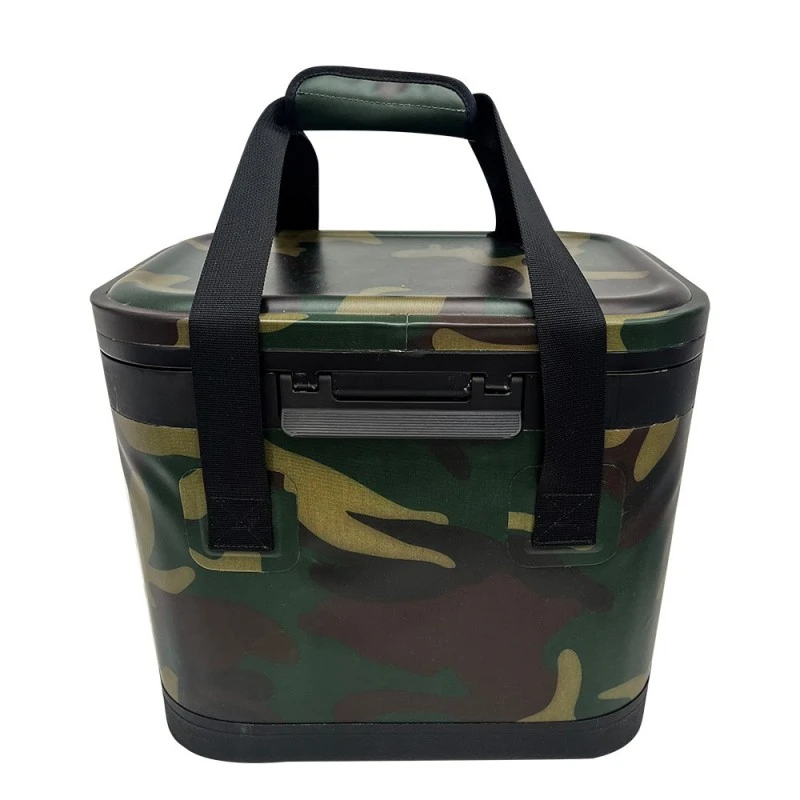
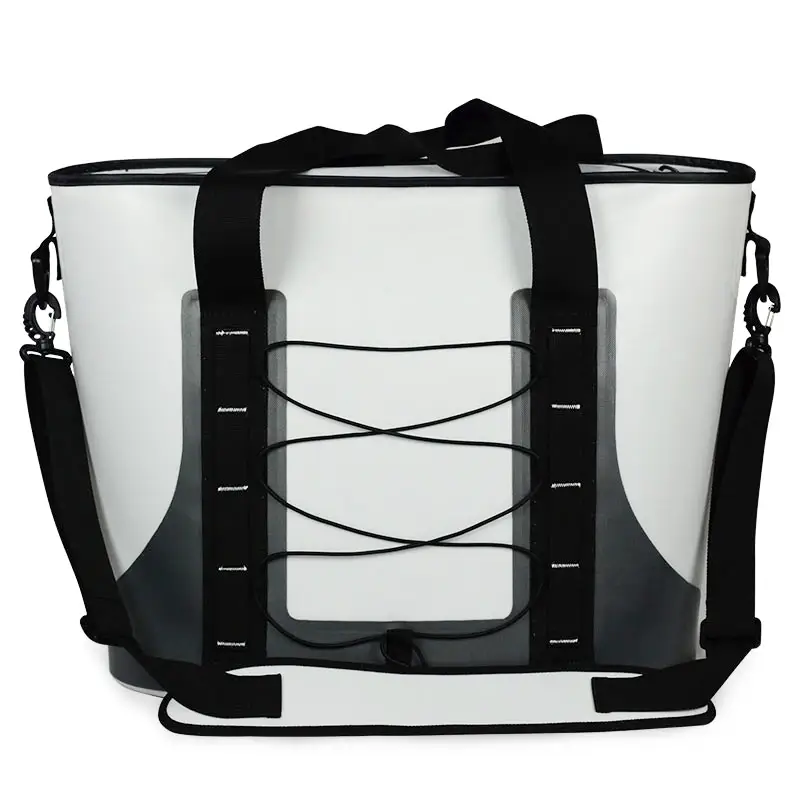
28L airtight-zipper insulated backpack cooler SL-I274 28L Airtight-Zipper Backpack Cooler (SL-I274) Up to 48 hr, 3 cm EVA core Larger capacity for group camping; ergonomic padded harness, utility pocket, side panels View
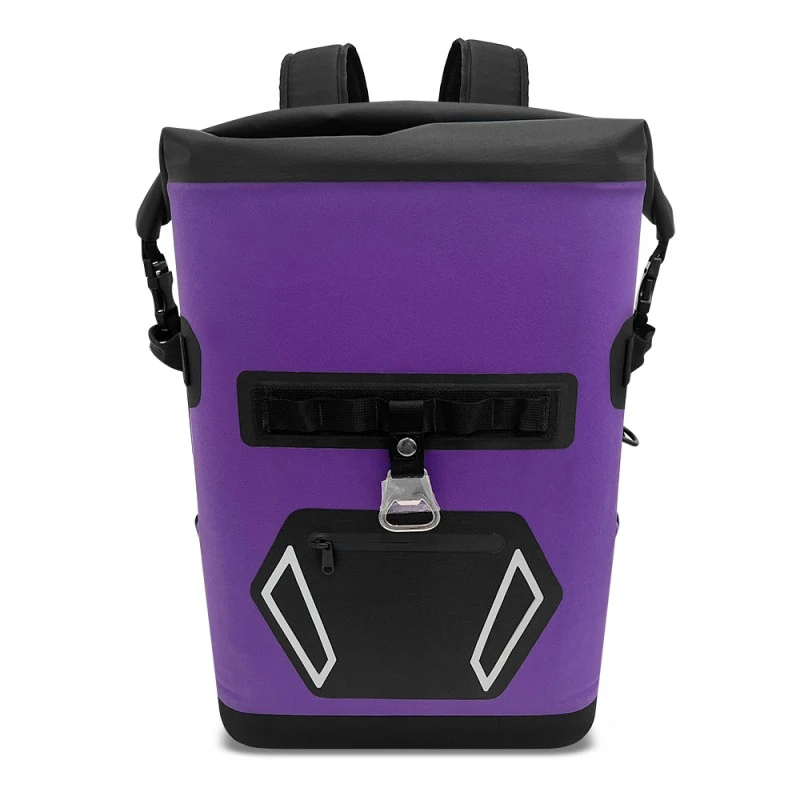
45L roll-top backpack cooler SL-I270 45L Roll-Top Backpack Cooler (SL-I270) Up to 36 hr, 3 cm EVA foam The volume option for a group's supplies; gear webbing, reflective trim, bottle opener, UTX buckles View
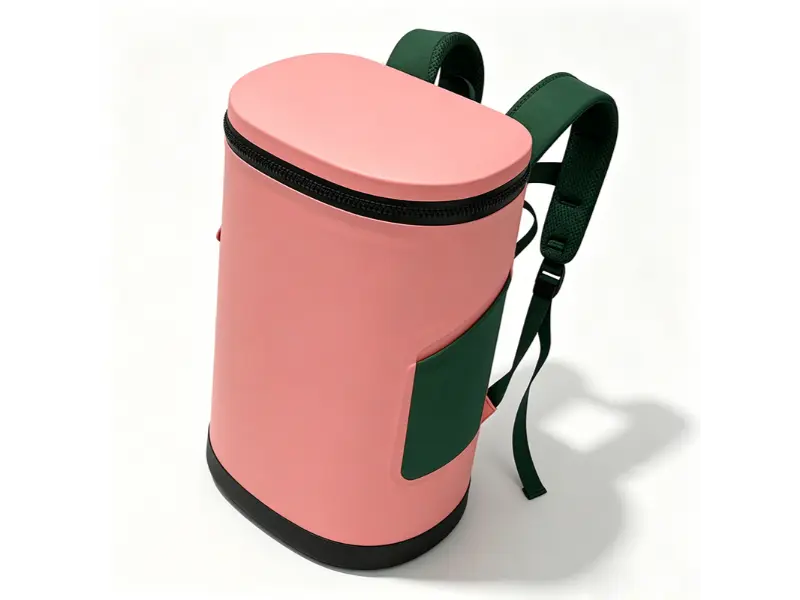
Barrel insulated cooler backpack SL-I309 Barrel Cooler Backpack (SL-I309) ~24–36 hr, closed-cell EPE Overnight and short trips; sternum and waist straps, front slip pocket, reinforced base View
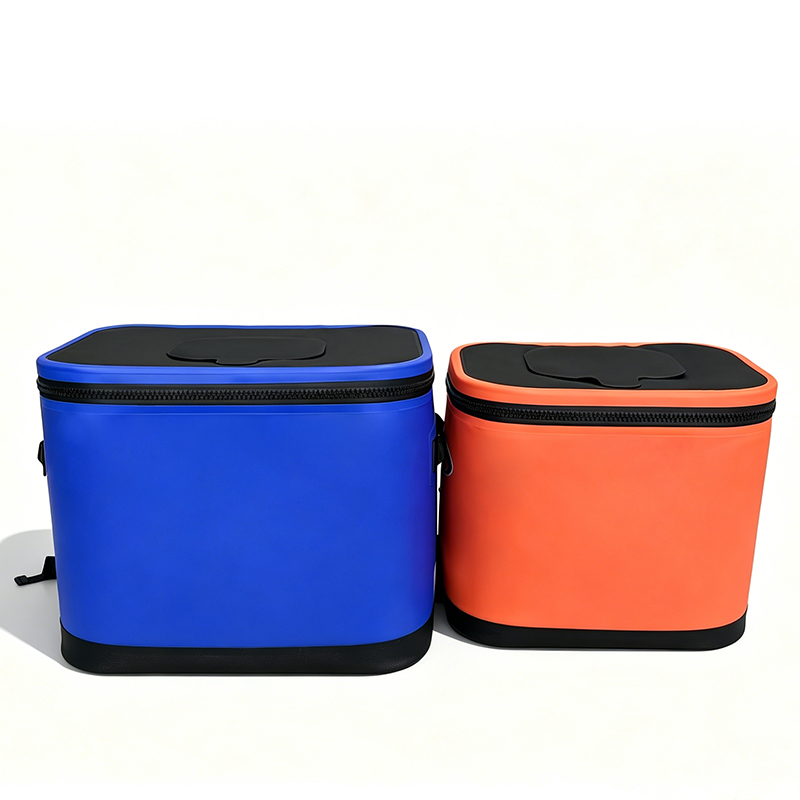
Insulated soft cooler backpack with molded lid SL-E050B Insulated Cooler Backpack, molded lid (SL-E050B) ~24 hr, closed-cell EPE The camp drinks-and-day-trip cooler in a two-cooler system; molded flip lid for fast access, two sizes View

The spread is deliberate and maps onto the two-cooler strategy: the 48-hour-class packs are candidates for the sealed food vault, while the 24-hour-class packs with fast-access lids are the ones you actually open all day. A camping range benefits from carrying both rather than pretending one bag does both jobs.

For Brands: Developing a Camping Cooler Range

Camping is where insulation specification earns its money, and a demanding brief is welcome. Beyond colour and logo, Sealock develops ground-up from a sketch, sample or performance target: the insulation tier and wall thickness engineered to a stated cold-hold, premium options up to PU, VIP vacuum panels, EPP and aerogel where a multi-day claim has to hold, the closure that reseals fully and fast, welded leakproof containment so meltwater stays in, a harness sized for a loaded multi-day carry, a reinforced base, and IPX6–IPX8 seal levels for wet-weather trips — then proven by cold-hold and immersion testing before production, so the hours on the hangtag reflect a real test. Ground-up work runs longer at sampling, so book against the season. See Custom Insulated Cooler Backpacks: Spec Your Foam, Liner & Capacity and OEM Soft Cooler Backpacks: What You Can Customize Beyond Logo & Color.

MOQ / lead time 300 pcs per design; samples 7–15 days; production 30–45 days; FOB Guangdong
Origin China or Vietnam on the same specification
Certifications ISO9001, BSCI, SMETA P4, GRS, HIGG, SCAN

FAQ: Camping Cooler Backpacks

Q: How many days will a cooler backpack keep food cold?

A: Be realistic: soft-sided and thin-walled coolers generally manage 1–2 days, while well-packed thick hard-sided coolers reach 3–4. A thick high-density soft cooler in the 48-hour class, packed with block ice, frozen food and minimal openings, is the practical upper end for a backpack. For longer trips, plan on re-icing or a two-cooler system rather than expecting one bag to carry the whole trip.

Q: What is the single most effective way to extend cold on a multi-day trip?

A: Stop opening it. Every minute the lid is open can cost an hour of ice life, and the food cooler should ideally be opened no more than twice a day. That is why the two-cooler system works so well — a drinks cooler absorbs the constant openings while the food vault stays shut.

Q: Block ice or cubed ice for camping?

A: Both, in roles. Large blocks at the bottom act as the thermal engine, and cubed ice fills the gaps between food. Frozen food and frozen jugs of water count toward the roughly 2:1 ice-to-food ratio, and jugs give you drinking water as they thaw. Pre-chill everything: nothing room-temperature should go into a multi-day cooler.

Q: Can I use dry ice in an airtight cooler backpack?

A: No — not while it is sealed. Dry ice sublimates into carbon dioxide gas that must vent, and a sealed cooler can build pressure. Never seal a cooler airtight with dry ice inside; if you use dry ice, use a container that vents or leave the closure open enough to release gas. Also wrap it in several layers of newspaper, keep it off food it should not freeze, and avoid skin contact.

Q: Should I drain the meltwater while camping?

A: Generally no. Cold meltwater insulates the remaining ice better than air does, so draining makes the ice work harder. Keep it unless it becomes a food-safety issue or you need to shed weight for a carry. A welded leakproof bag makes keeping it practical, since the water cannot escape into your pack or tent.

Q: Is a cooler backpack enough for a week-long camping trip?

A: On its own, no. Beyond two days you are managing food safety — bacteria multiply between 40°F and 140°F — so a week needs re-icing, a larger food vault kept closed, frozen provisions and ideally a thermometer to verify temperature without opening. A cooler backpack is excellent as the portable part of that system, not the whole of it.

Sourcing camping cooler backpacks? Sealock (YiFuLong Outdoor Gear Co., Ltd.) welds insulated cooler backpacks at 27.12 MHz in China and Vietnam across cold-hold classes from 24-hour day packs to 48-hour multi-day builds, with cold-hold figures validated by testing. Tell the team the trips your customers take, and they will spec the insulation, closure and harness to match.

Email: info@sealock.com.hk  |  Phone: +86-13632981825  |  Browse the soft cooler range

Cold-retention figures, ice-strategy guidance and food-safety references cited here reflect publicly available outdoor-industry and manufacturer sources as of mid-2026; real-world performance varies with packing, ambient conditions, opening frequency and product. Dry-ice handling carries genuine safety risks — follow the supplier's instructions and never use it in a sealed airtight container. This is general guidance, not food-safety advice.

Related News
Leave me a message
X
We use cookies to offer you a better browsing experience, analyze site traffic and personalize content. By using this site, you agree to our use of cookies.Privacy Policy
RejectAccept