Soft Cooler Factory Audit Checklist for Importers

2026-09-02 0 Leave me a message
A factory audit is not a tour. Most importers who arrange one — or watch one over video — treat it as confirmation that the building exists and the machines are running, which is exactly the level of scrutiny a weak supplier is prepared for. A real audit is a structured evaluation against defined criteria, and for welded soft coolers it has to include product-specific checks that no generic checklist contains. This guide gives both: the standard audit framework, and the cooler-specific items that determine whether a factory can actually make a sealed insulated bag to a consistent standard. Sealock (YiFuLong Outdoor Gear Co., Ltd.) welcomes audits against every item below.


This article covers the audit itself. For deciding whether a supplier is worth auditing in the first place, see Choosing an OEM Soft Cooler Backpack Manufacturer: A Buyer's Checklist.

What an Audit Is — and What It Is Not

The definition worth working from: < cite index="103-1">a factory audit is a structured, independent evaluation of a manufacturer's legal status, quality management systems, production capability, equipment and test instruments, raw material handling, workforce practices and social compliance — conducted on-site by a qualified auditor against agreed standards, with findings documented in a scored report and corrective action plan. The same source addresses the common misconception directly: < cite index="103-1">many importers assume a factory audit is essentially a general factory tour — a visual walkthrough that confirms the facility exists and looks operational. In practice, a professional factory audit is far more systematic.

An important boundary: < cite index="103-1">a factory audit and a pre-shipment inspection serve different purposes and cannot substitute for each other — a factory audit evaluates the supplier's organisational capability. The audit tells you whether the factory can do it repeatedly; the inspection tells you whether this particular batch is right. You need both.

The Seven Standard Sections

A complete framework covers seven areas: < cite index="103-1">legal and business legitimacy (licences, registration, export permits), quality management system effectiveness (ISO 9001 implementation, QMS documentation, corrective action records), production capacity and capability (equipment, output rates, subcontracting disclosure), test instruments and calibration records, raw material handling and incoming inspection procedures, workforce training and key personnel, and social compliance (working hours, wages, safety systems) — and the same source notes that < cite index="103-1">any checklist that covers fewer than these seven areas provides an incomplete picture of the supplier.

Below, each section is expanded with the cooler-specific items to add.

1. Legal legitimacy

  • Business licence and unified social credit code verified against the official registry, matching character for character.
  • Business scope containing manufacturing, not only trading or wholesale.
  • Export licence and, where relevant, the entity that will actually appear on your invoice and bank details.

2. Quality management system

Standard items to review: < cite index="98-1">ISO 9001 certification status and validity, quality manual documentation, customer complaint handling procedures, CAPA system effectiveness, internal audit schedule and records, quality metrics tracking, training records for quality personnel, and document control with version management.

Verify certificates rather than accept them: < cite index="99-1">check the certificate's issue and expiry dates and that the certification body is reputable, and ensure the scope of certification matches the product or process you are sourcing. A certificate whose scope covers a different product line tells you nothing about your bag.

CAPA is the section that reveals real maturity: < cite index="99-1">ask for examples of how past quality issues were investigated and fixed — a strong system shows evidence of identifying root causes and implementing changes to prevent recurrence. A factory that cannot produce a single documented corrective action either has never had a problem (implausible) or does not record them.

3. Production capability — where cooler-specific checks begin

Generic capacity verification first: < cite index="103-1">auditors count active production lines and workstations and assess daily output throughput against claimed capacity, and capacity should be < cite index="104-1">evaluated against the buyer's anticipated order volume and delivery schedule — a factory that is capable but fully loaded is still a delivery risk.

Cooler-specific capability checks — add these to any standard checklist:
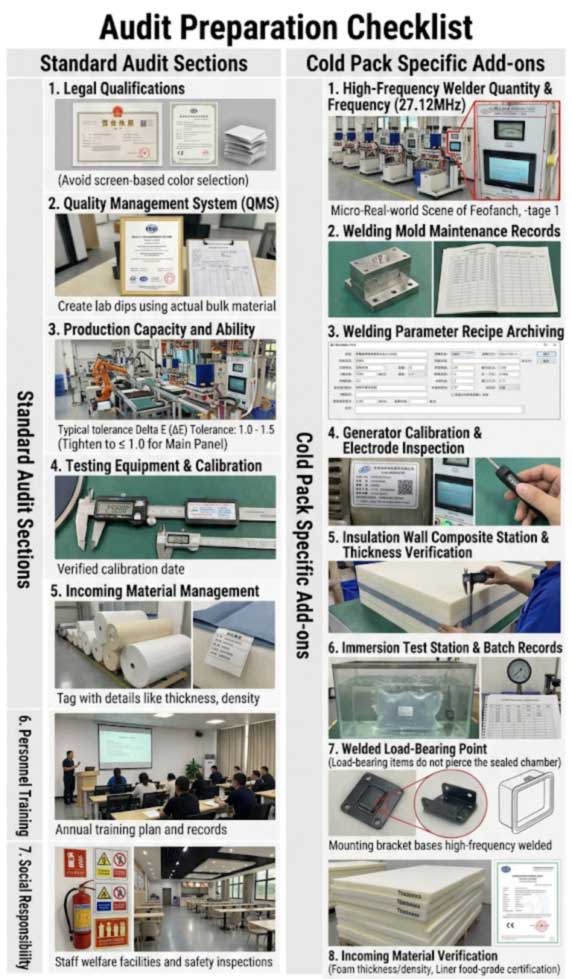
  • High-frequency welding machines on site — count them, note the frequency (27.12 MHz is standard), and confirm they are running, not parked.
  • Welding tooling and die maintenance — ask to see dies and the maintenance record. Worn or scarred dies produce thin welds that leak later.
  • Documented welding parameters — are recipes (power, pressure, weld time) stored per material and thickness, or set by operator judgement each time?
  • Generator calibration records — and how often electrodes are inspected.
  • Insulated wall lamination station — how shell, closed-cell foam and liner are combined, and how thickness is verified.
  • Immersion test station — does one physically exist, and are records kept per batch?
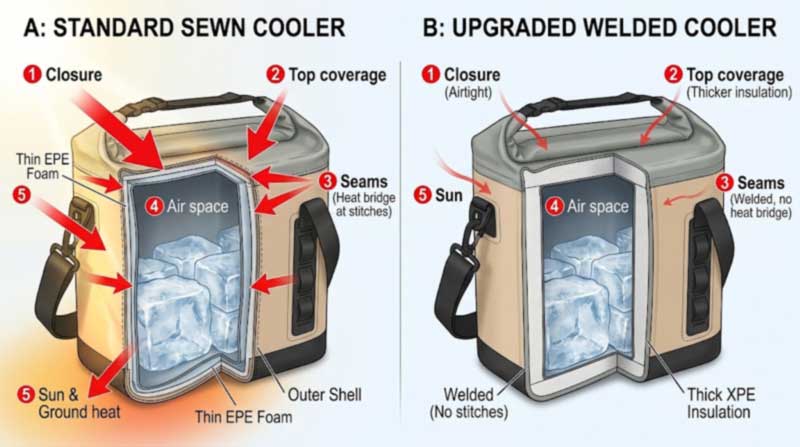
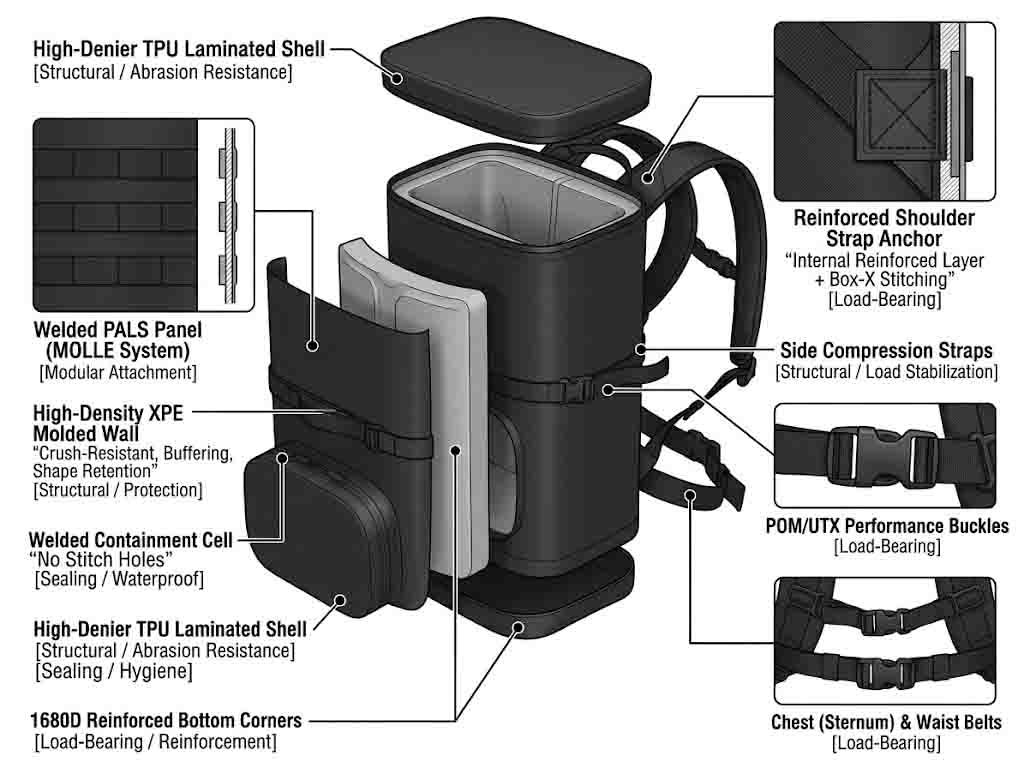
  • Welded attachment zones — ask to see how load-bearing straps and webbing are anchored without stitching through the sealed chamber.

Subcontracting disclosure deserves particular attention here, because it is the most common gap: < cite index="104-1">this is especially important when critical production processes are performed outside the audited facility. On a cooler, the critical process is the welding. A factory that subcontracts welding is not a welding factory, whatever the front office says.

4. Test instruments and calibration

Standard checks include < cite index="98-1">calibration programmes for measuring devices and equipment maintenance records. For a cooler factory, ask specifically what the lab can test: load cycling, tensile, adhesion, abrasion, salt spray, colour fastness, and full water immersion. Then ask to see recent records, not just the equipment.

5. Raw material handling and incoming inspection

This matters more on a cooler than on most products, because two of the three main materials become invisible after welding. Nobody can verify foam thickness, foam density or liner grade by looking at a finished bag — so if it is not checked at IQC, it is never checked. Review: incoming inspection procedures for shell fabric denier and coating, foam thickness and density, liner material and food-grade documentation, plus < cite index="98-1">material handling procedures and storage conditions.

6. Workforce and training

Welding quality depends on trained operators, so training records are not a formality here. Ask how welding operators are trained and assessed, and how long the current operators have been in post — particularly relevant after the annual post-holiday workforce turnover common in Chinese manufacturing.

7. Social compliance

Standard scope covers < cite index="103-1">working hours, wages and safety systems, with < cite index="99-1">confirmation that the factory does not employ underage workers or forced labour as an absolute requirement. If your retail customer requires a formal ethical audit, insist on the full SMETA or BSCI report rather than a certificate image.

seven-section factory audit framework with cooler-specific additions for welded insulated bag production

How to Run the Audit

The professional sequence is consistent across sources: < cite index="101-1">define scope and goals, prepare a checklist, assign auditors, inspect processes, documents and safety while observing operations closely, log non-conformances with attached evidence, create CAPA tasks with clear deadlines, evaluate supplier feedback, confirm the actions work, then close the audit. Two practices are worth calling out.

Watch the floor, not just the folder

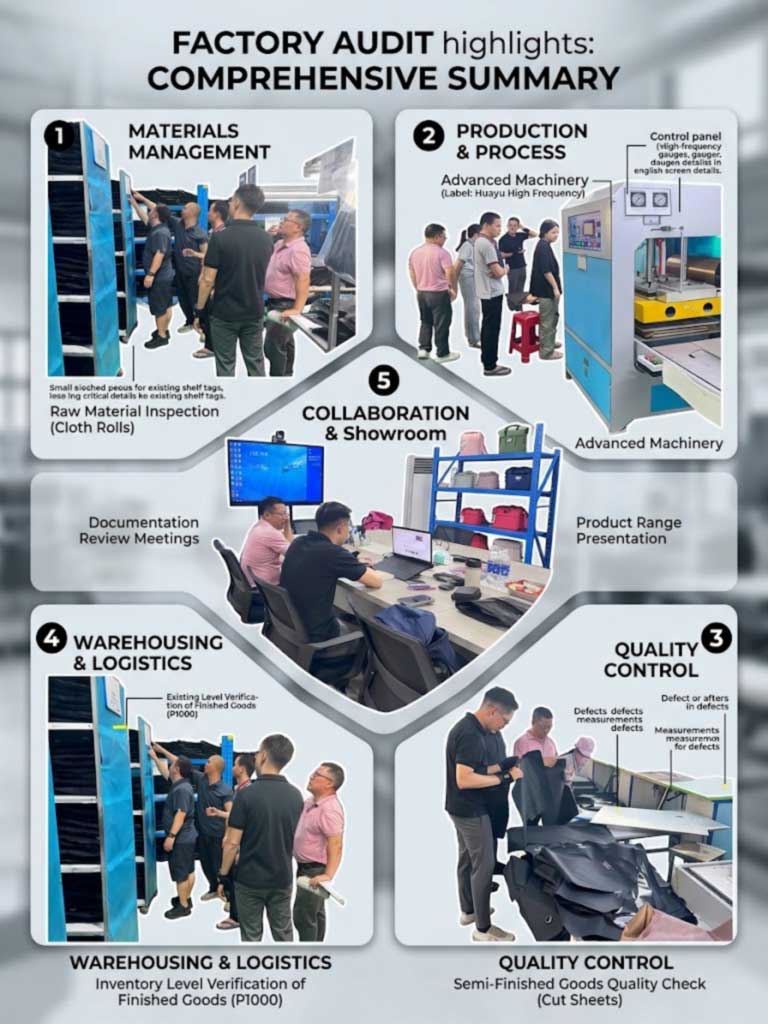
The most common auditor error is documentary bias: < cite index="98-1">many auditors spend too much time reviewing paperwork and not enough time observing actual operations — real quality problems often exist in the gap between what's documented and what actually happens on the production floor. Standard method is to < cite index="104-1">compare documented procedures with actual factory practices. Ask an operator to explain their own check; ask what happens when a weld fails; watch whether the recorded procedure is what people actually do.

Sample the records, look for trends

< cite index="98-1">Review a representative sample of quality records, test results and corrective action reports from recent production, looking for trends, completeness, and evidence of effective problem-solving. Records that are all perfect are as suspicious as records that are all missing.

Findings, Scoring and CAPA

An audit's value is in what happens afterwards. As one guide puts it bluntly: < cite index="102-1">the purpose of a supplier quality audit is not to produce a score — it is to identify specific, actionable gaps in a supplier's quality system.

A complete report should contain < cite index="102-1">audit date, scope and auditor names; the audit criteria used; a summary score by section and overall; and specific findings for each non-conformance with objective evidence. Where non-conformities are found, < cite index="104-1">the factory may be required to prepare a Corrective Action Plan, and closure has a standard: < cite index="102-1">effectiveness verification must be completed with objective evidence of no recurrence before the CAPA can be formally closed. A CAPA closed on a promise is not closed.

Stop-work findings. Some results should end the evaluation regardless of the total score: no valid business licence or a registry mismatch; child or forced labour indicators; blocked fire exits; a request to pay a personal bank account; welding subcontracted while presented as in-house; or refusal to allow floor access or record sampling. These are not points deducted — they are reasons to walk away.


When You Cannot Visit: The Virtual Audit

A live video walkthrough is a legitimate substitute when travel is not practical, provided it is run like an audit rather than a presentation. Make it live rather than pre-recorded, and drive the route yourself: ask the camera to go to the welding line, to pan across the dies, to show the calibration log, to open the IQC records for the current material lot, to walk to the immersion test station, and to show the fire exits. Ask for unplanned things — a specific machine's maintenance record, a named operator's training file — because a prepared tour cannot anticipate them.

For context on cost and audit types, a third-party quality audit typically runs a few hundred dollars per man-day, and audits can be announced, semi-announced or unannounced — each revealing something different about the factory's normal state. Those trade-offs are covered in the supplier checklist.

The Condensed Cooler Audit Checklist

Section Key evidence to request Fail signal
Legal Licence + registry match; manufacturing scope Trading-only scope; mismatched entity on payment details
QMS ISO 9001 with matching scope; CAPA examples; internal audit records No documented corrective action ever
Welding capability Machines on site and running; frequency; die maintenance log; parameter recipes Welding subcontracted; parameters "by experience"
Wall build Lamination station; foam thickness verification No thickness check at any stage
Testing Immersion test station; lab equipment; recent test records Equipment present but no records
IQC Foam density/thickness, liner food-grade documentation, shell denier checks Materials accepted on supplier claim alone
In-process QC Weld inspection at the weld station, not only at final Welds "checked at final inspection"
Attachment method Welded anchor zones for straps and webbing Stitching through the sealed chamber
Workforce Operator training and assessment records No training records; high unexplained turnover
Social compliance Full SMETA/BSCI report; hours and wage records; fire safety Certificate screenshots only; blocked exits
Traceability Material lot traceability to finished goods No lot records — a recall would be impossible

What an Audit Should Return at Sealock

Legal entity YiFuLong Outdoor Gear Co., Ltd. — registry-verifiable, manufacturing scope
Since 2003 — over 20 years welding insulated bags
Welding 27.12 MHz high-frequency welding, in-house across three factories — not subcontracted
Sites Dongguan, Guangdong, China + Ho Chi Minh City, Vietnam
Quality system IQC / IPQC / OQC; in-line weld inspection; AQL sampling; gold-sample sign-off
Testing Full water-immersion batch testing; lab suite covering load cycling, tensile, adhesion, salt spray, abrasion, colour fastness and colour difference
Third-party SGS or QIMA inspection welcomed
Certifications ISO9001, BSCI, SMETA P4, GRS, HIGG, SCAN — verifiable with the issuing bodies
Materials Food-grade inner liners across the entire range; migration testing available for the destination market
Terms MOQ 300 pcs per design; samples 7–15 days; production 30–45 days; FOB Guangdong

None of that should be taken on trust — the point of a checklist is that every line is something you can ask to see.

factory audit walkthrough route for a welded cooler plant: incoming materials, welding station, in-line inspection

FAQ: Auditing a Soft Cooler Factory

Q: What does a factory audit actually cover?

A: Seven core areas: legal and business legitimacy, quality management system effectiveness, production capacity and capability, test instruments and calibration, raw material handling and incoming inspection, workforce training, and social compliance. A checklist covering fewer than these gives an incomplete picture. For coolers, add welding capability, wall-build verification and immersion testing as product-specific sections.

Q: Is a factory audit the same as a pre-shipment inspection?

A: No, and they cannot substitute for each other. The audit evaluates the supplier's organisational capability — whether they can produce to standard repeatedly. The inspection checks whether a specific batch conforms before it ships. Serious programmes use both.

Q: What should I check that a generic audit checklist misses?

A: Everything specific to welded coolers: whether high-frequency welding machines are on site and running, at what frequency, whether welding is subcontracted, whether weld parameter recipes are documented per material, whether dies are maintained, how foam thickness is verified at incoming inspection, whether an immersion test station exists with batch records, and how straps are anchored without stitching through the sealed chamber.

Q: Can I audit remotely?

A: Yes, if you run it as an audit rather than watching a presentation. Insist on live video, direct the route yourself to the welding line, dies, calibration logs, IQC records and immersion station, and ask for unplanned evidence such as a specific machine's maintenance record. A prepared tour cannot anticipate specific requests.

Q: What happens after the audit?

A: Findings are documented with objective evidence and scored by section, and non-conformities go into a corrective action plan with owners and deadlines. Critically, a CAPA should only be closed once effectiveness is verified with objective evidence of no recurrence — a corrective action closed on a promise is not closed. The purpose is actionable gaps, not a score.

Q: What findings should end the evaluation immediately?

A: No valid licence or a registry mismatch, child or forced labour indicators, blocked fire exits, a request to pay a personal bank account, welding subcontracted while presented as in-house, or refusal to grant floor access or record sampling. These are walk-away findings rather than deductions.

Planning an audit? Sealock (YiFuLong Outdoor Gear Co., Ltd.) welcomes on-site and live video audits of its high-frequency welding lines in Dongguan, China and Ho Chi Minh City, Vietnam, including welding stations, calibration and IQC records, and immersion testing. Send your audit checklist ahead of time and the team will have the evidence ready.

Email: info@sealock.com.hk  |  Phone: +86-13632981825  |  Browse the soft cooler range

Audit frameworks, procedures and standards cited here reflect publicly available quality-assurance and sourcing sources as of mid-2026 and vary by audit scheme, product category and buyer requirements. This is general guidance, not a certified audit protocol — engage a qualified third-party auditor for formal supplier qualification.

Related News
Leave me a message
X
We use cookies to offer you a better browsing experience, analyze site traffic and personalize content. By using this site, you agree to our use of cookies.Privacy Policy