News

Travel Cooler Backpacks: Leakproof & Carry-On Friendly

2026-08-21 0 Leave me a message
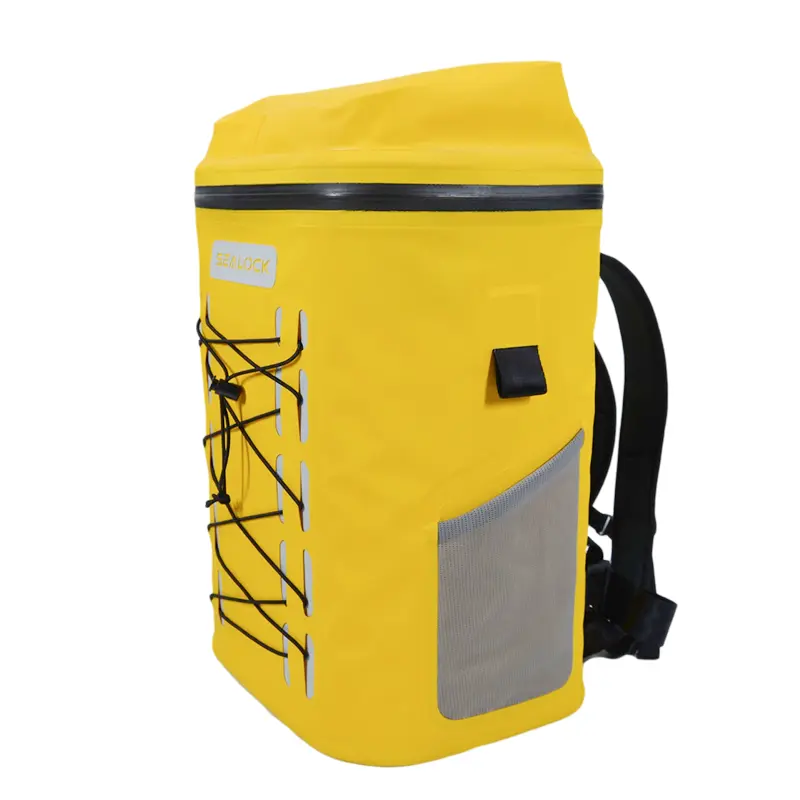
Air travel is the one environment where a cooler backpack has to satisfy a rulebook rather than just the weather. Get the ice packs wrong and they are confiscated at the checkpoint. Get the dimensions wrong and the bag is gate-checked. And get the construction wrong and melted ice soaks a suitcase full of clothes in an overhead bin. This guide covers the three things that actually decide whether a cooler travels well — the security rules on cold sources, the size limits that define "carry-on friendly," and the leakproof construction that protects everything around it. Sealock (YiFuLong Outdoor Gear Co., Ltd.) builds welded leakproof cooler backpacks suited to travel.


The Rule That Catches Travellers Out: "Frozen Solid"

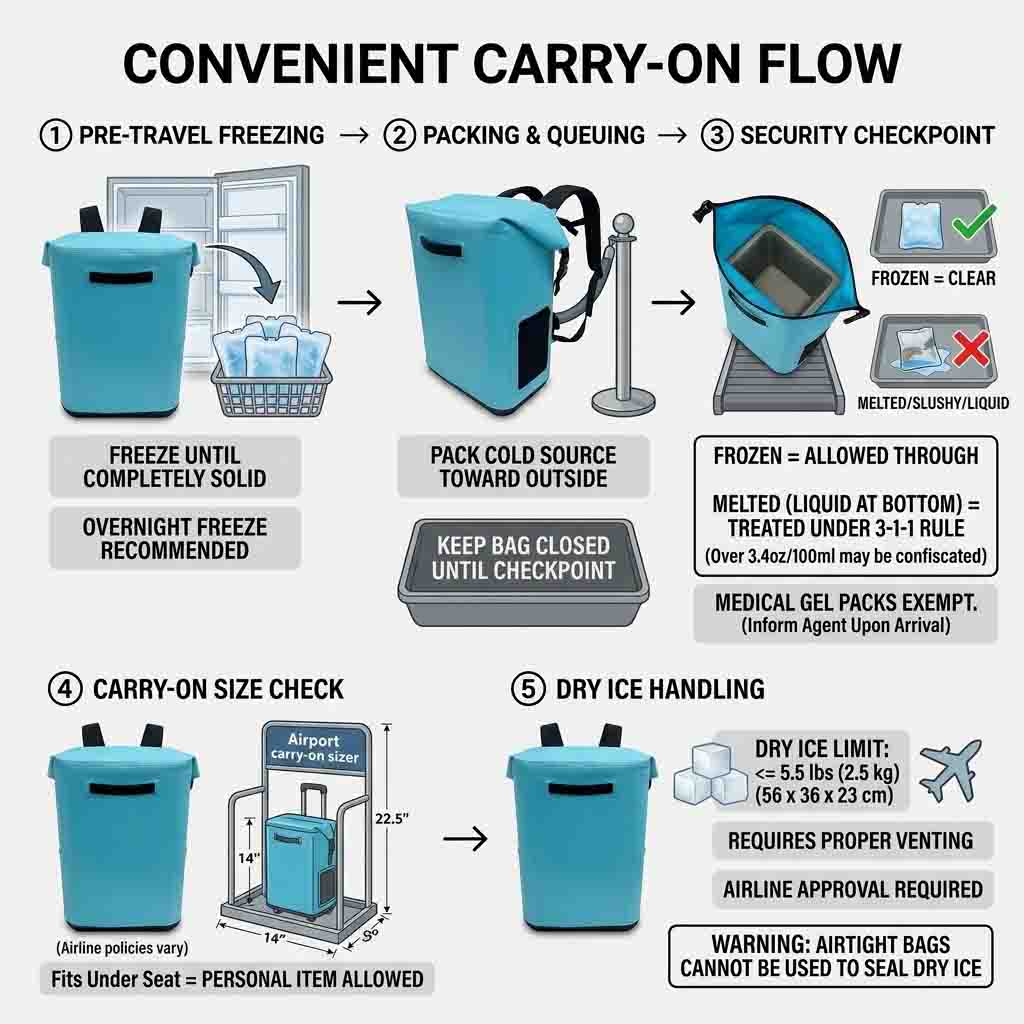
The single most common travel-cooler failure has nothing to do with the bag. TSA's own wording on gel ice packs is precise, and it is stricter than most people assume: frozen liquid items are allowed through the checkpoint as long as they are frozen solid when presented for screening; if frozen liquid items are partially melted, slushy, or have any liquid at the bottom of the container, they must meet 3-1-1 liquids requirements.

Read that carefully. A gel pack that has softened even slightly — slushy, or with liquid pooled at the bottom — stops being "a frozen item" and becomes a liquid, subject to the 3-1-1 rule of containers not exceeding 3.4 ounces, fitting inside a one-quart clear resealable bag. Almost no ice pack is under 3.4 oz. So a partly thawed pack is, in practice, a confiscated pack.

The timing risk is real and specific: an ice pack that left your freezer in perfect shape can soften on the ride to the airport, during curbside check-in, or while you wait in a long security line. This is the one case where a cooler's insulation quality has a direct regulatory consequence — the bag's job is to keep the packs solid until the moment they hit the X-ray belt.

How to get cold sources through screening:
  • Freeze everything solid overnight, not just a few hours.
  • Keep the cooler closed until you reach the front of the line. Practical packing advice is to put the densest packs closest to the outside of the insulated bag and keep the cooler closed until you reach the front of the queue.
  • Wrap packs around already-frozen food or keep them in a well-insulated bag so they stay solid longer.
  • Medical exception: TSA states that medically necessary gel ice packs in reasonable quantities are allowed regardless of their physical state — melted or slushy — with or without the presence of breast milk; notify the officer at the checkpoint for inspection.
  • Loose ice is different from packs. Wet ice or ice water is generally not accepted in carry-on; sealed frozen packs are the practical choice.
Dry ice has its own rules — and they conflict with airtight coolers. Air travel permits limited quantities: the FAA's passenger hazmat guidance allows up to 5.5 pounds (2.5 kg) of dry ice per person in carry-on or checked baggage, as long as the package vents and the airline approves it. Airlines also require notification and labelling. Note the venting requirement: an airtight-zipper or fully sealed roll-top cooler is designed to be gas-tight, which makes it unsuitable for dry ice unless deliberately left able to vent. Never seal dry ice inside a sealed cooler.


"Carry-On Friendly" Means Specific Numbers

The second travel constraint is dimensional, and it is worth designing and shopping to real figures rather than a vague sense of "small enough." Carry-on allowances vary by airline: Delta and American list 22 × 14 × 9 inches for a standard carry-on, while Southwest lists 10 × 16 × 24 inches, with all measurements including handles and wheels, and the bag must fit in the bin or under the seat. Checked coolers have their own thresholds — under 62 linear inches and 50 lbs to avoid oversized or overweight fees.

Two practical points follow. First, a soft cooler has a real advantage here: soft-sided insulated bags are an ideal choice because their flexible construction makes them easy to stow, and their waterproof material prevents liquids inside from leaking out. A rigid box either fits or does not; a soft welded cooler compresses into the space available. Second, a smaller cooler backpack can qualify as a personal item — an insulated bag small enough to fit under the seat in front of you may be carried as a personal item, though airline-specific size rules should be checked first. That is often the smarter play: the cooler goes under the seat, and the carry-on allowance stays free for the actual suitcase.

Travel slot Typical limit Cooler backpack sizing
Personal item (under seat) Airline-specific; smaller than carry-on Compact ~15–20L builds; check your airline
Standard carry-on e.g. 22 × 14 × 9 in (Delta, American) Most ~20–28L soft coolers fit; soft sides help
Checked Under 62 linear in and 50 lb Larger builds; seal contents against leaks in transit

Why Leakproof Matters More on a Plane Than Anywhere Else

On a beach, a leaking cooler wets sand. In an overhead bin, it wets other passengers' luggage — and in a checked bag, it soaks your own clothes for the whole flight before you find out. Travel is the use case where containment failure has the highest consequence and the least chance of early detection.

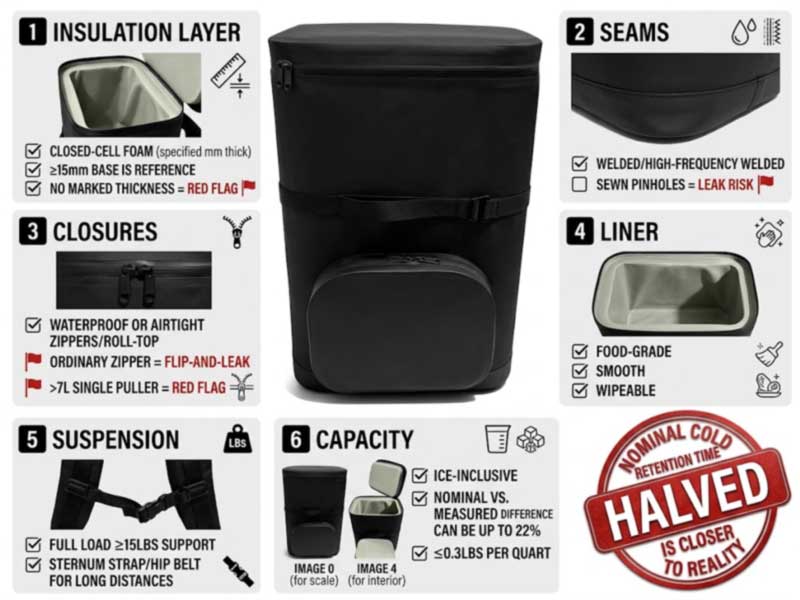
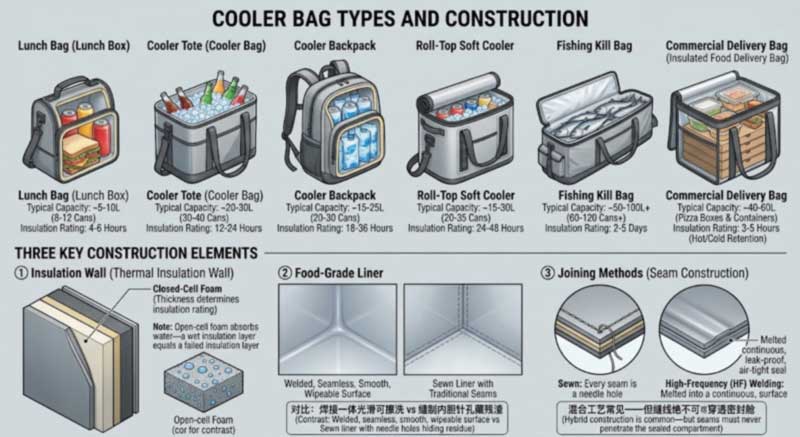
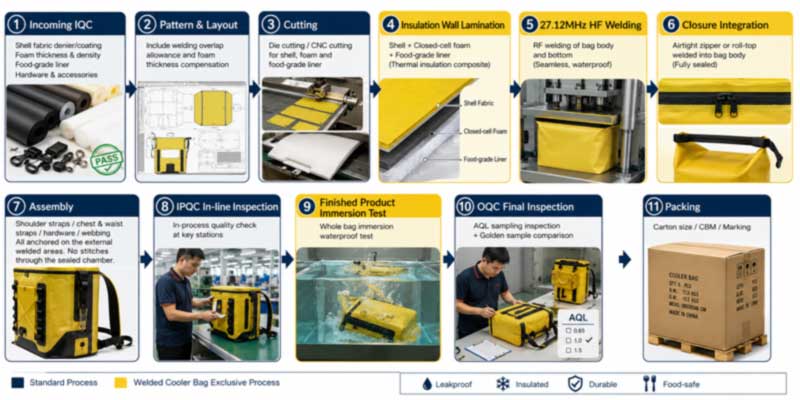
That is an argument for welded construction specifically. A stitched cooler leaks melt-water through the needle holes at its bottom seam; a high-frequency-welded body with a welded liner has no holes to leak through, and a sealed closure holds when the bag is laid flat, stacked, or wedged sideways into a bin — which is exactly how luggage is handled. The construction detail is covered in Leakproof Cooler Backpack Manufacturer: Welded vs Stitched Seams, and choosing and using one in Leakproof Cooler Backpacks: Stop Melt-Water Leaks for Good.

Note also that the liquids inside a cooler are still liquids in the eyes of security: any liquids or gels inside the bag must comply with the 3-1-1 rule, so drinks and sauces need the same treatment as anything else in a carry-on.

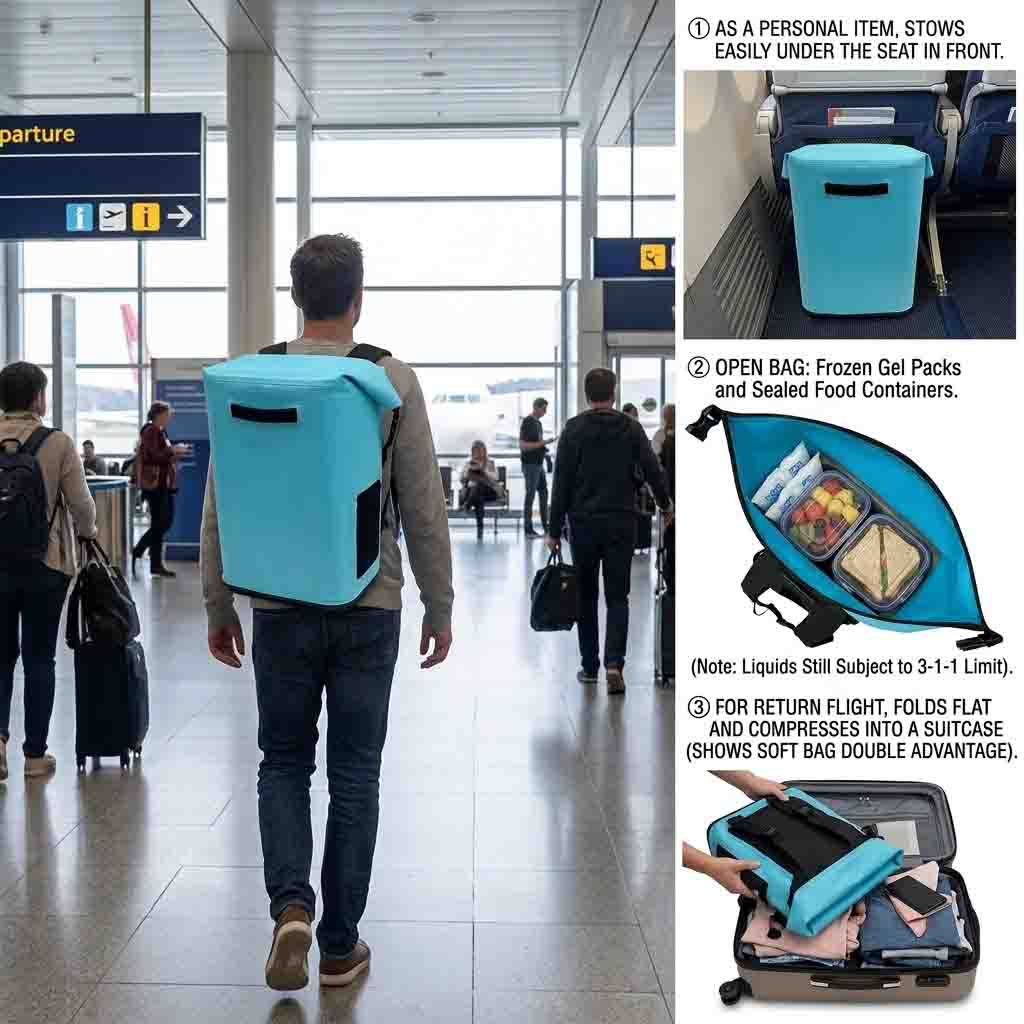
airport screening flow for a travel cooler backpack covering frozen-solid ice packs, 3-1-1 liquids and carry-on size limits

What Makes a Cooler Backpack Travel Well

Requirement For travel, specify Why
Dimensions Within carry-on limits; compact builds for under-seat use Gate-checking a cooler defeats the purpose of carrying it
Construction HF-welded body and liner A leak in a bin or a suitcase is the worst-case scenario
Closure Sealed and holds in any orientation Luggage is laid flat, stacked and wedged
Cold-hold Enough to keep packs frozen solid to the checkpoint and cold to destination Insulation quality has a direct regulatory consequence here
Empty weight Low Counts against airline weight allowances
Packability Soft, compressible, flat-foldable when empty Stows into a suitcase for the return leg
Carry Backpack straps, ideally stowable Hands free through terminals; straps out of the way in a bin
Cleanability Wipe-clean welded food-grade liner Hotel rooms and airports offer poor washing facilities

One more travel-specific advantage of a soft cooler: on the outbound leg it carries food; on the return leg it packs flat inside a suitcase, or carries a wine bottle, cheese or a fresh catch home. A rigid cooler occupies its full volume in both directions.

Sealock's Travel-Suited Cooler Backpacks

Sealock welds insulated cooler bags at 27.12 MHz across three factories in Dongguan, China and Ho Chi Minh City, Vietnam, with food-grade inner liners across the entire range. Real builds suited to travel, chosen by fit rather than rank — note dimensions against your airline's limits before flying:

Image Model Size & build Travel fit Link
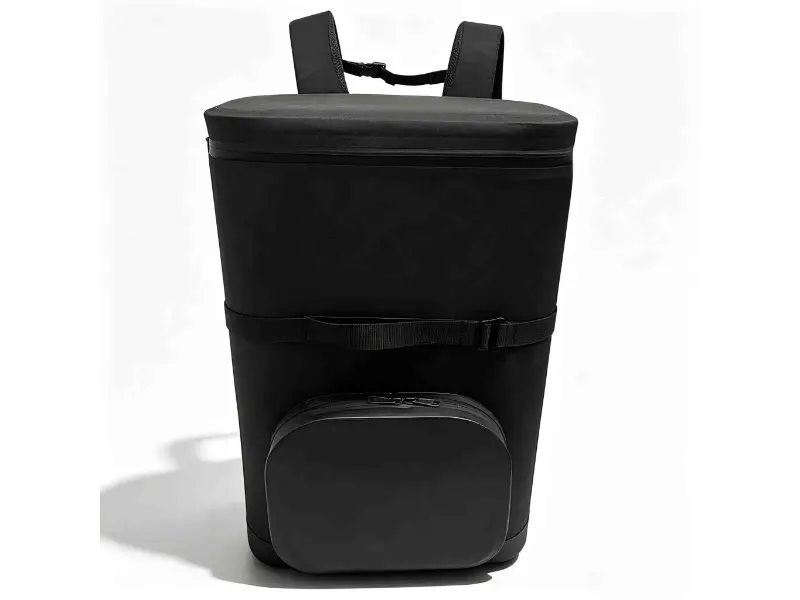
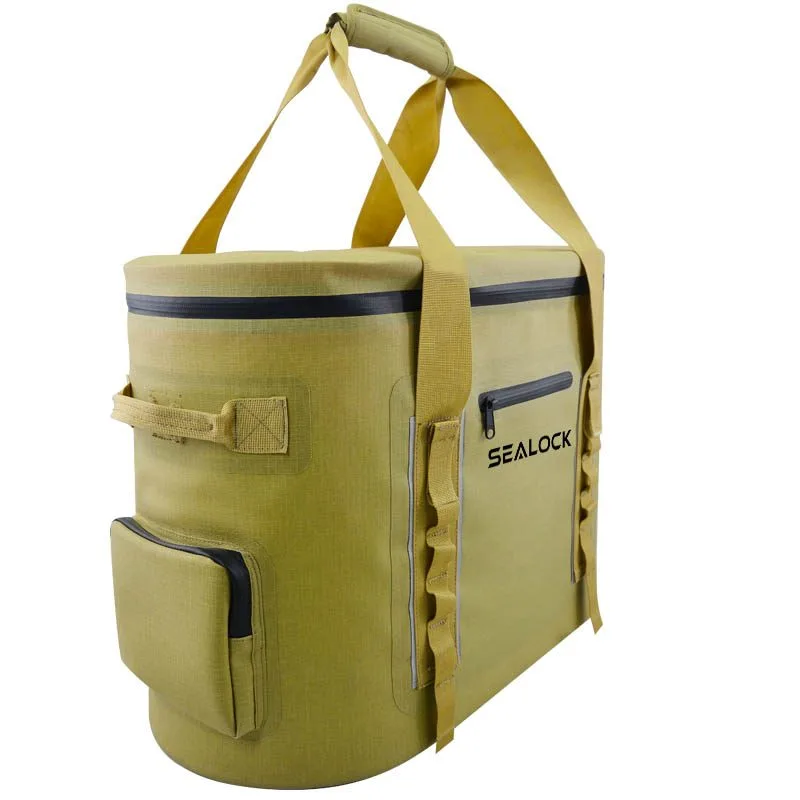
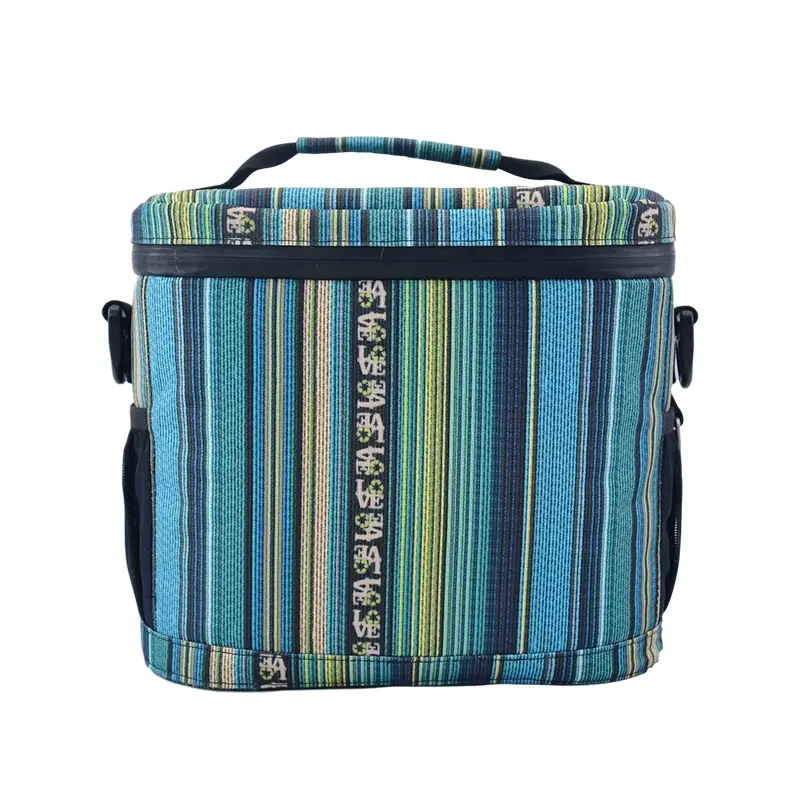
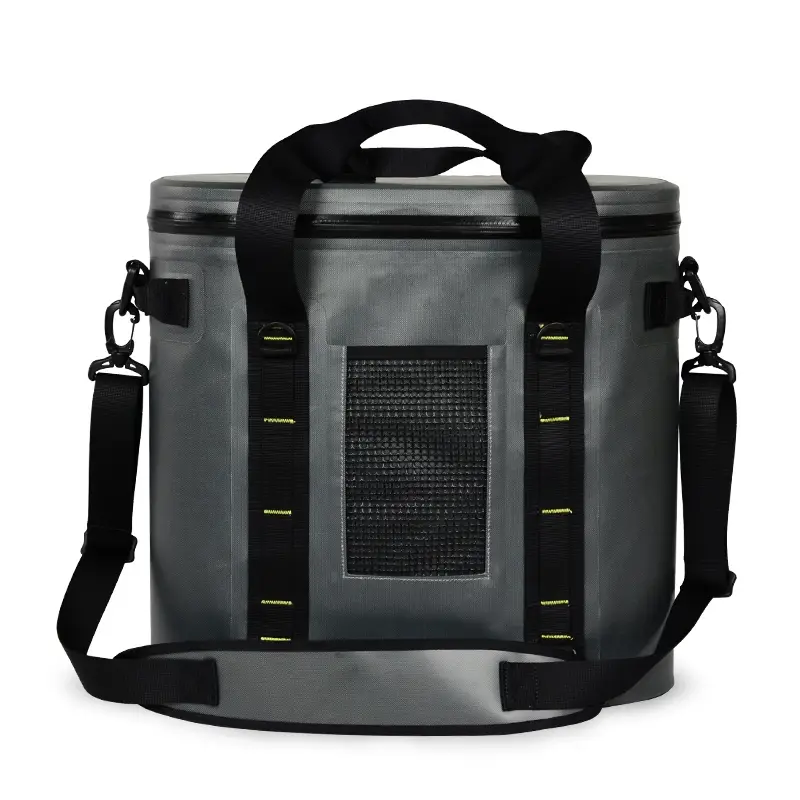
Lightweight waterproof cooler backpack SL-I272 Lightweight Waterproof Cooler Backpack (SL-I272) 30 × 21.5 × 47.5 cm, TPU, folding closure The lightest option here and comfortably inside standard carry-on dimensions; folding closure packs down View
Barrel insulated cooler backpack SL-I309 Barrel Cooler Backpack (SL-I309) 34 × 23 × 47 cm, ~18L, ~1.3 kg, closed-cell EPE Compact and light — the smallest capacity here, easiest to fit and carry through a terminal View
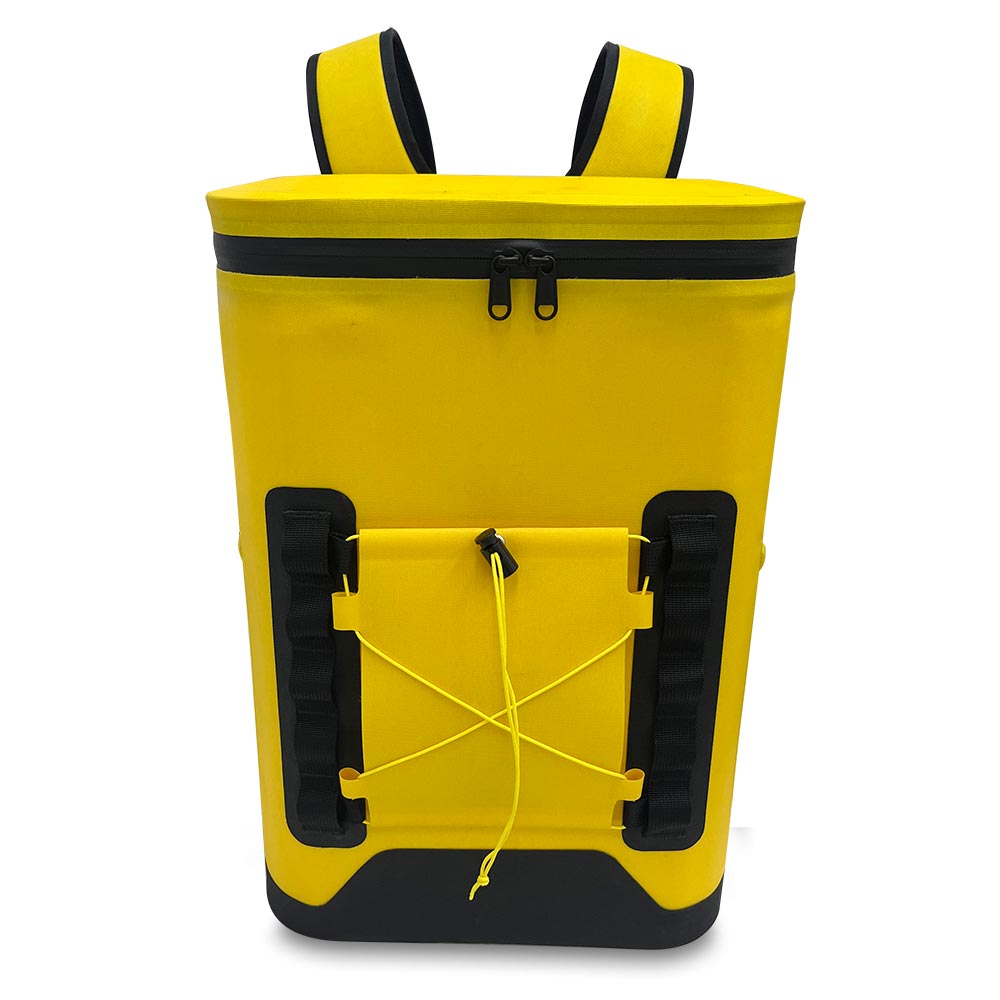
22L IPX7 cooler backpack SL-I280 22L IPX7 Cooler Backpack (SL-I280) 22L, 50 mm XPE, IPX7 airtight zipper, 48 hr+ Longest cold-hold and a fully sealed closure — the safest choice for long itineraries and for keeping packs solid through delays View
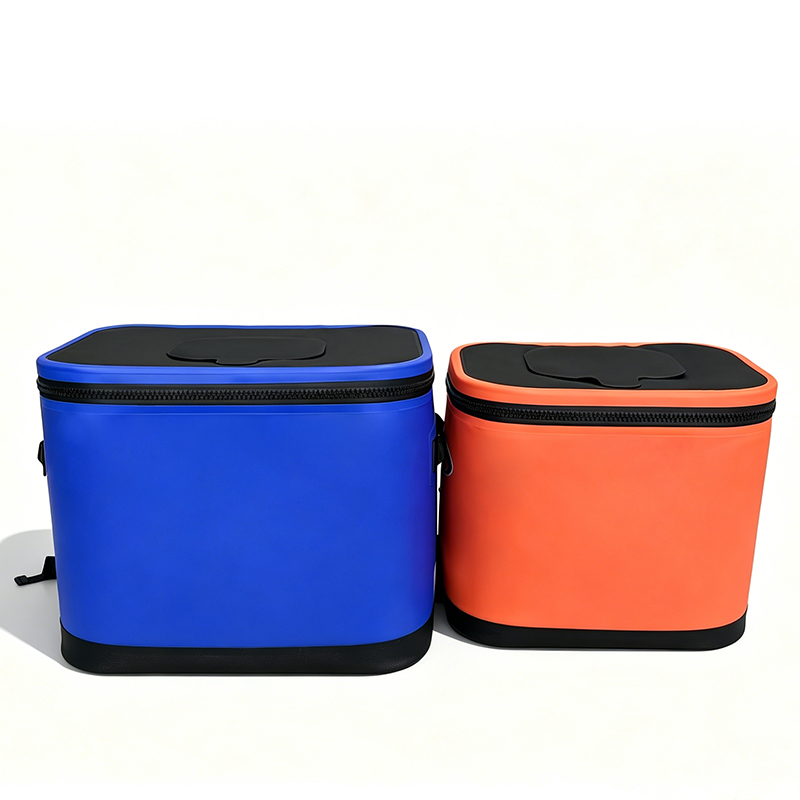
Insulated soft cooler backpack with molded lid SL-E050B Insulated Cooler Backpack, molded lid (SL-E050B) 37.5 × 26.5 × 32 cm, ~25L, ~1.4 kg, two sizes Wide fast-opening lid for checkpoint inspection; the smaller size suits tighter allowances View
28L airtight-zipper insulated backpack cooler SL-I274 28L Airtight-Zipper Backpack Cooler (SL-I274) 32 × 22 × 47 cm, 28L, up to 48 hr, airtight zipper Largest capacity here with a sealed closure — check dimensions against your airline before assuming carry-on View

All are welded and leakproof by construction, which is the property that matters most in a bin or a suitcase. Sizing is where travel differs from every other use: the right bag is the one that clears your airline's limits, not the one with the biggest number.

travel cooler backpack carried through an airport, stowed under the seat, and packed flat into a suitcase for the return leg

For Brands: Developing a Travel Cooler Range

Travel is a specification driven by rules rather than weather, and demanding briefs are welcome. Beyond colour and logo, Sealock develops ground-up from a sketch, sample or performance target: external dimensions engineered to specific carry-on or under-seat allowances rather than approximated, low empty weight to preserve airline weight allowances, welded leakproof containment so a bin or suitcase is never at risk, a sealed closure that holds in any orientation, a cold-hold tier sufficient to keep gel packs frozen solid through check-in queues and delays, a wide opening for checkpoint inspection, compressible or flat-foldable construction for the return leg, stowable harness components, and a wipe-clean food-grade liner. Premium insulation up to VIP vacuum panels and aerogel is in scope where a brand wants maximum cold-hold inside a fixed carry-on envelope — a genuinely useful application, since travel caps the dimensions but not the performance. Ground-up work runs longer at sampling, so book against the season. See OEM Soft Cooler Backpacks: What You Can Customize Beyond Logo & Color and Custom Insulated Cooler Backpacks: Spec Your Foam, Liner & Capacity.

MOQ / lead time 300 pcs per design; samples 7–15 days; production 30–45 days; FOB Guangdong
Origin China or Vietnam on the same specification
Certifications ISO9001, BSCI, SMETA P4, GRS, HIGG, SCAN

FAQ: Travel Cooler Backpacks

Q: Can I take a cooler backpack through airport security?

A: Yes — insulated bags are allowed in carry-on or checked baggage, provided the contents comply and the bag meets your airline's size limits. Officers make the final call at the checkpoint, so pack so the contents are easy to inspect, and remember that liquids and gels inside the cooler still fall under the 3-1-1 rule.

Q: Are ice packs allowed in carry-on luggage?

A: Only if they are frozen solid at screening. TSA allows frozen liquid items through the checkpoint when they are frozen solid when presented; if they are partially melted, slushy, or have any liquid pooled at the bottom, they must meet 3-1-1 limits — which almost no ice pack does. Freeze overnight, keep the bag closed until the front of the queue, and expect the risk to rise with long waits.

Q: What about breast milk, formula or medical cold packs?

A: There is an explicit exception: medically necessary gel ice packs in reasonable quantities are allowed regardless of physical state — melted or slushy — with or without breast milk present. Notify the TSA officer at the checkpoint for inspection rather than sending them through unannounced.

Q: Can I bring dry ice on a plane in a cooler?

A: Within limits and with airline approval. FAA passenger guidance allows up to 5.5 lb (2.5 kg) per person in carry-on or checked baggage, provided the package vents and the airline agrees; airlines typically require notification and labelling. Critically, the venting requirement means dry ice must not be sealed inside an airtight cooler.

Q: What size cooler backpack counts as carry-on?

A: It depends on the airline — Delta and American list 22 × 14 × 9 inches, Southwest lists 10 × 16 × 24 inches, and measurements include handles. A smaller insulated bag that fits under the seat in front of you can often travel as a personal item instead, which keeps your carry-on allowance free. Always check your specific airline before flying, since these limits change.

Q: Why does leakproof construction matter so much for travel?

A: Because of where the leak ends up. In an overhead bin it reaches other passengers' luggage; in a checked bag it soaks your own clothes for the entire flight before you discover it. A welded body and liner with a sealed closure has no needle holes to leak through and holds when the bag is laid flat or wedged sideways — which is exactly how luggage gets handled.

Sourcing travel cooler backpacks? Sealock (YiFuLong Outdoor Gear Co., Ltd.) welds leakproof cooler backpacks at 27.12 MHz in China and Vietnam, with dimensions that can be engineered to specific carry-on allowances and cold-hold validated by testing. Tell the team your target airline envelope and market, and they will spec and prove the build.

Email: info@sealock.com.hk  |  Phone: +86-13632981825  |  Browse the soft cooler range

Security and airline rules cited here reflect publicly available TSA, FAA and airline sources as of mid-2026 and change frequently; limits also differ outside the United States. Screening officers make the final determination at the checkpoint. Confirm current rules with TSA or your national authority and with your airline before travelling.

Related News
Leave me a message
X
We use cookies to offer you a better browsing experience, analyze site traffic and personalize content. By using this site, you agree to our use of cookies.Privacy Policy
RejectAccept