News

Boating Cooler Backpacks: Dry Storage That Doubles as a Cooler

2026-08-18 0 Leave me a message
Space on a boat is finite, and every bag you bring aboard has to justify the deck it occupies. That is the appeal of a cooler backpack that also works as dry storage: one bag instead of two, carrying the food and drinks cold while keeping phones, keys, wallets and dry clothes safe from spray. It is a genuinely good idea — but only if the bag is built to do both jobs in separate compartments, because a cold chamber and dry storage are thermally incompatible in the same space. This guide explains why, and what a real dual-purpose boating bag needs. Sealock (YiFuLong Outdoor Gear Co., Ltd.) builds welded cooler backpacks with sealed construction for this use.


The Conflict Nobody Mentions: Cold Chambers Make Condensation

Here is the physics that ruins the naive version of this idea. Sealing warm, humid air into a waterproof container and then chilling it produces liquid water inside — the same reason a cold drink sweats. Sea to Summit's guidance on packing electronics states it directly: the air trapped inside a dry bag when you seal the roll-top will contain moisture vapour, and if the dry bag is then exposed to a cooler environment — which is often the case on the water — that moisture vapour will condense inside the bag, turning back into liquid.

Now apply that to a cooler chamber, which is not merely "a cooler environment" but a deliberately refrigerated one packed with melting ice. Anything dry-sensitive stored in there is sitting in a saturated, condensing space. A waterproof cooler that keeps outside water out perfectly will still soak a phone left inside it, from the inside. Waterproof does not mean dry.

The practical answer used across the marine world is the same one that should shape the product: separate the functions, and add a desiccant. Because of the possibility of condensation, it is a good idea to pack a desiccant — such as the silica gel packs that come with electronics — into the dry bag, and this applies to other waterproof enclosures including hard-shell cases. Marine storage advice says the same for boat compartments: add silica gel packs and airflow, and installing waterproof liners or bags inside storage compartments adds another barrier, especially for valuables, electronics or emergency equipment. Boat owners handle phones the same way — a waterproof container with silica gel packets manages humidity around a phone, since silica gel absorbs moisture and prevents condensation forming on screens and internal components during the temperature fluctuations common on the water.

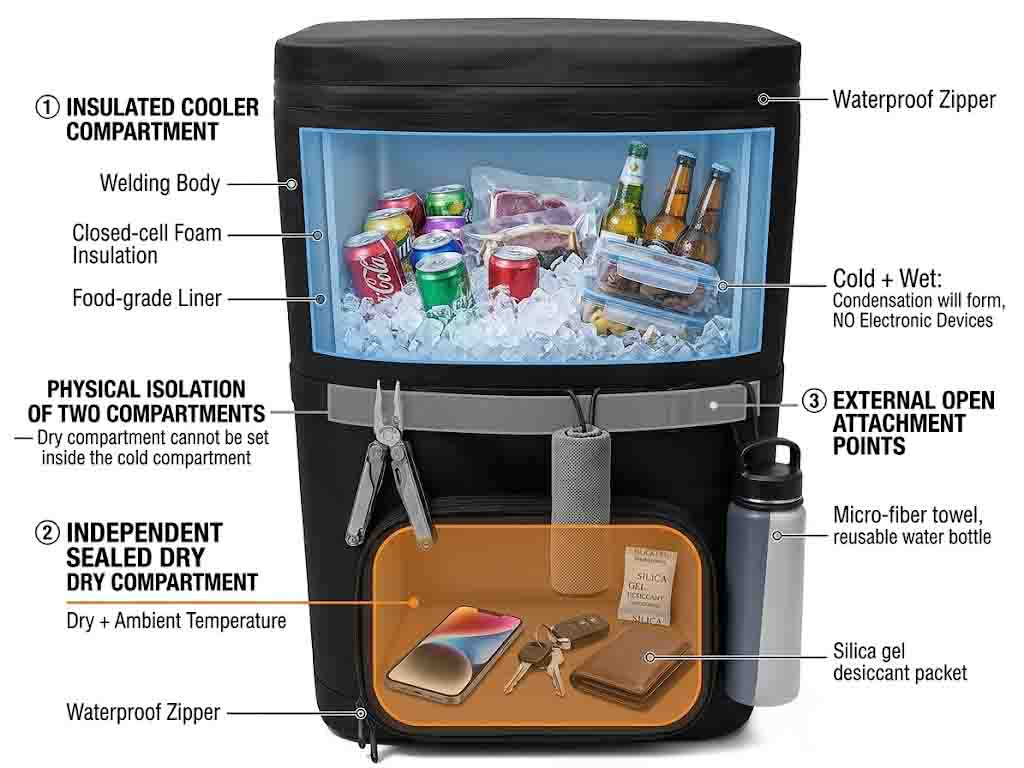
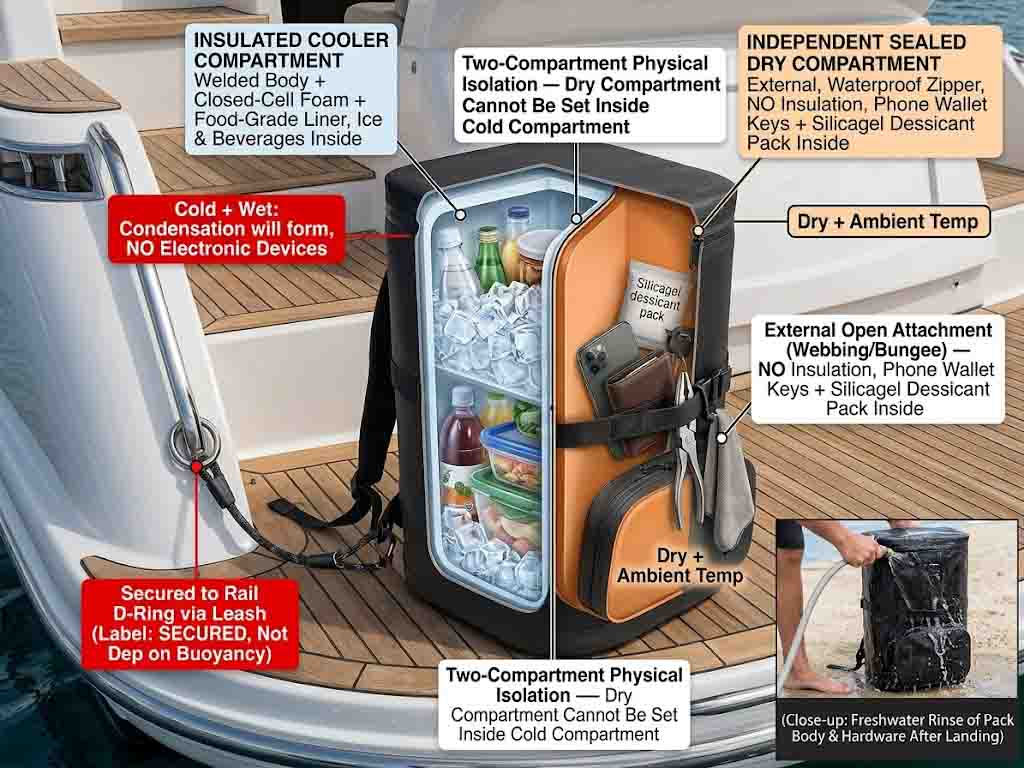
What this means for the product: a dual-purpose boating bag needs two isolated compartments — an insulated cold chamber, and a separate waterproof dry pocket outside it. Putting a "dry pocket" inside the cold chamber does not work: it inherits the chamber's temperature and its condensation. The dry storage has to be a distinct, sealed, uninsulated compartment on the exterior of the bag.


What Goes Where

Compartment What belongs there What must not
Insulated cold chamber (welded, food-grade liner) Food, drinks, ice or ice packs, catch — anything that benefits from cold and tolerates moisture Phones, keys, wallets, cameras, documents, dry clothes, anything electronic
Sealed dry pocket (waterproof, uninsulated, exterior) Phone, keys, wallet, documents, sunscreen, a dry layer, first-aid items Ice, anything wet, anything that leaks
Open external pockets / webbing Tools, pliers, bottle, towel, wet items you want outside the dry zone Anything valuable that must stay dry

The rule of thumb for a boat is simple: cold and wet in one sealed space, dry and valuable in another sealed space, and wet-but-not-precious on the outside. A bag that gives you all three is doing the job of two or three bags without pretending one chamber can serve conflicting purposes.

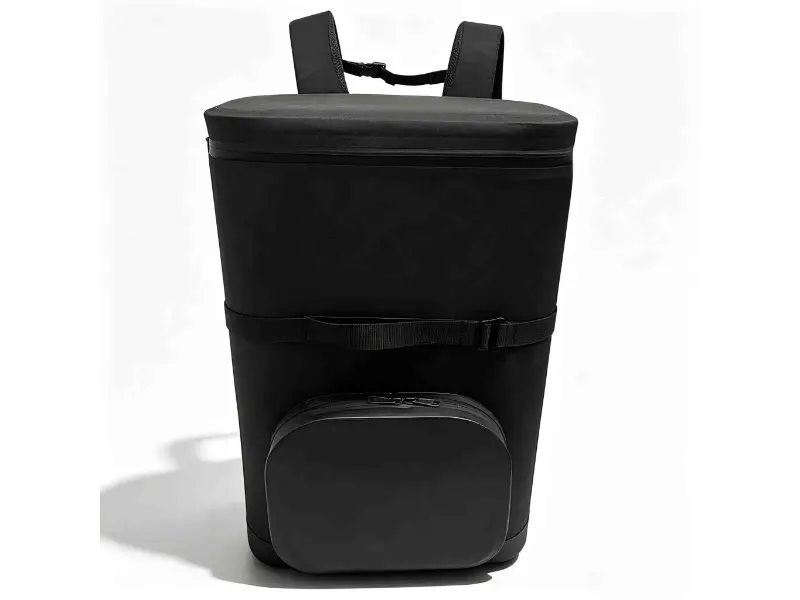
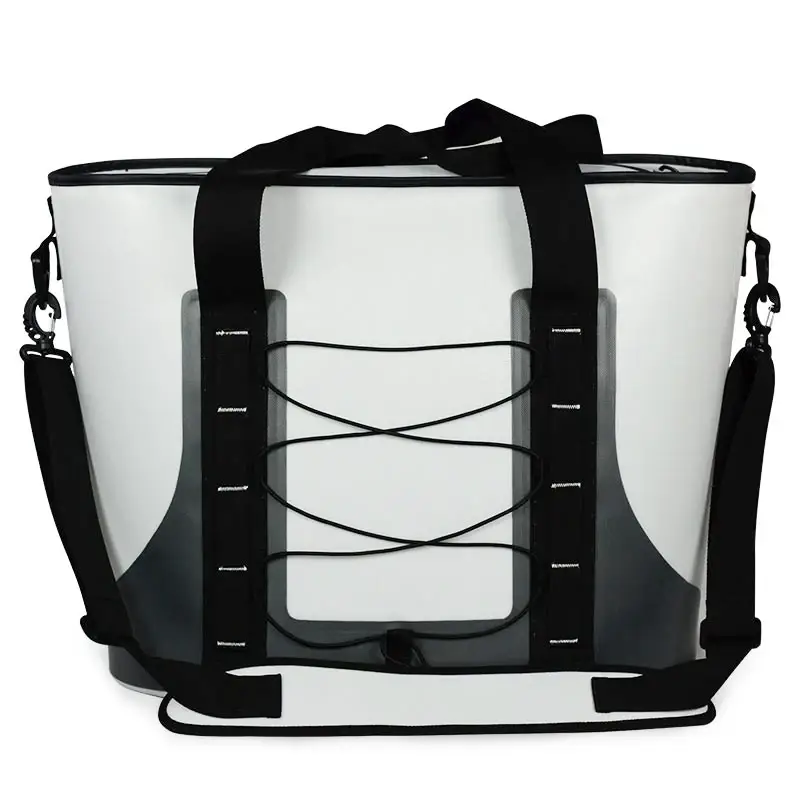
dual-compartment boating cooler backpack with insulated cold chamber separated from a sealed dry pocket

What Boating Demands of the Bag Itself

Beyond the compartment architecture, boating sets requirements that overlap with — but are not identical to — kayaking and general marine use.

Sealing rated for going over, not just getting splashed

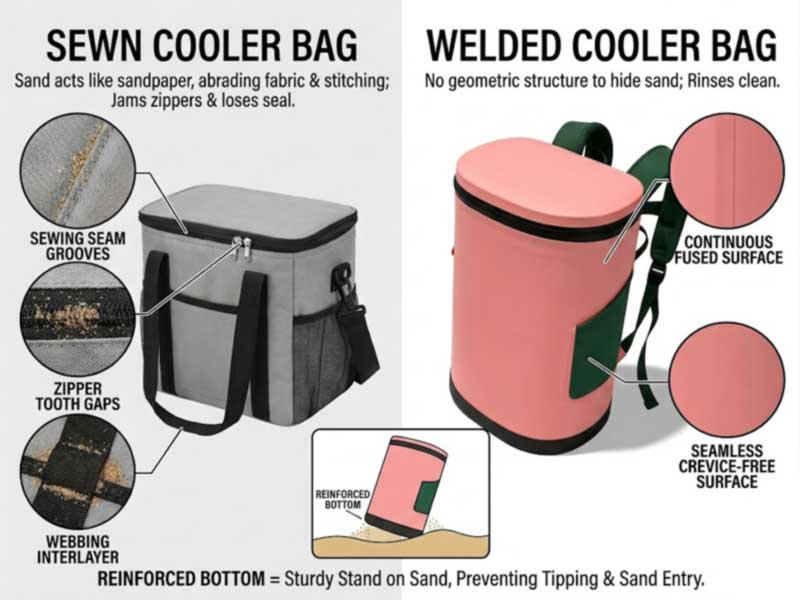
On a boat the bag will be sprayed constantly and could go overboard. That puts the target at an immersion rating — IPX7 or IPX8 — delivered by welded seam-free construction and a closure that seals in any orientation. A standard zipper caps the bag at splash level whatever the body is made of; see Waterproof Cooler Backpacks: How Welded Construction Keeps Water Out.

Buoyancy, honestly bounded

A closed-cell foam wall plus a sealed air chamber makes a cooler backpack float, which is a real margin if it goes over the side. It is not a flotation device, and a heavily loaded bag can still sink — and a floating bag drifts fast in wind and current, so lash it to the boat regardless. The physics is covered in Waterproof Insulated Backpacks: Cold Retention Meets Full Submersion.

Hardware that survives salt

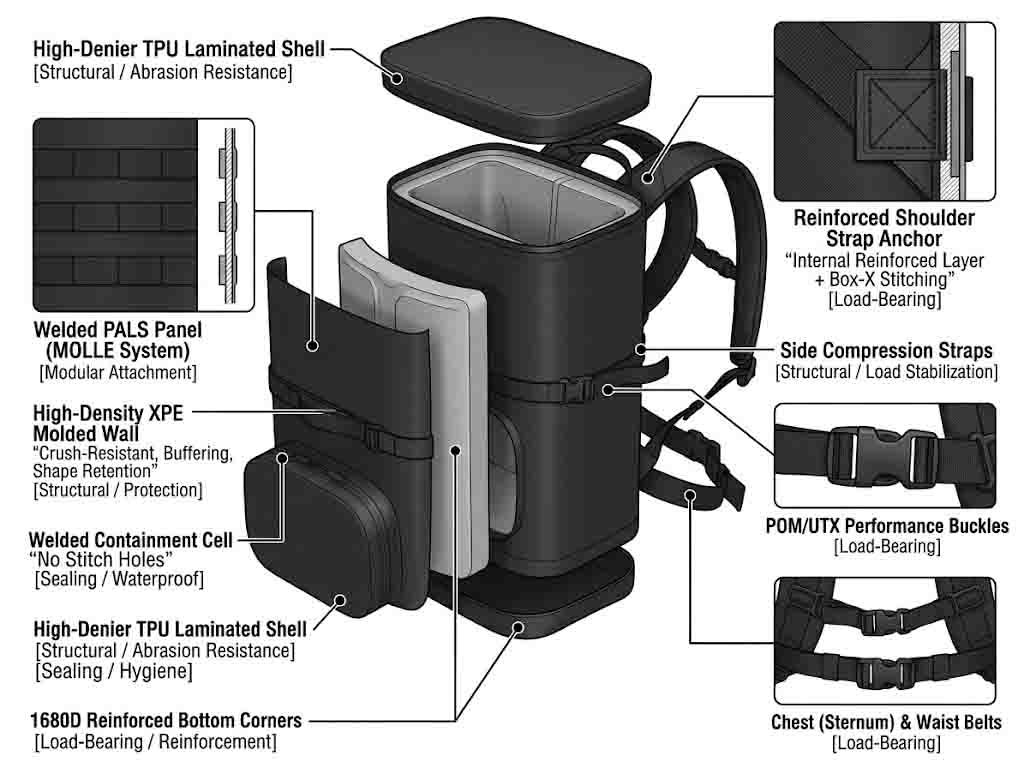
Boating means chloride on every buckle, and the splash zone above the waterline is the most aggressive place for metal hardware. Polymer buckles (POM, UTX-type) do not corrode at all; where metal is genuinely needed, 316 stainless is the marine grade. Full detail in Marine Cooler Backpacks: Saltwater-Grade Materials & Hardware.

Stowable and securable on deck

A soft cooler backpack stows into spaces a rigid box will not, and compresses when part-full — both valuable on a boat. It needs lash points (D-rings, webbing, compression straps) so it can be tied down against the boat's motion, and a low profile so it does not become a trip hazard on a working deck.

Specifying a Boating Cooler Backpack

Requirement Specify Why aboard
Compartments Insulated cold chamber + separate sealed dry pocket Condensation makes a single chamber unusable for electronics
Seal level IPX7 or IPX8, welded, sealed in any orientation Spray is constant; overboard is possible
Closure Airtight zipper or welded roll-top Must hold when the bag is knocked over or submerged
Hardware Polymer buckles; 316 stainless where metal is required Splash-zone chloride destroys lesser grades
Insulation Closed-cell foam Will not waterlog; contributes buoyancy
Attachment D-rings, webbing, compression straps Must be lashed against boat motion
Liner Food-grade, welded, wipe-clean Rinses free of salt, catch residue and sunscreen
Visibility Reflective trim, bright colourways optional On-water safety and finding gear at dusk

Sealock's Boating Cooler Backpacks

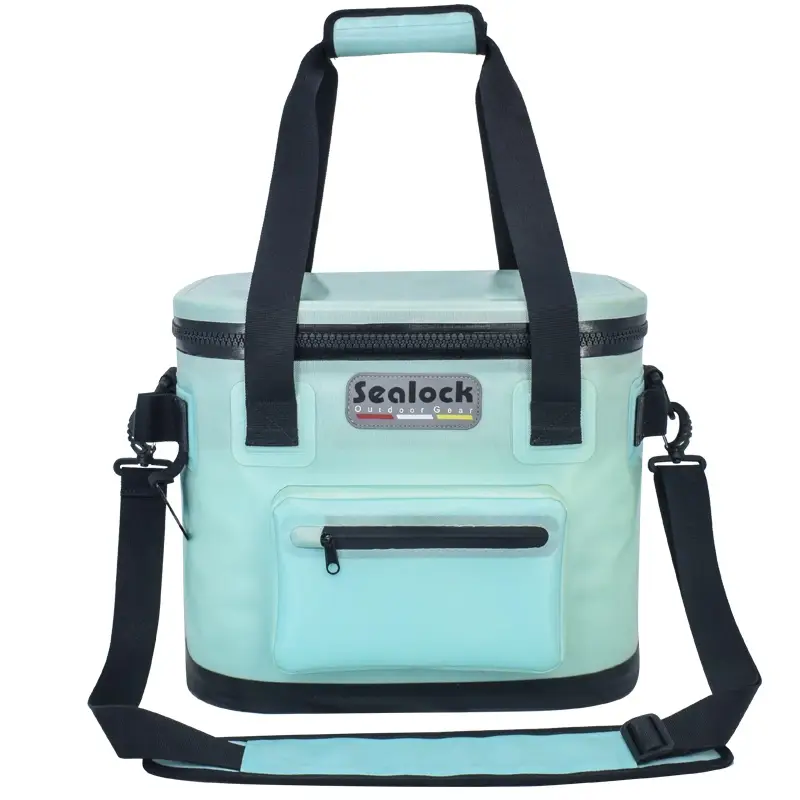
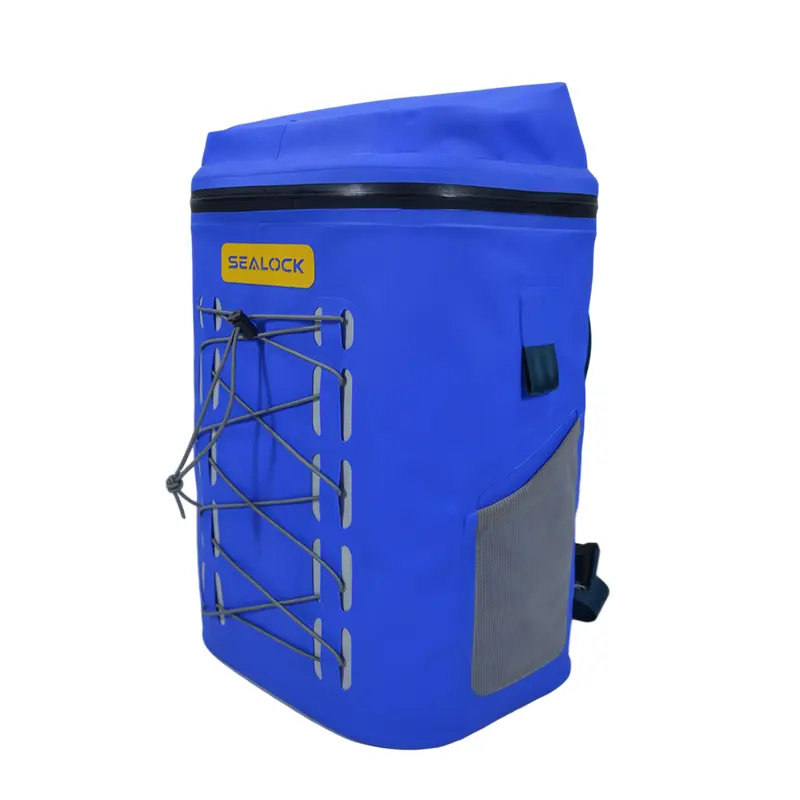
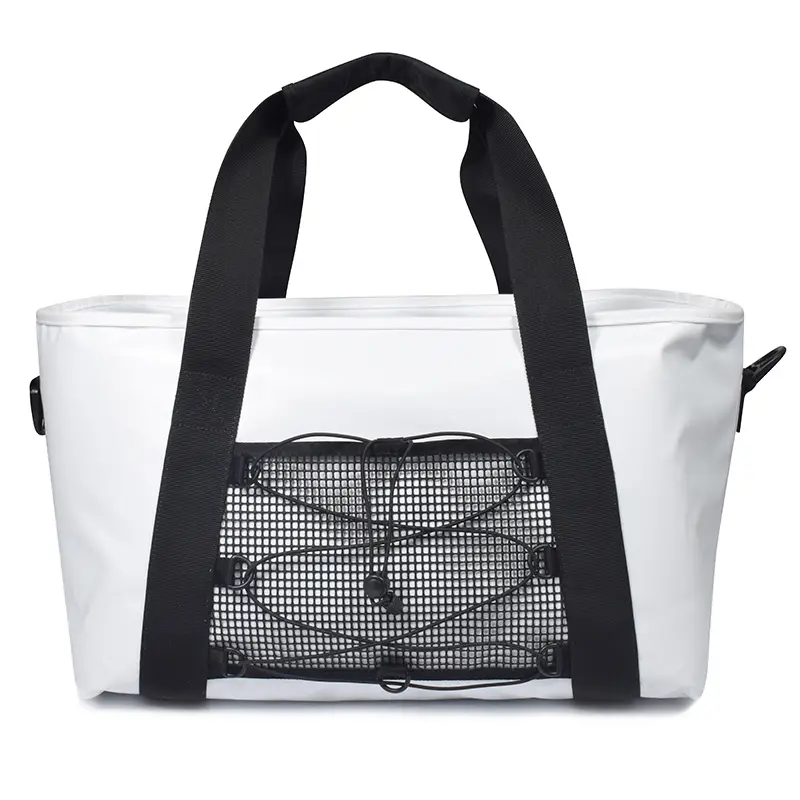
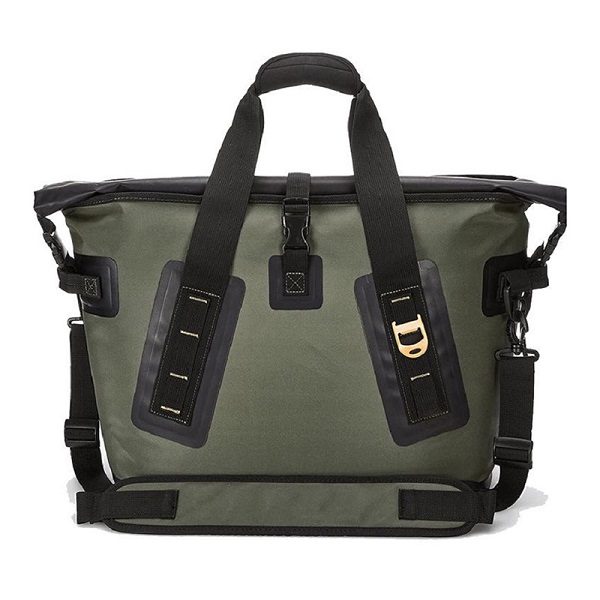
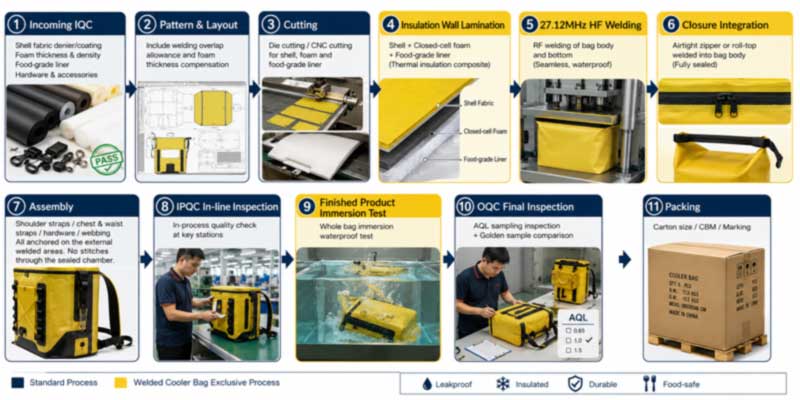
Sealock welds insulated cooler bags at 27.12 MHz across three factories in Dongguan, China and Ho Chi Minh City, Vietnam, with food-grade inner liners across the entire range, and validates sealed builds by full water immersion. Real builds for boating, chosen by fit rather than rank — note the external pocket in each, which is where the dry storage function lives:

Image Model Cold chamber Dry / external storage Link
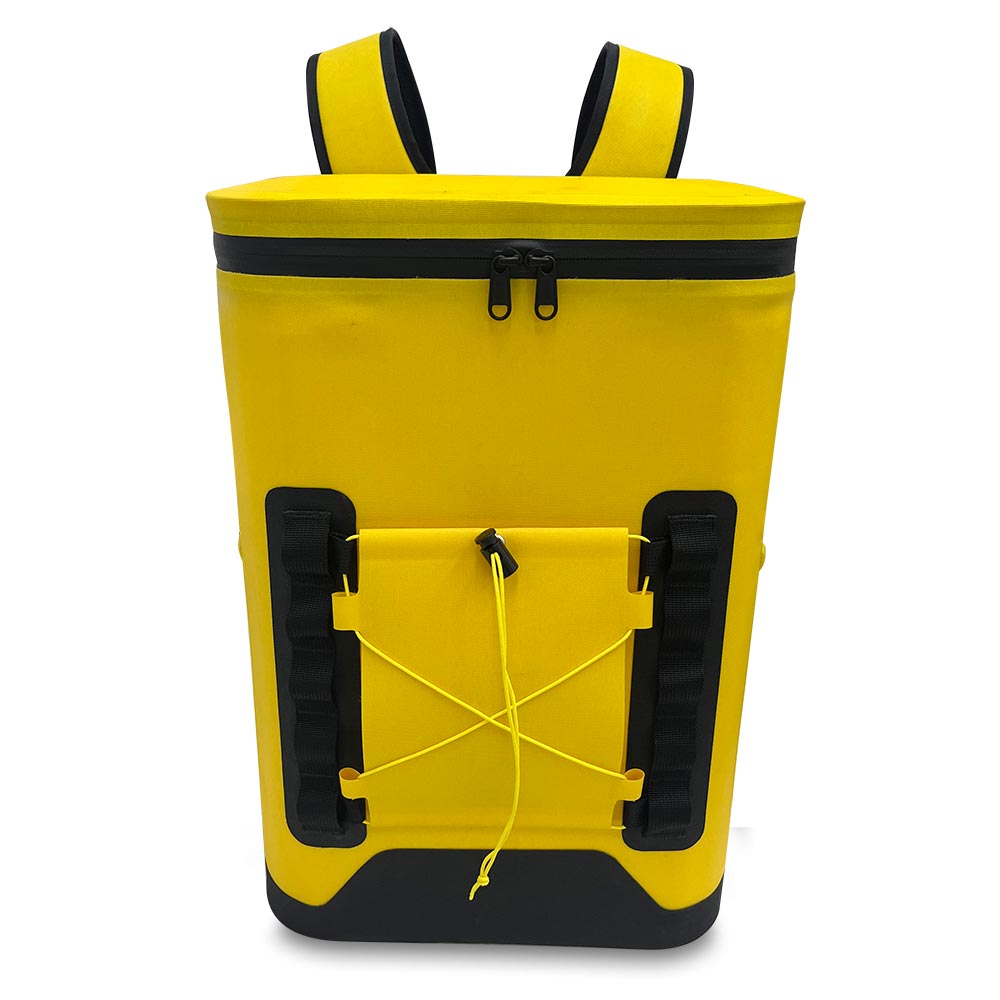
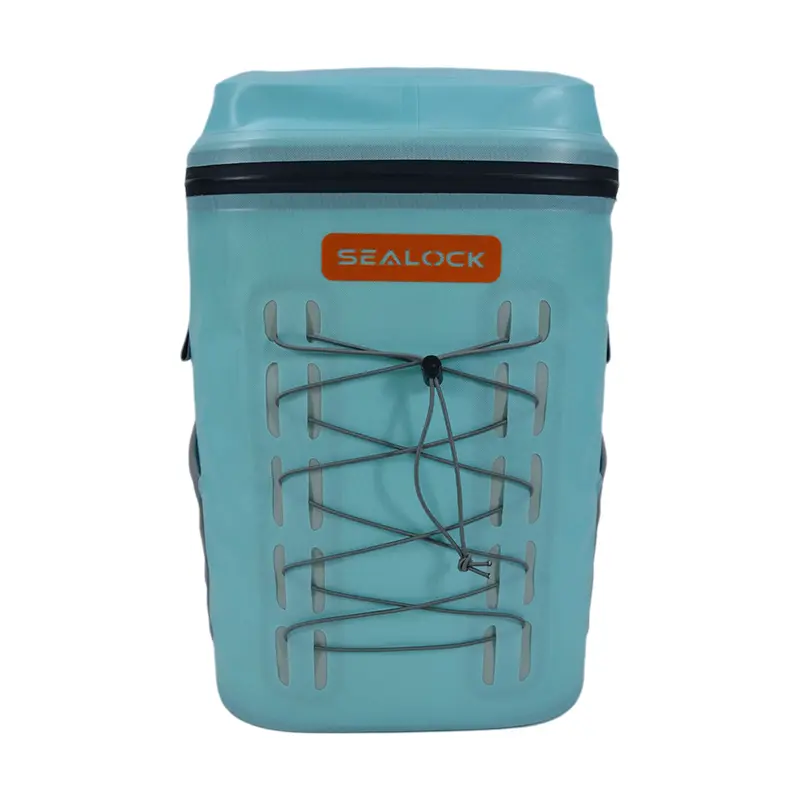
28L airtight-zipper insulated backpack cooler SL-I274 28L Airtight-Zipper Backpack Cooler (SL-I274) 28L, airtight waterproof zipper, 3 cm EVA core, food-grade TPU membrane, up to 48 hr Utility pocket, front bungee and side panels for tools and wet items; UTX buckles View
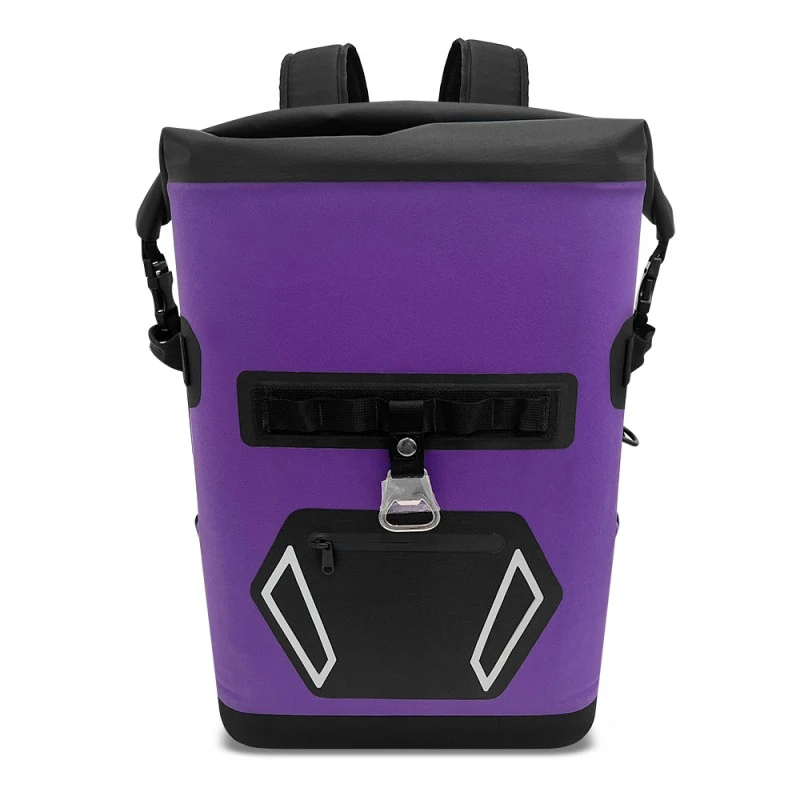
45L roll-top backpack cooler SL-I270 45L Roll-Top Backpack Cooler (SL-I270) 45L, welded roll-top with no zipper channel to foul, 3 cm EVA foam, up to 36 hr Front pocket plus gear webbing for lashing and accessories; bottle opener, reflective trim, UTX buckles View
22L IPX7 cooler backpack SL-I280 22L IPX7 Cooler Backpack (SL-I280) 22L, IPX7 immersion-rated, airtight zipper, 50 mm closed-cell XPE, 48 hr+ POM clips and D-rings for lashing; the highest seal level here View
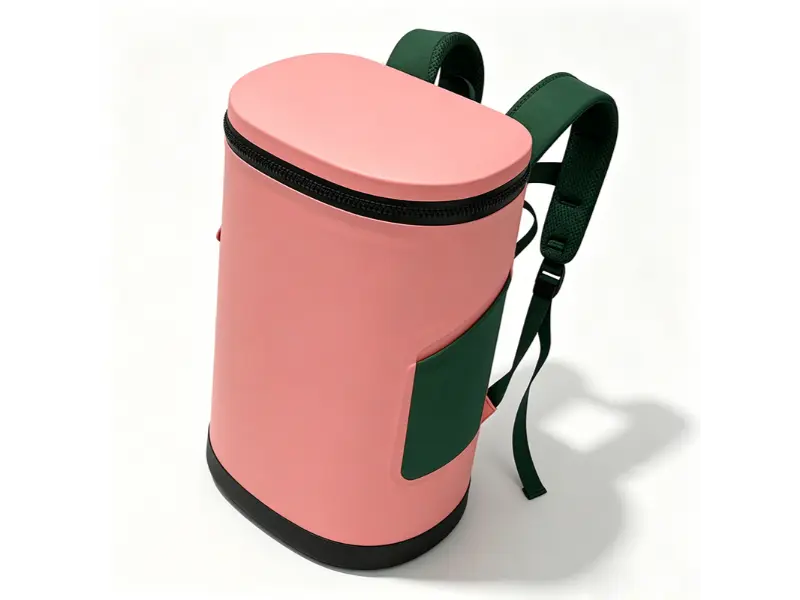
Barrel insulated cooler backpack SL-I309 Barrel Cooler Backpack (SL-I309) ~18L, closed-cell EPE, ~24–36 hr — water-resistant, not submersible Front slip pocket; compact for a small boat on calm water View

Two honest notes. First, the external pockets on these builds vary in how watertight they are — if a brand needs a genuinely sealed dry compartment for phones and documents, that is a specification to set at development rather than assume. Second, the SL-I309 is water-resistant rather than submersible: fine for a calm-water day, but for open water specify an immersion-rated build.

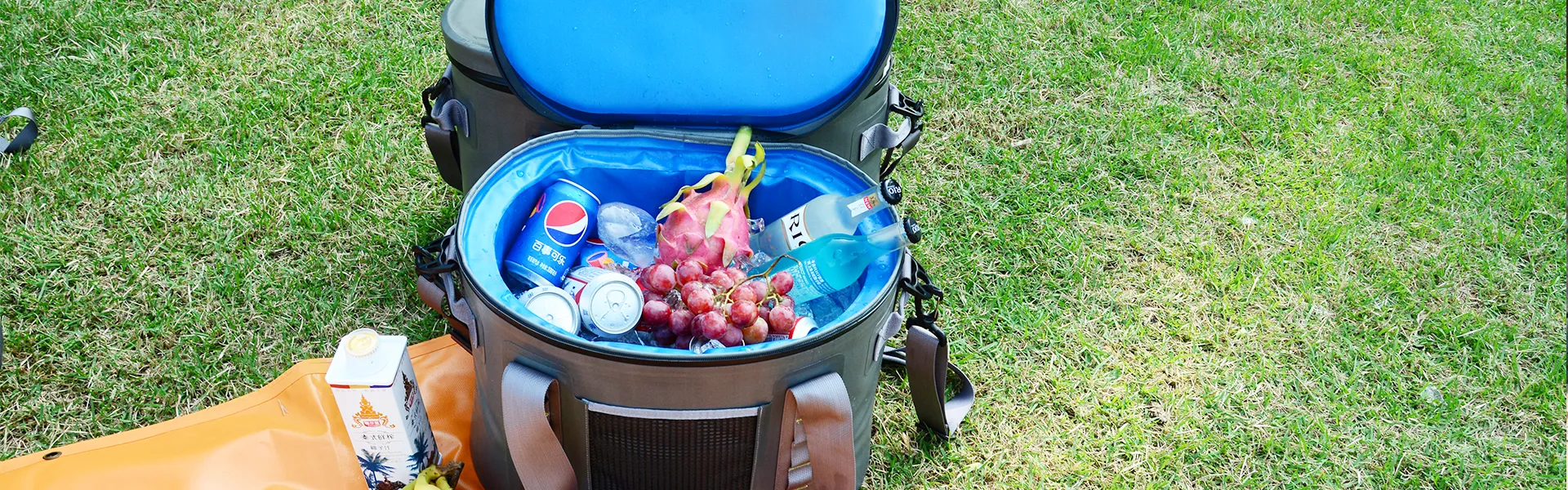
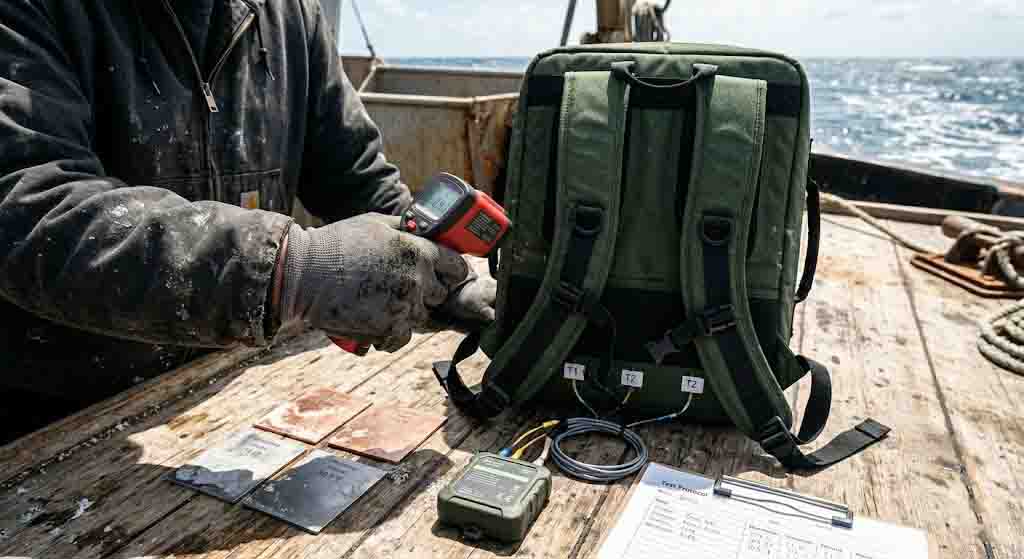
boating cooler backpack lashed on deck with dry pocket holding phone and keys and cold chamber holding drinks

Practical Habits Aboard

  • Put a silica gel pack in the dry pocket. Cheap, reusable, and it handles the condensation that temperature swings on the water create inside any sealed enclosure.
  • Lash it, do not trust flotation. A floating bag still leaves the boat faster than you can retrieve it.
  • Keep the cold chamber shut. Every opening costs cold; put the things you reach for constantly in the external pockets.
  • Rinse with fresh water after every saltwater trip, inside and out, then dry it open and store it out of the sun.
  • Do not seal dry clothes in with the ice — a towel or spare layer in the cold chamber comes out damp even if nothing leaked.

For Brands: Developing a Dual-Purpose Boating Bag

A cooler that is also credible dry storage is a genuinely interesting brief, and demanding briefs are welcome. Beyond colour and logo, Sealock develops ground-up from a sketch, sample or performance target: a welded insulated cold chamber to a stated cold-hold, a physically separate sealed dry compartment with its own waterproof closure engineered outside the insulated wall so it stays warm and dry, external webbing and open pockets for wet gear, an IPX7 or IPX8 seal level proven by immersion testing, closed-cell insulation that contributes buoyancy, welded D-rings and lash points for securing on deck, corrosion-immune polymer hardware with 316 stainless where metal is required, and reflective trim or high-visibility colourways. Premium insulation up to VIP vacuum panels and aerogel is in scope where cold-hold has to be maximised in a compact bag. Ground-up work runs longer at sampling, so book against the season. See OEM Soft Cooler Backpacks: What You Can Customize Beyond Logo & Color and ODM Soft Cooler Backpack Supplier: Design-Led, Ground-Up Development.

MOQ / lead time 300 pcs per design; samples 7–15 days; production 30–45 days; FOB Guangdong
Origin China or Vietnam on the same specification
Certifications ISO9001, BSCI, SMETA P4, GRS, HIGG, SCAN

FAQ: Boating Cooler Backpacks

Q: Can I keep my phone in a waterproof cooler backpack?

A: Not in the cold chamber. Sealed air contains moisture vapour, and chilling it makes that vapour condense into liquid inside the bag — so a perfectly waterproof cooler will still soak a phone stored among the ice. Use a separate sealed dry pocket outside the insulated wall, and add a silica gel packet to absorb the moisture that temperature swings create.

Q: Why does the inside of my dry bag get wet even though nothing leaked?

A: Condensation. The air you seal in carries moisture vapour, and when the bag is exposed to a cooler environment — common on the water, and guaranteed next to ice — that vapour turns back into liquid inside. It is not a leak, and a desiccant packet is the standard fix, used the same way in hard cases and boat lockers.

Q: Can one bag really work as both a cooler and dry storage?

A: Yes, if it has two isolated compartments: an insulated, welded cold chamber for food, drinks and ice, and a separate sealed, uninsulated pocket on the outside for phones, keys and documents. What does not work is a "dry pocket" inside the cold chamber, which inherits the chamber's cold and condensation.

Q: What waterproof rating do I need on a boat?

A: An immersion rating rather than a splash rating — IPX7 as a minimum, IPX8 for rougher conditions — because a boat bag is sprayed constantly and could go overboard. That needs welded seam-free construction and an airtight zipper or welded roll-top that seals in any orientation.

Q: Will it float if it goes overboard?

A: A closed-cell, sealed cooler backpack normally floats, thanks to the foam wall and trapped air. But buoyancy depends on load, it is not a rated flotation device, and a floating bag drifts in wind and current faster than you can recover it. Always lash the bag to the boat rather than relying on it floating.

Sourcing boating cooler backpacks? Sealock (YiFuLong Outdoor Gear Co., Ltd.) welds sealed cooler backpacks at 27.12 MHz in China and Vietnam — IPX7 and IPX8 seal levels, closed-cell buoyant walls, corrosion-immune hardware, and separated dry-storage compartments engineered to spec. Tell the team how your customers use the boat, and they will design and prove the build.

Email: info@sealock.com.hk  |  Phone: +86-13632981825  |  Browse the soft cooler range

Condensation behaviour, storage guidance and marine practice cited here reflect publicly available outdoor and marine-industry sources as of mid-2026 and vary with conditions, load and product. Buoyancy is not a substitute for a rated personal flotation device. Confirm a product's tested IPX rating and compartment construction before relying on it for valuables.

Related News
Leave me a message
X
We use cookies to offer you a better browsing experience, analyze site traffic and personalize content. By using this site, you agree to our use of cookies.Privacy Policy
RejectAccept