News

Private-Label Grocery Cooler Bags: 4 Design Specs for Brand Buyers

2026-06-18 0 Leave me a message

If you are developing a private-label grocery cooler bag for a retail channel, the specification is decided by how your end shopper will use it — not by how it looks in the sample photo you approve. That is the single principle most brand buyers under-weight, and it is where retail programs go wrong. A promotional giveaway tote only has to arrive and look good for ten seconds. A retail bag gets bought, filled with a full frozen shop, dropped into a cart, reused every week for years, and eventually thrown in the wash.

Design the retail bag like a giveaway and you inherit the consequences: torn handles, a base that collapses at the checkout, a soured lining, or a size that will not fit a cart — all of which come back to your brand as returns and one-star reviews. This guide is written for brand buyers and importers placing an OEM order. It covers the four design requirements your retail customers depend on, and exactly how to write each one into your spec so the factory builds the bag your channel actually needs.

Start by separating the two use cases in your own brief — because they demand different builds:

Your shopper's reality Promotional tote build Retail bag build you must spec
Carries a full shop Light load assumed Rated load + reinforced handles
Spills happen Cleaning ignored Defined cleaning method
Loads at checkout / cart Floppy is fine Structured stand-up base
Reused for years Short life acceptable Durable, cart-fit sizing
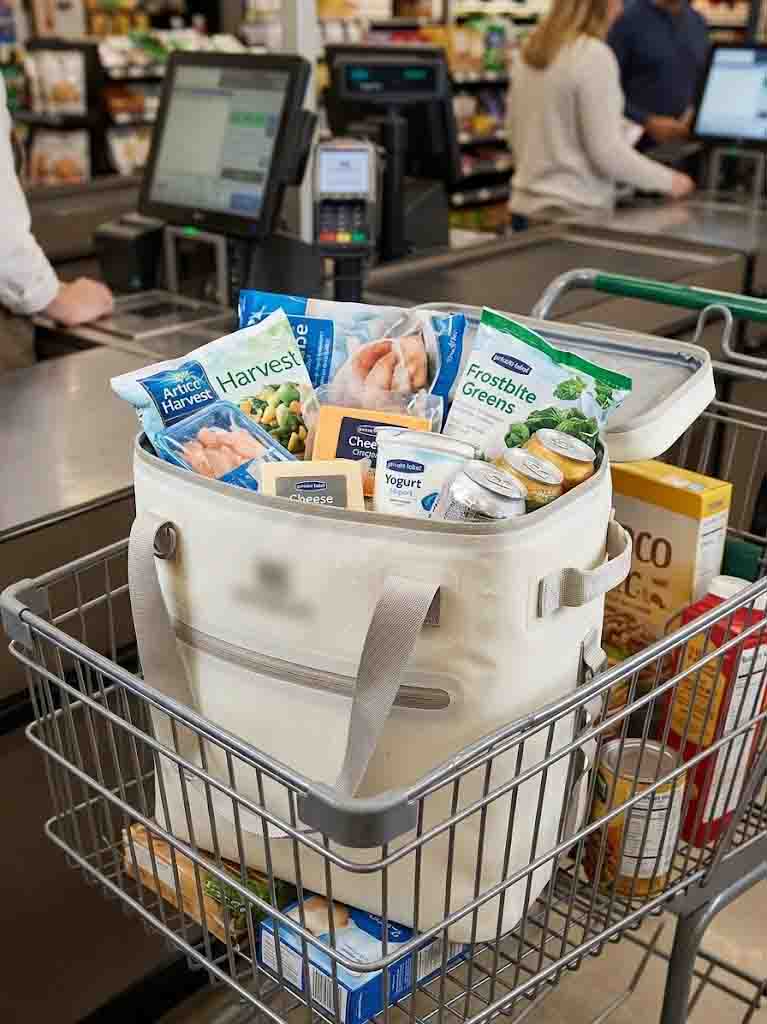
Private-label grocery cooler bag loaded with chilled goods standing upright in a shopping cart

Figure 1: The conditions your OEM spec has to anticipate — a fully loaded bag standing upright in a cart. Spec for this, not for the empty sample on your desk.

1. Load capacity — name it, or the factory assumes it

A weekly grocery shop is heavy — cans, bottles, frozen packs. The most common retail failure is a handle tearing away from the body, and it almost always traces back to a load capacity the buyer never specified, so the factory built the handle anchoring, seams, and base to a lighter default. As the brand buyer, you close this gap by naming a target load in the spec and letting the factory engineer to it: reinforced handle anchoring, welded or heavily stitched seams, and a base built to carry the weight.

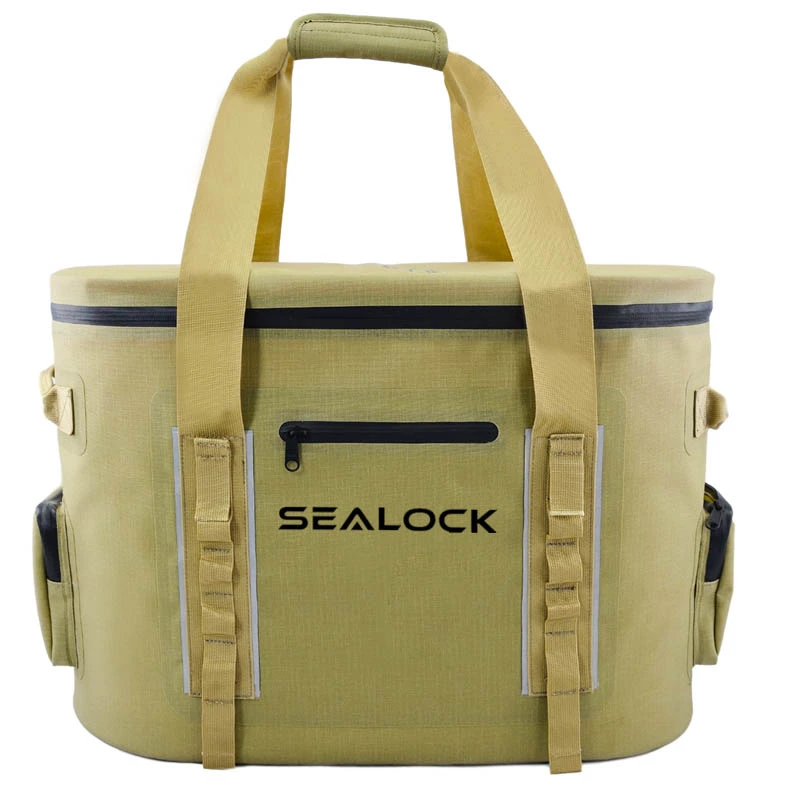
For a concrete reference point, our Softe Cooler Tote (SL-C529) is built to a 40 lb (about 18 kg) load rating, with a widened ribbon handle engineered specifically for that weight rather than added as an afterthought. Whatever number fits your product, write it explicitly into the spec — for example "minimum 18 kg load with reinforced handle anchoring" — so it becomes a build requirement the factory is accountable to. You can see load-rated constructions across the tote soft cooler range.

2. Cleaning method — decide it before sampling

Your retail customer will spill in the bag — a cracked egg, a thawing pack, a burst yoghurt. If the lining traps that or sours, they stop using the bag and blame your brand. The baseline you can specify is a food-safe PEVA lining that wipes clean and rinses without holding odours, which covers the majority of grocery spills and is the standard interior on most of our cooler bags.

If you intend to market full machine-washability as a selling point, treat it as a construction decision you specify up front, not a lining swap at the end: the build has to stop water soaking into and staying in the foam layer, and the seams must survive wash cycles. The actionable rule for you as the buyer is to state the intended cleaning method in your brief — wipe-clean or machine-washable — so the factory selects the lining, foam encapsulation, and seam method to support it. It cannot be retrofitted onto a bag designed to be wiped.

3. A structured stand-up base

A bag that flops over when set down is a minor annoyance in a giveaway and a real usability problem in a retail bag. Picture your customer at the checkout: they need the bag to stay open and upright to pack it one-handed while the belt moves. In the cart and the car boot, a bag that will not stand tips and spills. Specifying a structured or reinforced stand-up base solves all three — it holds the mouth open for loading and keeps the loaded bag stable in transit. For a retail program it is cheap insurance against the "floppy bag" complaint that drives returns, so name it in the spec rather than leaving it to the default pattern.

4. Cart- and checkout-friendly sizing

Sizing is where retail bags quietly fail. If the bag is too tall for a cart child-seat, too wide for a self-checkout bagging area, or too deep to reach the bottom, your customer leaves it at home — which kills the repeat use that justified the program. As the buyer, choose dimensions against the real furniture of a grocery trip: the cart, the checkout belt and bagging shelf, and the shopper's reach.

A practical mid-size reference is around 50 × 30 × 30 cm (the footprint of the SL-C529), which balances meaningful capacity against a shape that loads easily and fits standard carts. Whatever you choose, validate the size physically against a cart and checkout during sampling rather than approving dimensions on a spec sheet alone.

Your OEM spec, in one place

Put these four into your purchase order and the factory designs for retail life rather than for a photo:

 Load capacity — stated target (e.g. 18 kg) with reinforced handle anchoring and base

 Cleaning method — wipe-clean PEVA, or machine-washable construction, stated up front

 Stand-up base — structured/reinforced so empty and loaded bag stays upright

 Dimensions — validated against a cart and checkout during sampling

If you are developing a private-label grocery line, the fastest way to get these right is to give the factory your retail use case — weekly shop, washable, cart-friendly — and have a sample built to it before bulk. You can request a retail-spec sample through our insulated bag catalog, or browse load-rated formats in the soft cooler range.

Private-Label OEM Division — SEALOCK COOLER: This guide is published by YiFuLong Outdoor Gear Co., Ltd. (SEALOCK), a soft cooler manufacturer — not a retailer — producing private-label cooler bags for European and American brands for over 20 years. Our reference model SL-C529 is built to a 40 lb load rating with a food-safe PEVA lining and EPE foam insulation.

With factories in Dongguan, China and Ben Cat, Binh Duong, Vietnam, we offer a dual-origin supply chain for US/EU tariff flexibility, certified across SMETA P4, HIGG, SCAN, GRS, BSCI, and ISO 9001. To develop a retail-spec private-label grocery cooler bag at our 300-piece baseline MOQ, contact our international trade desk: request a retail-spec sample & quote.

Related News
Leave me a message
X
We use cookies to offer you a better browsing experience, analyze site traffic and personalize content. By using this site, you agree to our use of cookies.Privacy Policy
RejectAccept