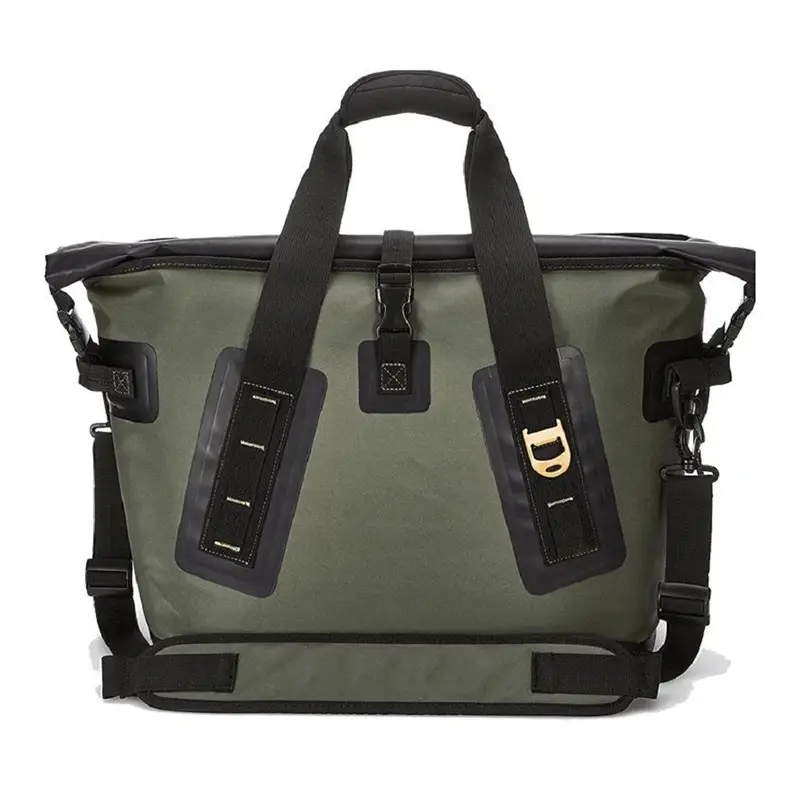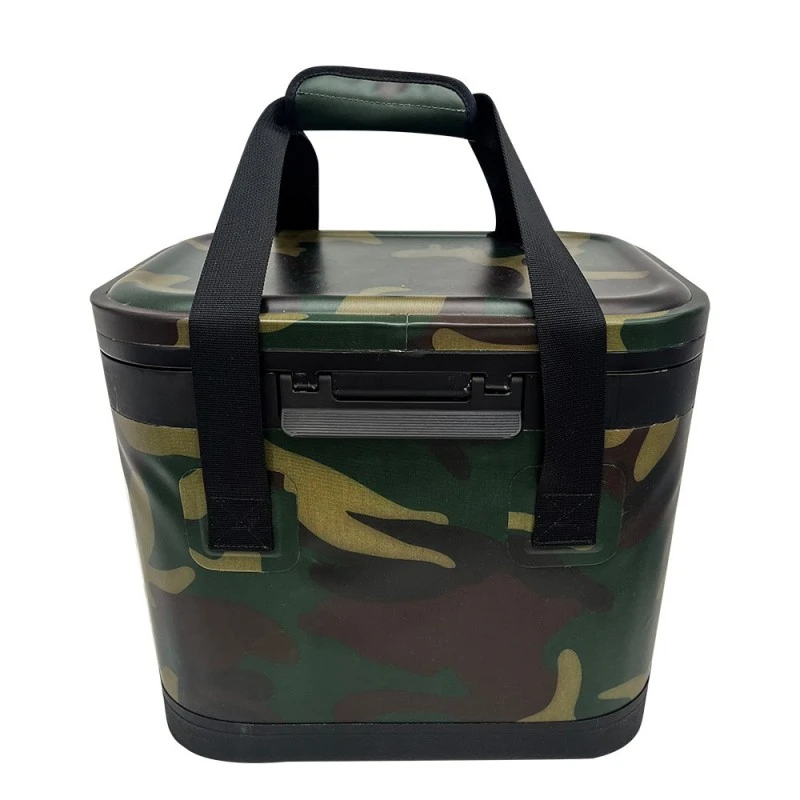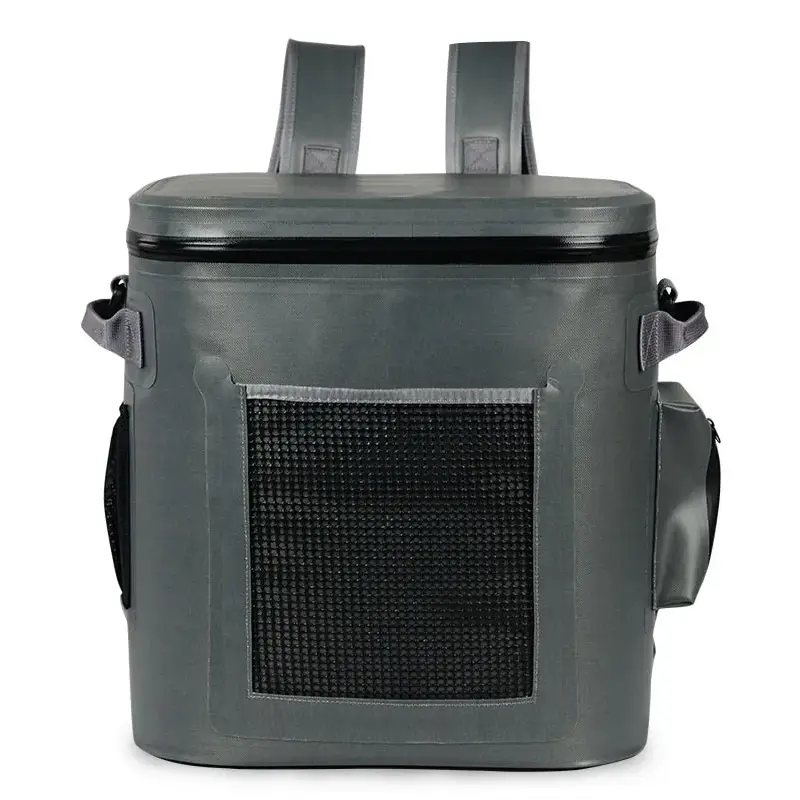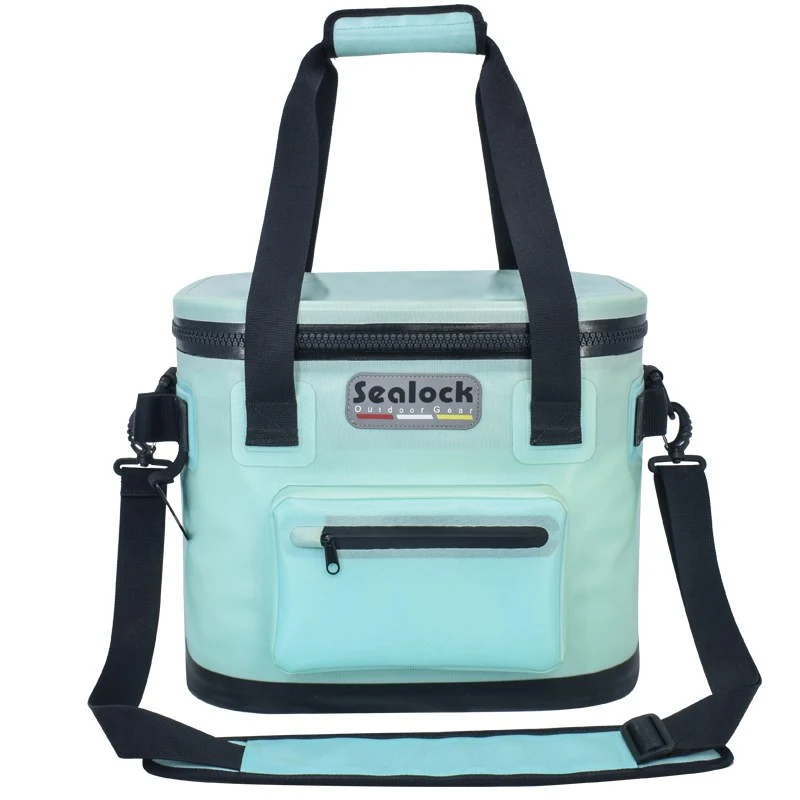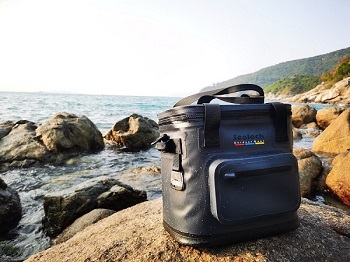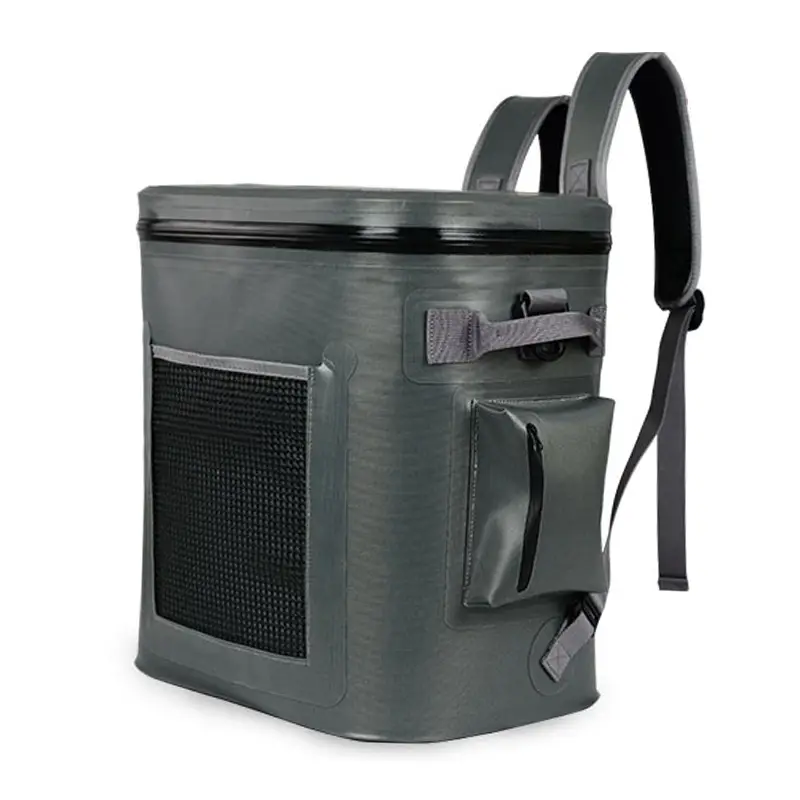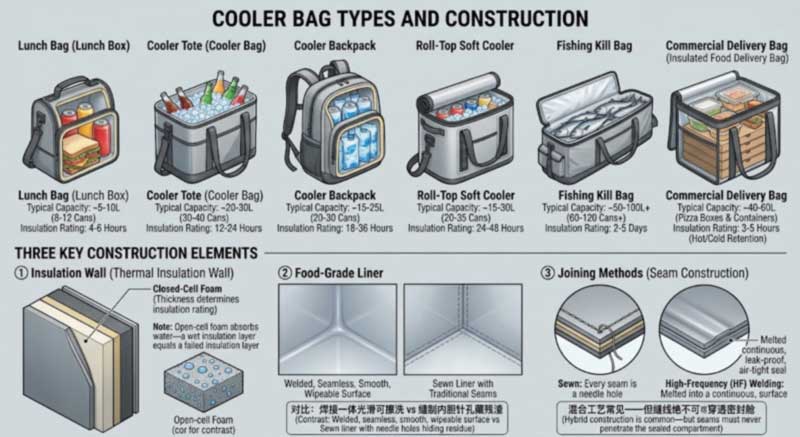
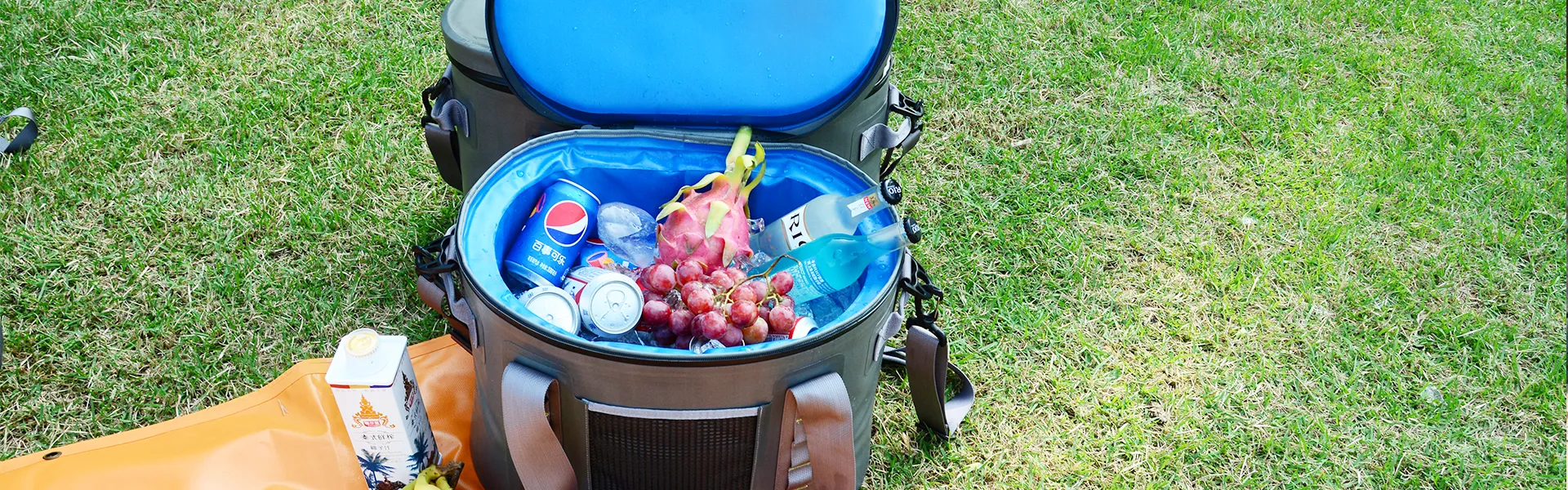
For sourcing managers and product directors in medical logistics, biopharma distribution, and premium food delivery, the engineering question isn't whether a soft cooler looks adequate—it's whether the construction method is actually capable of holding a controlled temperature environment for 48 to 72 hours under real handling and ambient conditions. The answer depends on three things: how the seams are built, what the insulation does when it gets wet, and whether the materials in contact with the payload meet the compliance standards the application requires.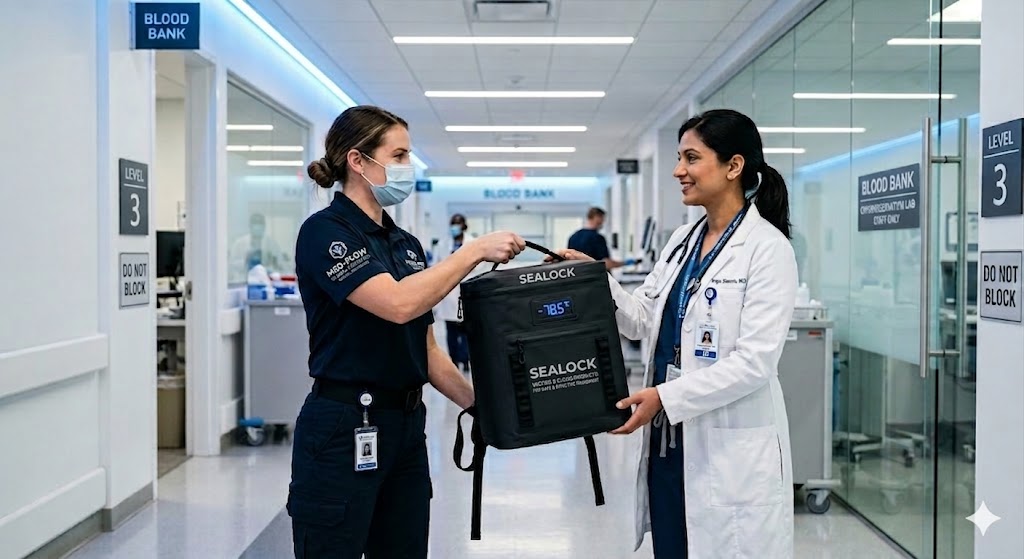
Why Stitched Construction Is Structurally Incompatible With Cold Chain Requirements
The problems with stitched soft coolers in cold chain applications aren't performance failures in the consumer sense—a warm drink, a melted ice pack. They're structural failure modes that compromise both thermal integrity and biological safety simultaneously.
Every needle pass through a waterproof membrane creates a perforation. A typical seam generates several hundred of these perforations per meter of seam length. Seam tape covers these holes adequately under stable, low-stress conditions. Under the thermal cycling that occurs during cold chain use—repeated transitions between refrigerated storage, ambient loading environments, and vehicle cargo areas—tape adhesive bonds expand and contract at different rates than the underlying TPU. Over time, and often within a single shipment lifecycle, bond edges lift and the perforations underneath become active leak pathways.
Two consequences follow, and they compound each other.
The first is thermal bridging. Compromised seams allow cold air to escape and ambient heat to infiltrate at the seam line—the exact locations where structural weakness and thermal vulnerability coincide. Ice retention times drop not because the insulation has degraded but because the shell is no longer hermetically sealed. A bag rated for 48-hour ice retention under controlled test conditions may deliver 20 hours in real logistics handling.
The second is a biological hazard that receives less attention but carries real compliance risk. When melted condensation or payload moisture seeps through a compromised seam into the space between the liner and the insulation foam, it cannot drain or dry. In the enclosed, dark, damp environment between liner and foam, mold and bacterial growth follow predictably. For bags used in medical transport or fresh food logistics, this is not an abstract contamination risk—it's a direct violation of the sanitary standards the application requires and a liability that falls on the brand whose name is on the product.
These are structural outcomes of the construction method, not quality control failures. A well-made stitched cooler has the same failure pathways as a poorly made one; the timeline to failure differs, the failure mode doesn't.
RF Welding at 27.12 MHz: How the Hermetic Seal Is Actually Achieved
Radio Frequency (RF) welding—also called High-Frequency or HF welding—solves the stitched seam problem by eliminating the seam as a distinct structural element. The join zone becomes continuous material rather than two panels held together by thread.
The process works through internal heating rather than surface conduction. When TPU materials are placed within an alternating electromagnetic field at 27.12 MHz—the ISM frequency band designated for industrial RF welding equipment—the polar molecules within the TPU attempt to realign with each oscillation of the field: approximately 27 million times per second. The friction from this molecular movement generates heat uniformly throughout the material at the weld zone. Under simultaneously applied pneumatic pressure, the material at the interface between two panels reaches fusion temperature and the layers merge at the molecular level.
When the field is removed and the material cools under sustained pressure, the interface between the two original panels has disappeared structurally. The weld zone is a single piece of material. In destructive pull testing, this zone typically fails in the base fabric before the weld line itself gives way—the weld is not the weak point.
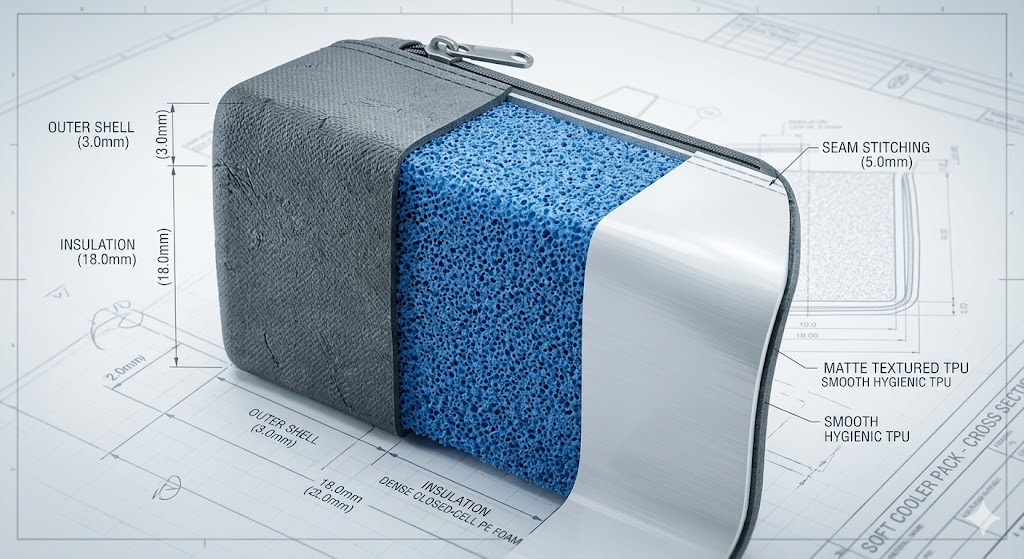
For cold chain applications specifically, what this construction method provides is a hermetic interior basin with no penetration pathways. There are no needle holes, no tape edges, no folded seam channels where fluids can accumulate. The smooth, continuous TPU interior surface can be wiped down or sterilized with medical-grade disinfectants without concern for penetrating a compromised seam. Condensation, melted ice water, and spilled medical fluids stay on the surface—they don't migrate into the insulation cavity. That's the structural basis for the biological safety claim, not a material property of the TPU alone.
The same construction logic applies to the hydrostatic performance claim. An RF welded soft cooler, properly manufactured and tested, holds 1.0 Bar of internal pressure without micro-bubble emission from any seam or closure point. That corresponds to the hydrostatic pressure of a 10-meter water column—well beyond the physical stresses of logistics handling—and it confirms that the hermetic seal holds under conditions more demanding than any last-mile delivery scenario will produce.
Closed-Cell Foam: The Thermal Engineering Behind 48 to 72-Hour Hold Times
A hermetic outer shell addresses the seam failure problem. Sustaining controlled temperatures for 48 to 72 hours under adverse ambient conditions requires the insulation layer to do its job continuously—which means it needs to keep doing its job even when it gets wet.
Open-cell foam has an interconnected internal structure. When moisture enters—from condensation, minor liner damage, or the humid environment of repeated loading cycles—it spreads through the foam matrix and stays there. Wet open-cell foam loses thermal resistance rapidly; the insulating effect of trapped gas is replaced by the thermal conductivity of water. For a bag rated on dry-condition ice retention testing, field performance will be significantly worse once the insulation has absorbed moisture.
Medical-grade soft coolers use high-density closed-cell foam—NBR (nitrile butadiene rubber) or premium high-density EVA are the relevant grades—where each gas bubble is fully sealed from its neighbors. Heat transfer through convection within the foam is eliminated because there's no pathway for air or fluid movement between cells. Conductive heat transfer is minimized by the gas fill of each sealed cell. This produces measurably higher R-values than open-cell alternatives at equivalent thickness.
The moisture behavior is equally important. Closed-cell foam is inherently waterproof at the material level—the sealed cell structure physically prevents water absorption regardless of exposure. A bag that experiences internal condensation over a 72-hour shipment will have insulation performing at the same R-value at hour 72 as at hour one. That consistency is what makes 72-hour temperature hold specifications achievable and verifiable rather than aspirational.
For applications requiring specific temperature windows—2°C to 8°C for biologics, sub-zero for certain pharmaceuticals—the combination of foam density, foam thickness, and phase change material volume can be engineered to maintain a defined range under specified ambient conditions. This is a specification conversation, not a fixed product parameter; the relevant variables are all tunable within the manufacturing framework.
The structural benefit is secondary but worth noting for medical applications specifically: high-density closed-cell foam provides meaningful impact protection for fragile vials, glass containers, and prefilled syringes without requiring a rigid outer shell. The foam acts as distributed cushioning across the load, reducing peak impact forces at any single contact point.
TPU Material Specifications: What FDA and REACH Compliance Actually Requires
For soft coolers used in medical transport or food-grade logistics, the material in direct or indirect contact with the payload needs to meet defined regulatory standards—not just avoid the most obvious problematic substances, but carry documented compliance for the specific application.
The relevant material for both exterior shell and interior liner in medical-grade soft coolers is 840-Denier TPU-coated nylon. PVC is the legacy alternative and is meaningfully cheaper; it is also increasingly incompatible with the regulatory environment these products operate in. PVC plasticizers—typically phthalate-based—are restricted under California Proposition 65 and EU REACH regulations. PVC also becomes brittle at low temperatures, which creates material integrity risk in cold chain applications that use dry ice or reach sub-zero cargo environments.
TPU avoids both problems. It maintains flexibility to -30°C, which covers the full range of cold chain temperature requirements. It is compatible with BPA-free and PFAS-free formulations, and food-grade TPU grades carry FDA compliance for direct food contact. For the interior liner specifically—the surface that contacts ice, ice packs, and potentially the payload itself—FDA-compliant, BPA-free, antimicrobial TPU is the material specification that meets medical and food-grade logistics requirements.
The chemical resistance profile of TPU is also relevant in medical applications: it holds up to the concentrated disinfectants used for between-use sterilization, including alcohol-based solutions that would degrade lesser liner materials over time. A liner that can be wiped down aggressively between shipments without surface degradation maintains its hygienic properties across a realistic product service life rather than just at initial deployment.
When evaluating an OEM partner for medical cold chain applications, the relevant documentation includes FDA compliance certificates for interior liner materials, REACH test reports confirming the absence of restricted substances, and BPA/PFAS-free material declarations specific to the production batch—not just the supplier's general material line. These documents should be available on request as part of standard material onboarding, not assembled in response to a specific audit inquiry.
Selecting an OEM Partner for Medical Cold Chain Applications
The engineering requirements for a genuine medical-grade soft cooler—RF welded hermetic construction, closed-cell foam insulation, FDA-compliant TPU liners—are well-defined. What varies is whether a specific manufacturing partner executes against those requirements with the process discipline and documentation infrastructure that medical and food-grade logistics applications demand.
The audit questions that matter: Does the facility pressure-test seams per-unit or by batch sampling—and to what Bar rating? Can they provide FDA compliance documentation for the specific interior liner material going into your product, not just their general material range? How is closed-cell foam sourced and is density validated on incoming material batches? Is the RF welding parameter set documented per material specification, and how is compliance verified across production volume?
A manufacturer with genuine capability in this application space will answer these questions in operational detail. The engineering behind 72-hour temperature hold performance under real logistics conditions is specific, verifiable, and not particularly difficult to describe—which means vague answers are meaningful information in themselves.
Frequently Asked Questions
What is the main advantage of RF welding over stitching in medical soft coolers?
RF welding fuses TPU panels at the molecular level, producing a continuous hermetic interior with no needle holes, no seam tape, and no penetration pathways for moisture or contamination. For medical and food-grade applications, this eliminates both the thermal bridging that reduces ice retention and the biological contamination risk created when moisture infiltrates the insulation cavity of a stitched bag. The interior surface of an RF welded cooler can be fully sterilized; the insulation cavity of a stitched cooler cannot.
Can closed-cell foam coolers reliably maintain temperature for 72 hours?
Under the right conditions, yes—but the specification needs to be precise about what those conditions are. High-density closed-cell foam, combined with an RF welded hermetic shell and airtight closure, maintains its rated R-value continuously because the foam doesn't absorb moisture that would degrade its thermal resistance. Actual hold time depends on ambient temperature, payload mass, phase change material volume, and how frequently the bag is opened. For specific temperature windows—2°C to 8°C for biologics, for example—these variables can be modeled and tested against defined ambient conditions to produce a verifiable performance specification.
Are TPU soft coolers compliant for transporting biologics and vaccines?
Food-grade, FDA-compliant TPU formulations meet the material requirements for biological and vaccine transport applications. The relevant specifications are BPA-free, PFAS-free, and FDA-compliant for food contact—which for medical applications is the relevant baseline standard. The interior liner also needs to be chemically resistant to the disinfectants used for between-use sterilization. Compliance documentation should be specific to the liner material and production batch used in your product, not a general capability claim from the supplier.