News

Custom Insulated Cooler Backpacks: Spec Your Foam, Liner & Capacity

2026-07-24 0 Leave me a message

Three specifications decide whether a custom insulated cooler backpack performs: the foam that resists heat, the liner that contains food and meltwater, and the capacity that has to match how the bag is actually used. Shell fabric and branding get most of a buyer's attention, but they do not keep ice frozen. This guide goes through each of the three in engineering terms—what the material options really deliver, where buyers overspend on one axis while undermining it on another, and how to write a specification that produces the product a brand intended. Sealock (YiFuLong Outdoor Gear Co., Ltd.) builds welded insulated cooler backpacks to custom spec across all three axes.

Axis 1: The Foam — Choosing an Insulation Tier

The foam core is the primary thermal barrier, and the choice is a genuine trade-off between insulating power, weight, flexibility, durability and cost. There is no single best foam—only a right tier for a defined use.

Understanding the R-value tiers

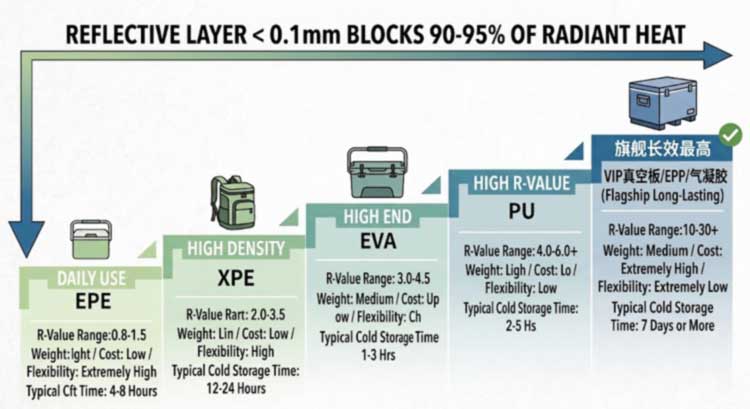
Published R-values give a workable ranking, though figures vary by test method and density, so treat them as tiers rather than absolutes. One materials guide puts the common cooler foams at roughly R-1.5 per inch for PE foam, R-2 for XPE, R-3.5 for PU, and R-5 to R-7 for vacuum insulation panels, while a buyer's guide reports higher figures for the same families—closed-cell PU or XPE around R-6.0 per inch, with EPE and EPS between R-3.6 and R-4.2 per inch. The absolute numbers differ; the ordering does not. PE and EPE sit at the accessible end, XPE and EVA in the middle, PU higher, and vacuum panels in a class of their own.

What each foam is actually good for

The practical differences matter more than the decimal places:

  • EPE (expanded polyethylene) — the volume standard. A factory guide states plainly that high-density EPE between 5 mm and 8 mm with a heat-sealed PEVA liner suits about 80% of commercial cooler bags on cost-efficiency and flexibility, while XPE is superior for outdoor coolers needing 12-plus hours of ice retention. Its weakness is compression: EPE is lighter and cheaper but compresses permanently after repeated folding, whereas PU and XPE retain thickness and thermal resistance even after 100-plus fold cycles.
  • XPE (cross-linked polyethylene) — denser and far more compression-stable. Testing bears this out: XPE retains 90% of its thickness after 10,000 compression cycles versus 75% for standard PE, and XPE/foil laminates outperform plain PE foams by 20–30% in standardized ice-melt tests. A wall that keeps its thickness keeps its rated performance for the product's life.
  • EVA—denser closed-cell structure, better compression resistance and a more premium feel; typically used in higher-end coolers where insulation performance and durability both matter. Thermal conductivity sits around 0.04 W/mK.
  • PU (polyurethane) — the highest foam R-value, but rarely used in soft bags because of processing limitations. It appears in soft coolers as thin semi-rigid panels rather than a flexible wall.
  • VIP (vacuum insulation panels), EPP and aerogel—the premium tier, delivering the longest hold per millimeter. They cost more, add rigidity and require careful structural design, which is why they suit flagship long-hold products rather than volume lines.

Thickness, and the reflective layer buyers forget

Thickness scales the hold roughly linearly, and it is the cheapest lever available — but it costs bulk, weight and shipping volume, so it should be specified to a target rather than maximised. A documented reference point: an 8 mm EPE bag with aluminum foil kept ice packs below 10°C for 6.5 hours and hot food above 50°C for 4.2 hours at 25°C ambient. That is the honest performance envelope of a thin-walled day bag — a 48-hour cooler needs a wall measured in tens of millimeters, not single digits.

The cheapest performance gain in the whole build is the radiant barrier. A reflective layer under 0.1 mm thick adds negligible weight but cuts radiant heat by 90–95%. On a cooler that sits in the sun, laminating a metallized film into the wall buys real hours for almost no bulk.

Matching tier to use: One industry guide maps it usefully—lightweight PE plus foil for 3–4 hour food-delivery holds, PU or EVA with foil for 6–8 hour cold-chain transport, and premium EVA for full-day outdoor use. Extend that ladder and a 24-hour daypack runs closed-cell EPE, a 48-hour expedition pack a thick high-density XPE wall, and a multi-day flagship a premium panel.
cooler backpack insulation foam tiers from EPE and XPE to EVA, PU and vacuum panels with R-value and use-case comparison

Axis 2: The Liner — Food Contact and Containment

The liner does two jobs at once: it is the food-contact surface, and it is the vessel that holds meltwater. Both have to be specified.

The material options

Three materials dominate, positioned differently: PEVA covers most standard applications, TPU targets premium performance, and PVC remains a low-cost alternative with compromises. The differences are concrete:

Liner Strengths Limits Typical fit
PEVA Chlorine-free, food-safe, odourless, wipe-clean, cost-efficient; passes FDA 21 CFR 177.1350 migration testing and resists odours and stains better than PVC Stiffer hand, lower abrasion life; hydrostatic head around 1,000–2,000 mm and Martindale roughly 10,000 cycles Volume and mid-range coolers
TPU Tear-resistant, recyclable, far higher waterproofing—TPU-laminated constructions reach 10,000+ mm hydrostatic head; stays flexible in cold where other materials turn brittle Highest liner cost — PEVA material costs 30–50% less than TPU laminates Premium, marine, cold-weather, long-life
PVC Cheap and waterproof Regulatory exposure — PVC contains phthalates and faces restrictions in EU markets and under California Proposition 65, with PEVA the non-chlorinated food-safe alternative Budget lines only; avoid for regulated retail

A useful extra: metallized TPU films can reflect heat, keeping cooler contents chilled longer — so on a premium build the liner and the radiant barrier can be one component rather than two.

The seam is the liner spec that actually decides leakproofing

This is where most specifications quietly fail. A cooler-bag factory puts the distinction bluntly: if the lining is not heat-sealed, the bag is leak-resistant rather than leakproof—once ice melts, water finds the needle holes at the bottom gusset. A stitched liner in a bag sold as leakproof is a warranty claim waiting to happen, regardless of how good the foam is.

The same source makes the integration point that most buyers miss: pairing premium foam with a stitched liner wastes the foam investment—premium foam belongs with a welded lining. The three axes are not independent. A 50 mm high-density wall behind a stitched PEVA liner and a non-sealing zipper will underperform a modest wall built into a properly welded, airtight envelope.

Buyer tip — the four questions that define a cooler: One manufacturer's advice is worth adopting verbatim as a purchasing habit: before confirming production, ask about foam type, foam thickness, lining type and seam method rather than judging from photos or dimensions. The same "24L cooler backpack" can be built four completely different ways, and only those four answers tell them apart.

Sealock specifies food-grade TPU or PEVA liners to the destination market's food-contact requirement, welded rather than stitched, with the liner integrated into the high-frequency welded body so the containment chamber is continuous. For the welding engineering behind that, see Waterproof Cooler Backpack Manufacturer: HF-Welded, Seam-Free Builds.

Axis 3: Capacity — Sizing to the Load, Not the Number

Capacity looks like the easy specification and is routinely the one that misses. The mistake is speccing litres in the abstract instead of working backward from what one user carries on one outing—and from the fact that a cooler is not a container of food, it is a container of food and ice.

Ice occupies the volume you sell

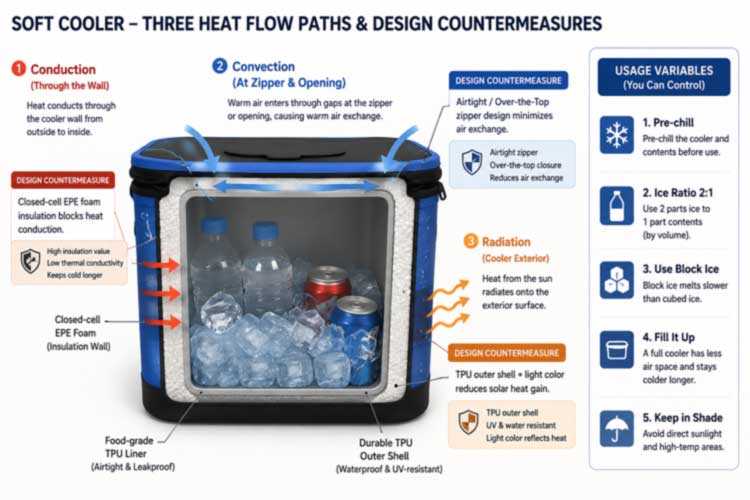
Standard cooler practice loads roughly two parts ice to one part contents. That means a 24L cooler is not a 24L lunch box — a substantial share of the volume is coolant. A brand advertising "holds 30 cans" should be clear whether that figure is with or without ice, because the honest packing reality is very different from the maximum-capacity photo. Specifying capacity therefore means specifying the intended payload first, then adding the coolant volume needed for the target hold.

Capacity drives the harness, and the harness drives the design

Weight scales with volume faster than buyers expect once ice is included, so the carry system has to be engineered alongside the litres rather than added afterwards:

Capacity Realistic payload (with ice) Use case Carry system required
12–15L One person, one day Commute, lunch, solo outing Padded straps sufficient
18–22L One to two people, or a long solo day Hike, beach, cycling, travel Padded straps + sternum strap
24–30L+ A group day, or two days solo Group camping, tailgate, expedition Full harness: sternum + waist belt

Interactions with the other two axes

Capacity is not independent of foam and liner — three interactions are worth designing around. First, a thicker wall shrinks the interior: a 50 mm insulation wall consumes far more external volume than an 8 mm one, so a brand chasing both maximum internal litres and maximum cold-hold will get a physically large bag. Second, empty air accelerates warming, so a cooler-sized well above its usual load underperforms a correctly sized one—oversizing is a real thermal cost, not just a bulk cost. Third, internal geometry beats raw litres: dimensions tuned to stand bottles upright or hold a specific can count make a cooler feel purpose-built. Offering one design in multiple sizes covers several use cases from a single development, though MOQ normally applies per size.

 cooler backpack capacity cross-sections showing ice-to-contents load and how wall thickness reduces internal volume   

Writing the Spec: A Worked Example

The three axes have to agree with each other. Two coherent specifications, at different positions:

24-hour day pack 48-hour expedition pack
Foam Closed-cell EPE, moderate wall High-density XPE, 40–50 mm wall
Radiant barrier Optional metallised film Metallised film or metallised TPU liner
Liner Food-grade PEVA, welded Food-grade TPU, welded
Closure Zip-around or molded lid, fast access Airtight welded zipper
Capacity ~18–25L, straps + sternum ~22L, full harness with waist belt
Positioning Beach, camping, daily, volume price point Marine, expedition, premium price point

Notice that each column is internally consistent. Upgrading only the foam on the left-hand column, while keeping a stitched liner and a loose closure, buys very little. Specification quality comes from coherence, not from maximising one line item.

Real Builds Across the Three Axes

These Sealock coolers resolve foam, liner and capacity differently—chosen by fit, not ranked:

Image Model Foam Capacity & hold Link
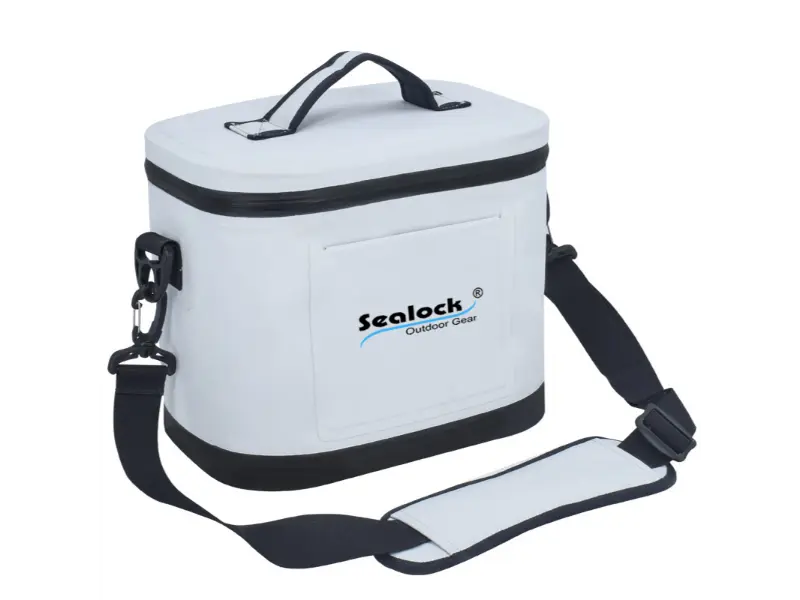
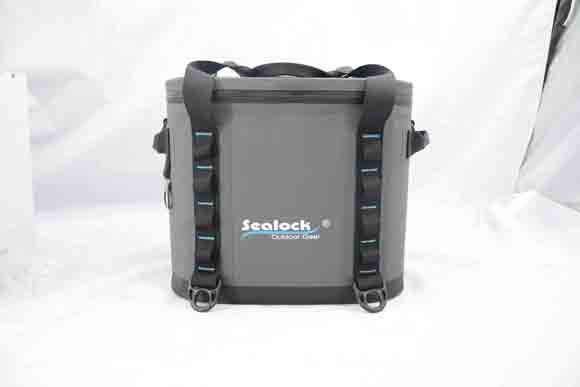
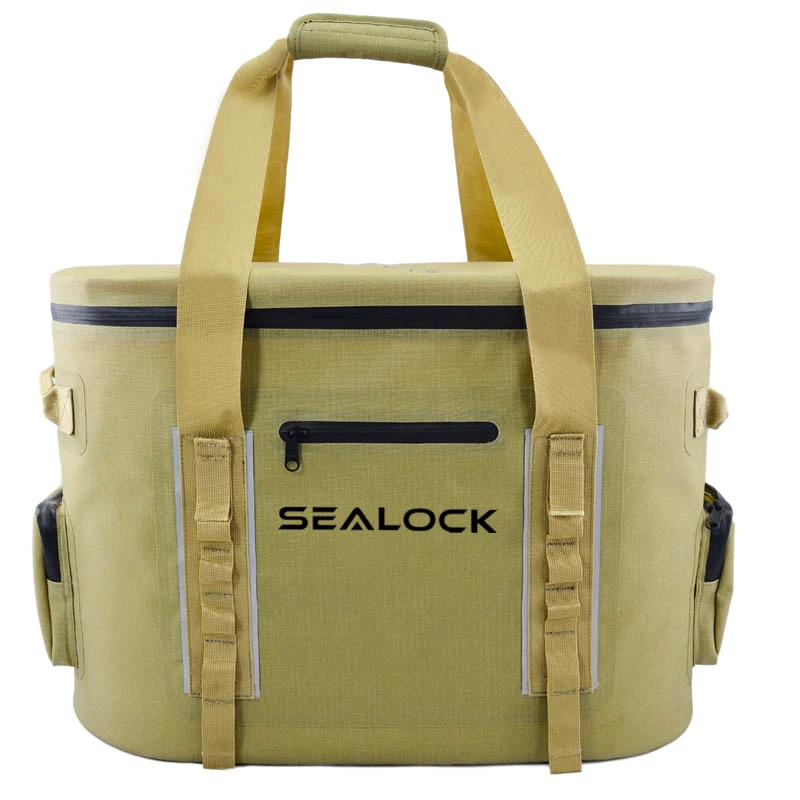
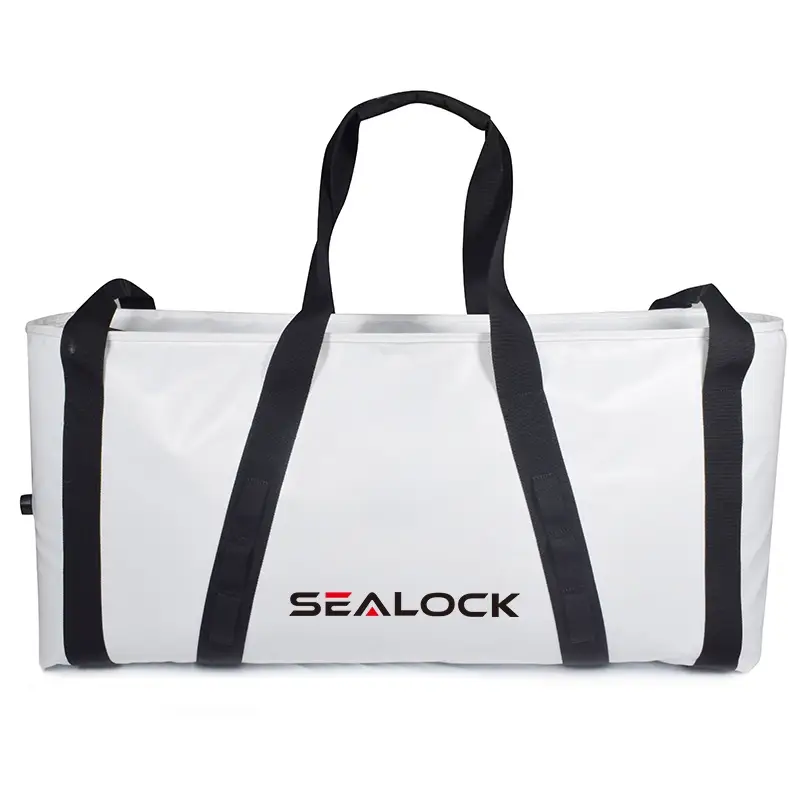
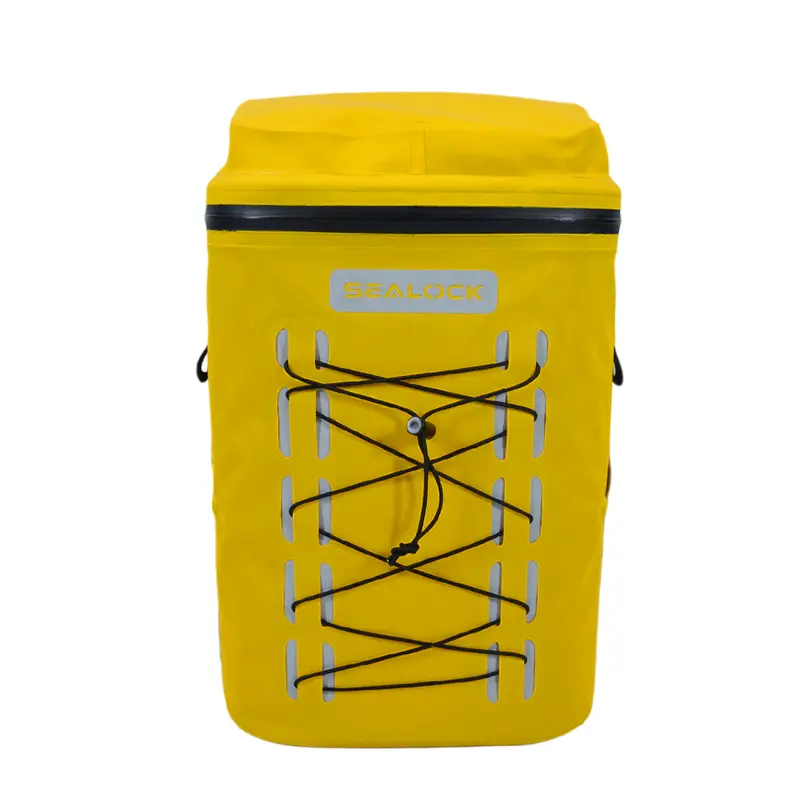
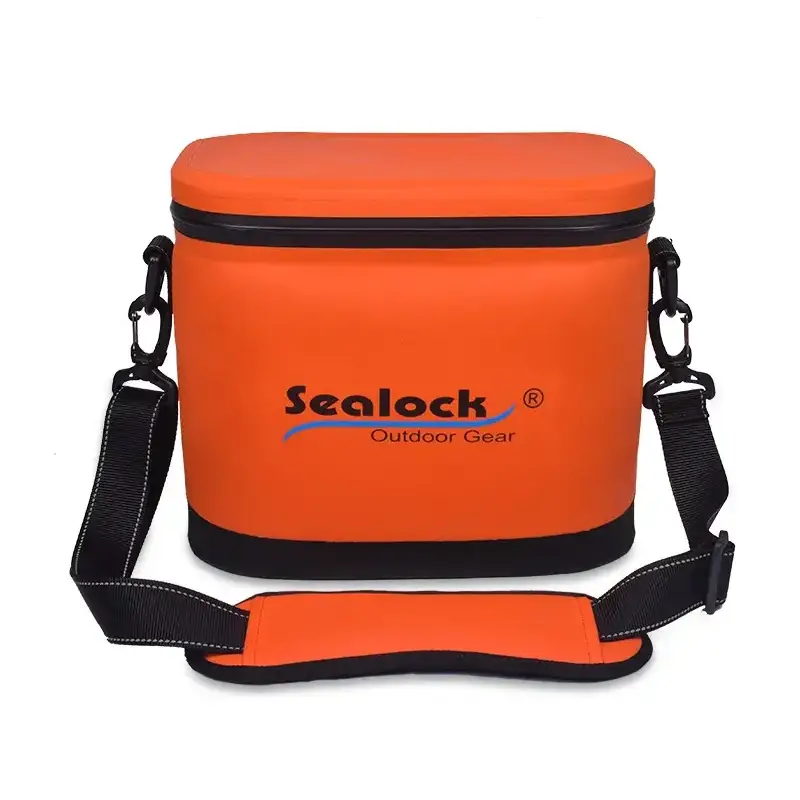
24L leakproof soft cooler SL-I094 24L Leakproof Soft Cooler (SL-I094) EPE, upgradeable to PU / VIP panel / EPP / aerogel 24L, 48 hr+ View
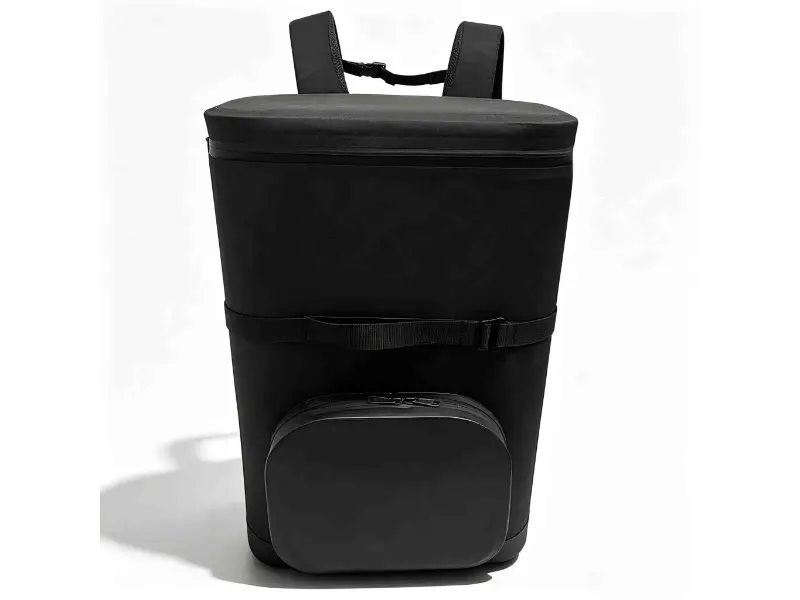
22L IPX7 cooler backpack SL-I280 22L IPX7 Cooler Backpack (SL-I280) 50 mm high-density XPE 22L, 48 hr+, full harness View
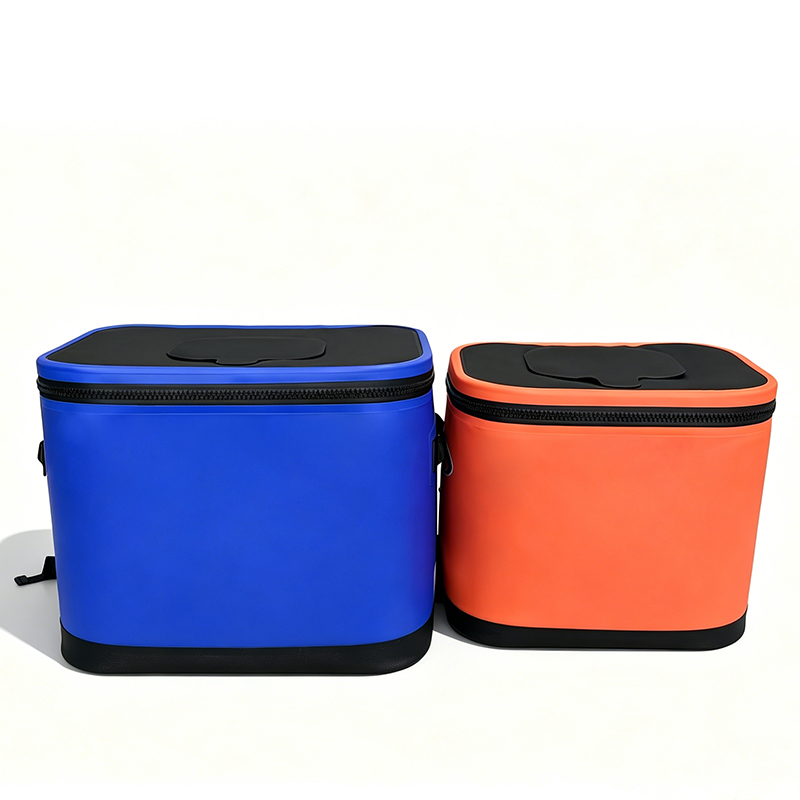
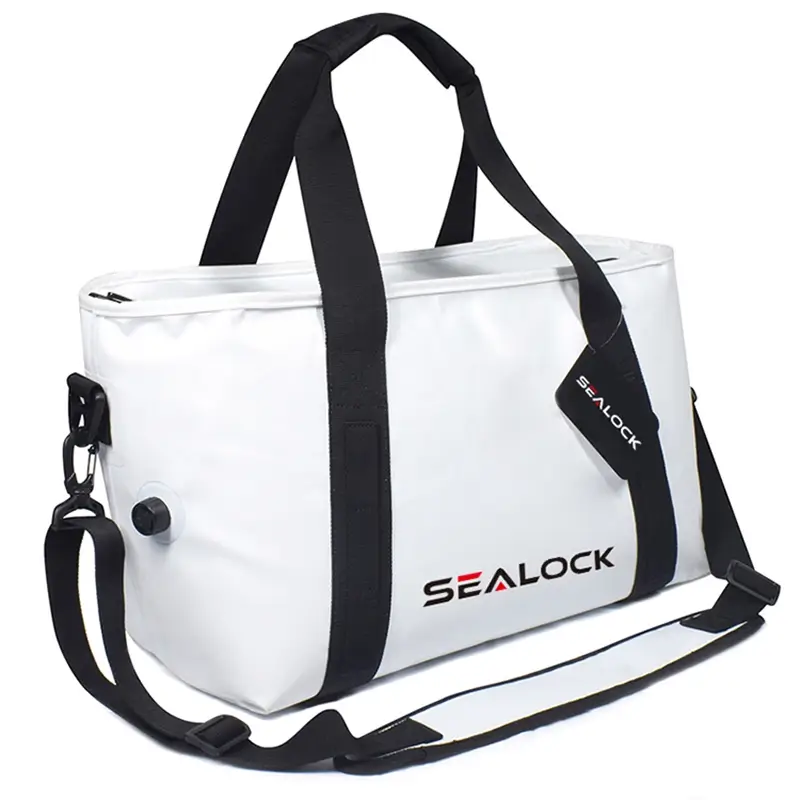
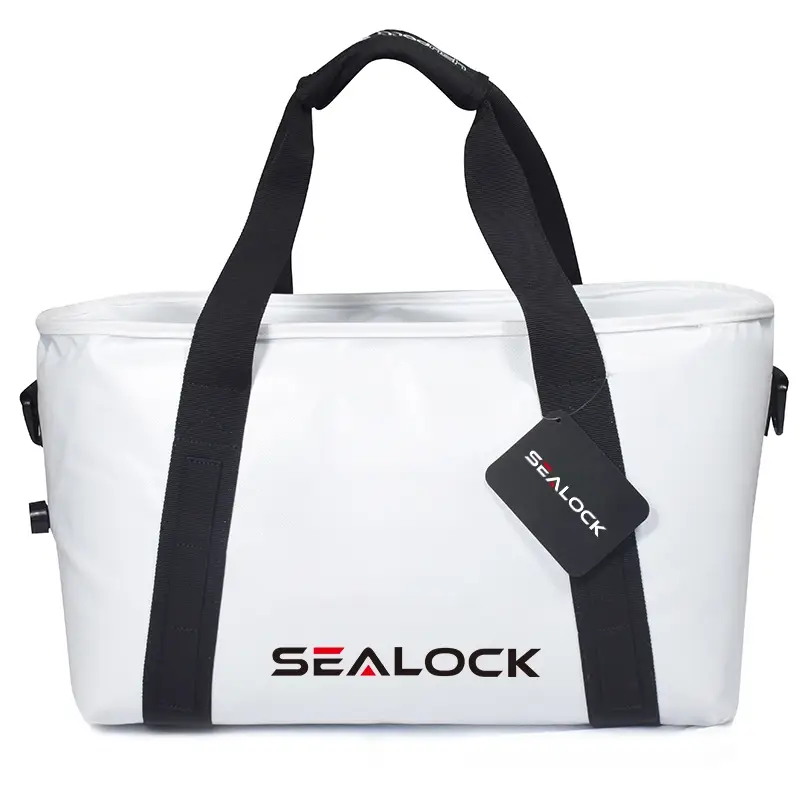
Insulated soft cooler backpack SL-E050B Insulated Cooler Backpack, molded lid (SL-E050B) Closed-cell EPE ~25L, ~24 hr, two sizes View
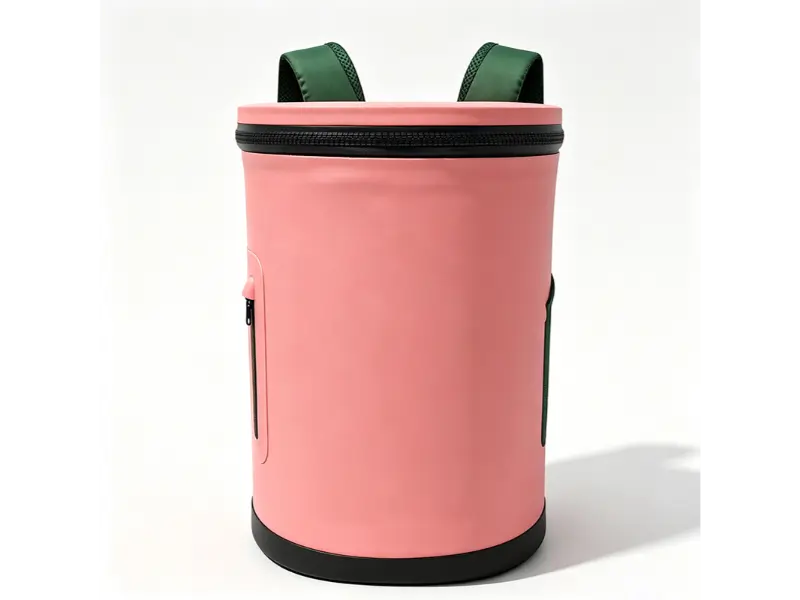
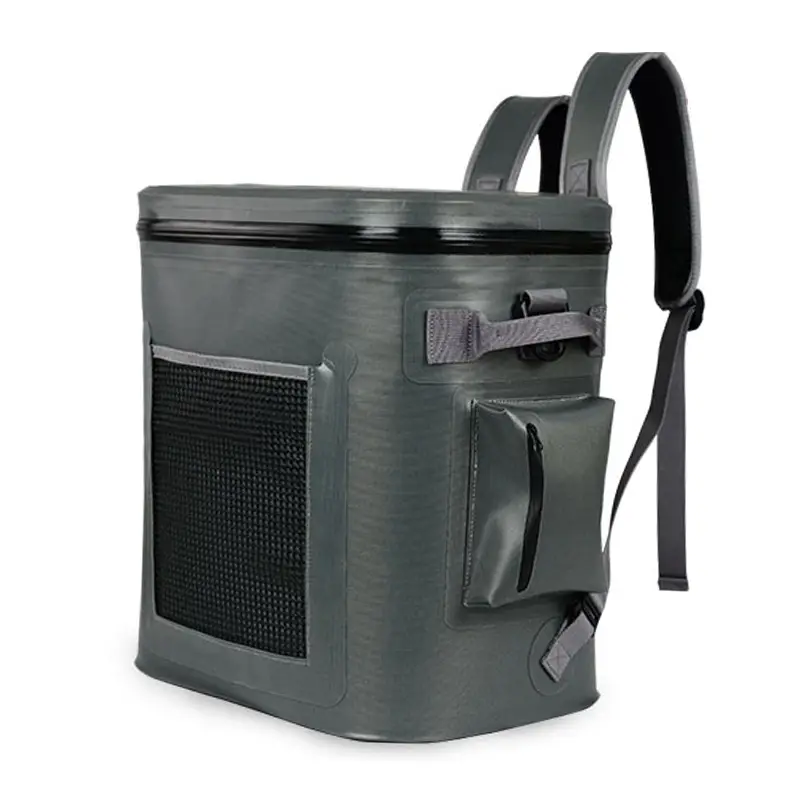
Barrel insulated cooler backpack SL-I309 Barrel Insulated Cooler Backpack (SL-I309) Closed-cell EPE ~18L, ~24–36 hr, sternum + waist View
12-20L TPU waterproof soft cooler SL-I032 Waterproof Soft Cooler 12/15/20L (SL-I032) 20–25 mm XPE 12 / 15 / 20L size ladder, 48 hr+ View

How Far the Customization Goes

All three axes are open, and demanding briefs are welcome rather than a problem. Beyond selecting from the tiers above, Sealock develops ground-up from a sketch, sample or performance target: a brand states the cold-hold hours, seal rating, capacity and market, and the factory engineers the foam type and wall thickness, the liner material and its food-contact compliance, the closure, the pattern and the harness to reach it — then proves it with immersion and cold-hold testing before production. Premium insulation up to VIP vacuum panels and aerogel, IPX6–IPX8 welded seal levels, metallised liners, bespoke hardware and strict compliance targets are all inside scope; a genuinely difficult specification is exactly what an in-house welding and development team exists to solve. Ground-up work runs longer than editing a stock platform, so book against a launch date.

Foam options Closed-cell EPE, XPE, EVA; PU, VIP vacuum panel, EPP, aerogel on premium builds
Wall thickness Specified to a target cold-hold, from thin day-pack walls up to 50 mm
Liner Food-grade PEVA or TPU, welded; metallised film option; to 21 CFR / LFGB as required
Capacity ~12L to 30L+, one design available in multiple sizes (MOQ per size)
Validation Full water-immersion testing; cold-hold testing; AQL and gold-sample sign-off
MOQ / lead time 300 pcs per design; samples 7–15 days; production 30–45 days; FOB Guangdong
Origin China or Vietnam on the same spec

For the wider customization menu see OEM Soft Cooler Backpacks: What You Can Customize Beyond Logo & Color; for shell materials, sizing and branding see Custom Soft Cooler Backpacks: Materials, Sizes & Branding Options; and for the cold-retention engineering behind the foam choices, see Insulated Cooler Backpack Manufacturer: EPE Foam & Cold-Retention Design.

FAQ: Speccing a Custom Insulated Cooler Backpack

Q: Which insulation foam should I choose for a custom cooler backpack?

A: Match the tier to the target hold. High-density EPE at 5–8 mm with a heat-sealed liner covers the large majority of commercial cooler bags on cost and flexibility; XPE is the better choice for outdoor coolers needing 12-plus hours, being denser and far more compression-stable; EVA suits premium builds; and vacuum panels, EPP or aerogel belong on flagship long-hold products. Specify the hours you want to advertise and let the factory engineer backward to the foam and thickness.

Q: What is the difference between EPE and XPE foam in practice?

A: Durability of the wall over time. EPE is lighter and cheaper but compresses permanently with repeated folding, while XPE retains its thickness and thermal resistance after 100-plus fold cycles, holding around 90% of thickness after 10,000 compression cycles versus about 75% for standard PE. Since a wall that thins loses its insulating value, XPE is the choice where the cooler will be packed, folded and loaded repeatedly.

Q: PEVA or TPU liner — which should I specify?

A: PEVA is the food-safe volume standard: chlorine-free, wipe-clean, FDA migration-tested and roughly 30–50% cheaper than TPU laminates. TPU costs more but offers far higher waterproofing, better tear resistance and flexibility in cold weather, which suits premium, marine and long-life products. PVC is cheaper still but carries phthalate-related restrictions in the EU and under California Prop 65, so it is best avoided for regulated retail.

Q: Why is my "leakproof" cooler still leaking?

A: Almost always the seams, not the material. If the liner is stitched rather than heat-sealed, the bag is only leak-resistant — once ice melts, water finds the needle holes at the bottom gusset. Premium foam behind a stitched liner and a non-sealing zipper wastes the foam investment; the liner, seams and closure have to be welded as one continuous envelope.

Q: How do I choose the right capacity?

A: Work backward from one user's actual load for one outing, then add coolant volume — standard practice is roughly two parts ice to one part contents, so a share of the litres is ice, not payload. Match the harness to the size (padded straps up to about 15L, a sternum strap from 18–22L, a full waist belt at 24L and above), and remember that a thicker insulation wall reduces internal volume for the same external size.

Q: What should I ask a supplier before confirming production?

A: Four questions decide the product: foam type, foam thickness in millimetres, liner material, and seam method (welded or stitched). Photos and outer dimensions cannot distinguish two very differently built coolers. Add a fifth for performance claims — on what test basis is the cold-hold figure stated, and is the IPX rating immersion-validated.

Ready to spec a custom cooler backpack? Sealock (YiFuLong Outdoor Gear Co., Ltd.) builds welded insulated cooler backpacks to custom foam, liner and capacity specifications, factory-direct from its own welding lines in China and Vietnam, with immersion and cold-hold validation before production. Send your target hold, capacity and market, and the team will spec the wall, liner and size to match — and sample it to prove it.

Email: info@sealock.com.hk  |  Phone: +86-13632981825  |  Browse the soft cooler range

Material properties, R-values, test figures and compliance references cited here reflect publicly available industry and materials sources as of mid-2026; published values vary with density, test method and construction, and real-world performance depends on build, load and conditions. Confirm specifications and food-contact requirements for your destination market on a physical sample before bulk production.

Related News
Leave me a message
X
We use cookies to offer you a better browsing experience, analyze site traffic and personalize content. By using this site, you agree to our use of cookies.Privacy Policy
RejectAccept