News

OEM vs ODM Cooler Backpack Manufacturing: Which Fits Your Brand

2026-08-25 0 Leave me a message
Choosing between OEM and ODM is not a procurement detail — it decides who owns the product you sell, how long it takes to launch, how much capital you commit before the first order, and whether a competitor can buy the same bag from the same factory next season. Both models are legitimate, both are used by successful brands, and the wrong one is expensive in a way that is hard to unwind. This guide compares them for cooler backpack manufacturing specifically, and gives a framework for deciding which fits your brand right now. Sealock (YiFuLong Outdoor Gear Co., Ltd.) works in both models, which is the position from which the comparison can be honest.


The Distinction in One Sentence

Everything else follows from a single question: who owns the product concept? As one sourcing guide puts it: the core difference is who owns the product concept — with OEM, the buyer leads the design; with ODM, the supplier leads the design; and everything else — cost structure, timeline, IP risk, quality control complexity — flows from that single distinction.

In practical terms for a cooler backpack: under OEM you arrive with a design or a full specification and the factory builds it to your brief. Under ODM the factory brings a proven base design — or develops one for you from its own design capability — and you brand and adapt it.

OEM: Control and Ownership, at a Price

What you gain

  • IP ownership. The buyer typically retains design rights, making it easier to protect the product and move production if needed. That portability matters more than brands expect — owning the design means you are not locked to one factory.
  • Exclusivity. As one practitioner puts it: no competitor can walk into the same factory and order your product because it does not exist without your specifications.
  • Strategic control. You determine the product roadmap, feature evolution and lifecycle.
  • Differentiation. By owning the unique design, you can produce products that stand out and offer a distinct value proposition.

What it costs

  • Higher upfront investment. Developing a custom product requires engineering resources, R&D investment, tooling, testing and certification.
  • Longer time to market. Development, tooling and sampling rounds add weeks or months before production begins.
  • Greater risk exposure. The buyer bears the full development cost and market risk if the product does not succeed.
  • Technical capability required. You need to be able to write, or commission, a specification a factory can build to.
Good news specific to soft coolers: the tooling cost that dominates OEM in hard-goods categories mostly does not apply here. Soft bags need no injection moulds — custom patterns, capacities, foam tiers, closures and harnesses are engineering and sampling work, not tooling. Tooling only enters if you specify custom moulded hardware or bespoke zippers. That makes OEM far more accessible in cooler backpacks than in categories where a single mould can run five figures.


ODM: Speed and Lower Risk, With Limits

What you gain

  • Faster launch and lower development cost. ODM accelerates market entry by leveraging proven platforms, reducing technical risk.
  • Proven production history. The factory has production history on the product and knows the common failure modes — a real advantage on a technical product like a sealed cooler.
  • Less internal capability needed. ODMs carry the burden of product design and development, reducing the client company's exposure to design-related risks.
  • Lower risk if demand is unproven. ODM is often better for startups testing demand because it reduces development time and cost.

What you give up

  • IP sits with the factory by default. By default, the manufacturer typically holds IP in the base platform; exclusivity and derivative rights can be granted through licensing and contractual agreements.
  • Exclusivity is not automatic. Unless exclusivity is agreed in writing, ODM manufacturers may sell the same or similar products to several buyers.
  • Competition shifts to price. Multiple brands may source the same base design from the same factory; competition shifts to price and marketing.
  • Bounded customisation. Modifications are restricted to what the factory's existing tooling can accommodate.
  • Roadmap dependency. Product upgrades depend on the factory's catalogue updates, and if the manufacturer changes or discontinues a design, the brand must adapt quickly.
The contract is the whole game on IP. Ownership is never assumed — ownership is not automatic, and the signed agreement must state who owns the IP, tooling, modifications and derivative work. Even under OEM, put it in writing: the final answer should always come from the contract, NDA and IP terms. Sourcing practitioners also recommend an NNN agreement (non-disclosure, non-use, non-circumvention) before sharing anything proprietary with a factory — get an NNN agreement signed before sharing any proprietary information. If exclusivity matters to your positioning, negotiate it before development, not after a competitor lists your bag.


The Trap: Mismatching Ambition and Budget

One sourcing consultancy puts the failure mode more sharply than anything else in the research, and it is worth quoting because it describes a very common situation: the wrong model can be more damaging than the wrong supplier — a capable factory cannot deliver OEM-level differentiation on an ODM-level budget.

Brands get into trouble by expecting a bespoke, exclusive, ground-up product while budgeting and scheduling for a rebadge. The result is a stretched development, disappointment on both sides, and often a product that is neither properly differentiated nor properly cheap. Deciding the model honestly, up front, prevents that.

Head to Head for Cooler Backpacks

OEM ODM
Who designs You (or your designer) The factory
IP ownership Usually the buyer — contract it Usually the factory unless licensed or transferred
Exclusivity Inherent to your specification Only if contracted in writing
Upfront cost Higher (development, sampling, certification) Lower
Time to market Longer — development plus sampling rounds Faster — base design already exists
Risk if it fails Buyer carries development cost Much lower exposure
Customisation ceiling Effectively unlimited Bounded by the existing platform
Capability needed Ability to specify or design Ability to brief and select
Best when Differentiation is the strategy Speed, cost or testing demand is the priority
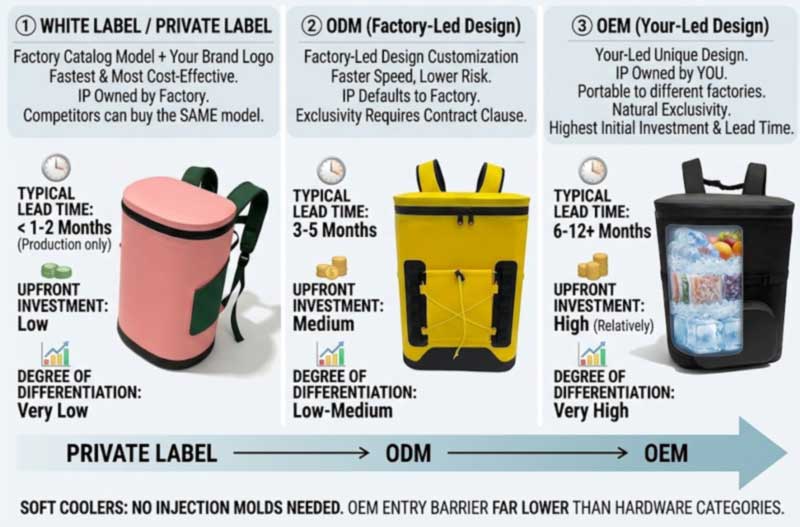
comparison of private label, ODM and OEM cooler backpack manufacturing by design ownership, cost and speed

Which Fits Your Brand: A Decision Framework

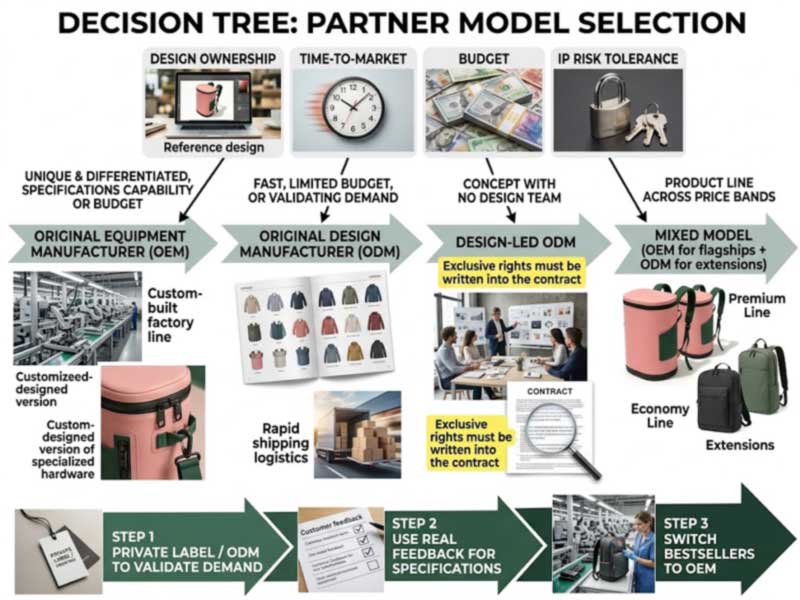
The research converges on a compact test — assess four criteria: design ownership, speed-to-market, budget and IP risk tolerance, then map your product to the most appropriate path. Applied to cooler backpacks:

Your situation Model Why
Testing whether a cooler line sells at all ODM / private label Lowest cost and fastest route to real demand data
Cooler is a hero product defining the brand OEM Differentiation and IP ownership are the strategy
No in-house product designer, but want something original Design-led ODM Factory does the design work; contract the ownership
Have a tech pack and a launch date OEM You already hold the capability OEM requires
Season deadline is tight ODM The base design already exists; skip development
Competing on price in a crowded category ODM Development spend will not be recovered at that price point
Selling into accounts that demand uniqueness OEM Retail buyers can spot a rebadged catalogue model
Broad range across price tiers Hybrid OEM the hero SKUs, ODM the category fillers

That last row is worth emphasising, because it is what most established brands actually do: OEM where differentiation earns its cost, ODM where it does not. The models are not mutually exclusive across a range — only within a single product.

The staged path

A sensible progression for a brand growing into the category: start with private label or ODM to prove the demand and learn what your customers actually complain about; use that knowledge to write a real specification; then move the proven best-seller to OEM where you own the design and can differentiate deliberately. Each stage funds and informs the next, and you commit development capital only once you know what to develop. See Private Label Cooler Backpacks: Launch Your Brand Without a Factory for the entry point.

What Each Model Looks Like at Sealock

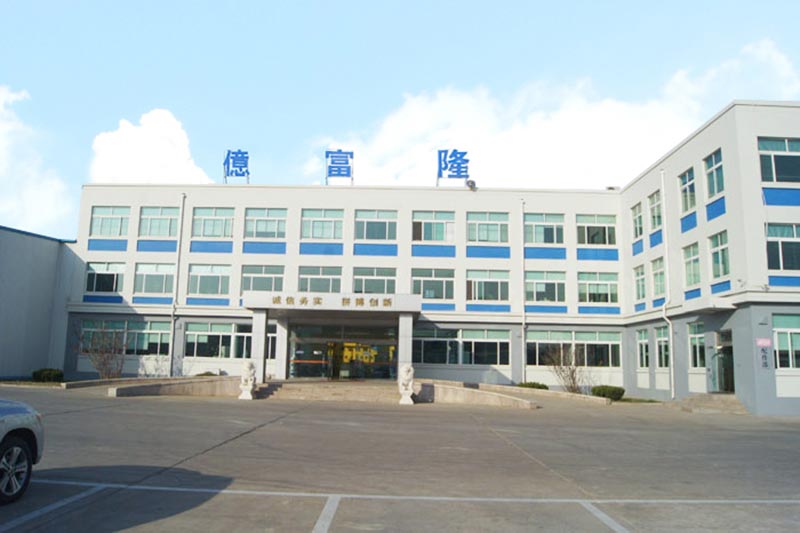
Sealock welds insulated cooler bags at 27.12 MHz across three factories in Dongguan, China and Ho Chi Minh City, Vietnam, with food-grade inner liners across the entire range, and works in both models.

OEM route ODM route
You bring A tech pack, drawings, a reference sample or a full performance spec A concept, a market need, a target price — or a chosen platform to adapt
The factory does Pattern engineering with weld lap and foam compensation, welding tooling, sampling, DFM, production Industrial design, CMF, pattern-making, prototyping and DFM as well as production
Typical scope Shell, insulation tier, seal level, capacity, closure, harness, hardware, branding — all to your brief Colour, branding, capacity variants, foam tier, closure and feature changes on a proven base
Ownership Your design; contract it explicitly Factory base design unless exclusivity or transfer is agreed — settle before development
Timing Longer at sampling; book against your launch Faster to first sample

Detail on each: OEM Soft Cooler Backpacks: What You Can Customize Beyond Logo & Color and ODM Soft Cooler Backpack Supplier: Design-Led, Ground-Up Development.

On capability, demanding briefs are welcome under either model: complex welded structures, premium insulation tiers up to PU, VIP vacuum panels, EPP and aerogel, IPX6–IPX8 welded seal levels, airtight-zipper integration, bespoke hardware and strict performance or compliance targets are all in scope, proven by immersion and cold-hold testing before production.

Proven Platforms You Could Start From

Under ODM, or as the reference point for an OEM brief, these are real Sealock cooler backpacks, chosen by fit rather than rank:

Image Model What it is a good base for Link
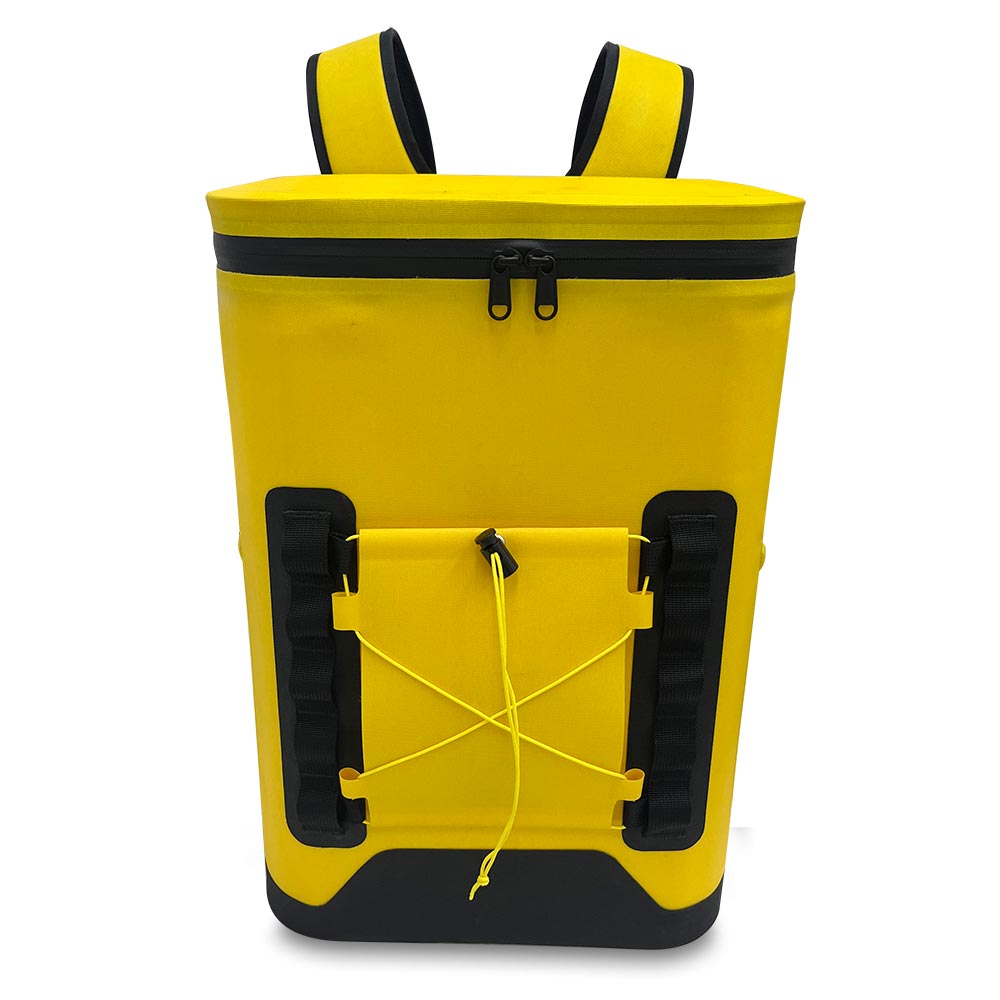
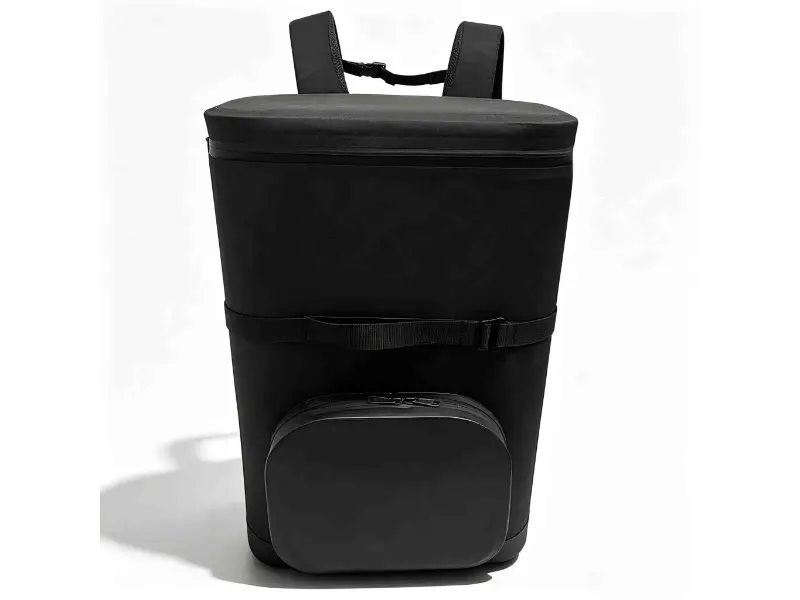
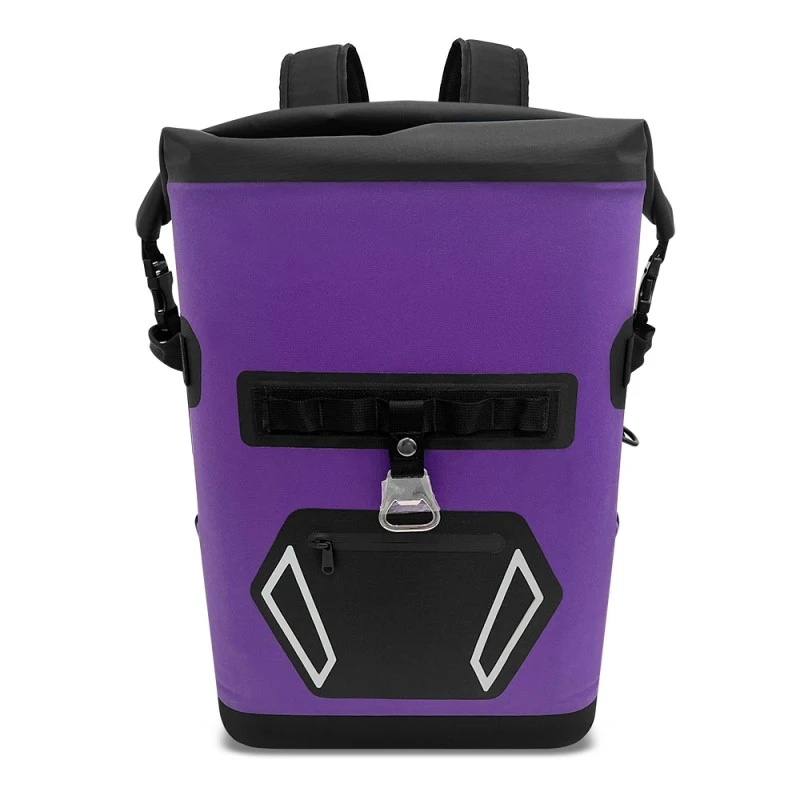
28L airtight-zipper insulated backpack cooler SL-I274 28L Airtight-Zipper Backpack Cooler (SL-I274) A sealed 48-hour flagship: 840D TPU, EVA core, airtight zipper, ergonomic harness View
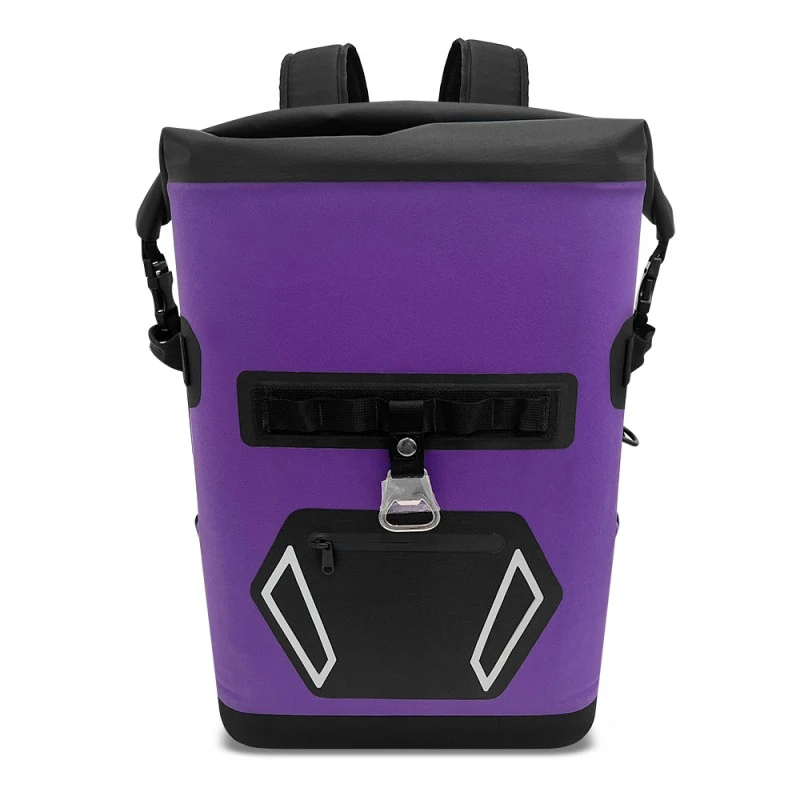
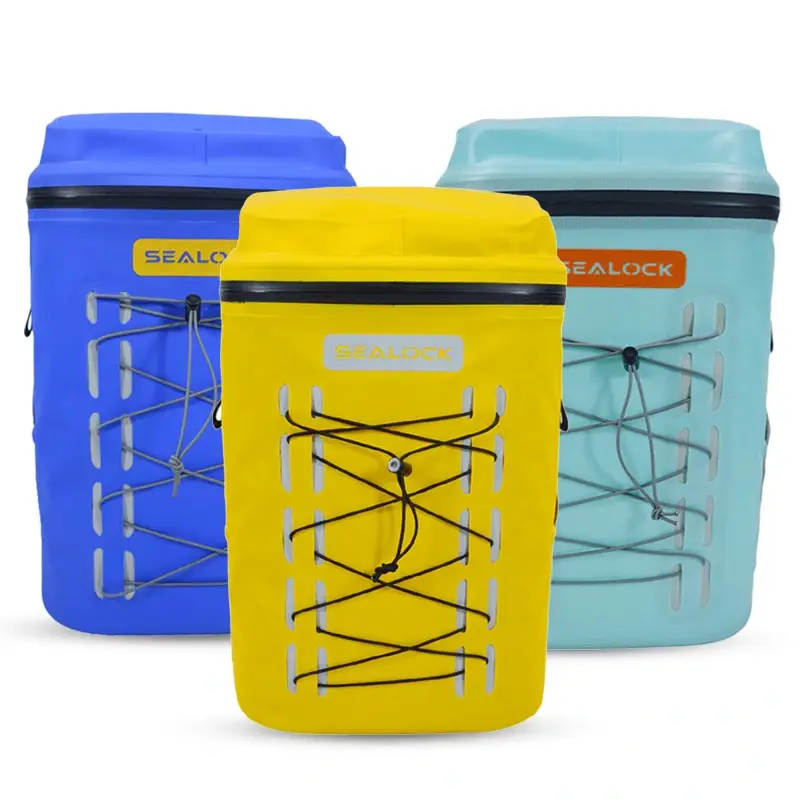
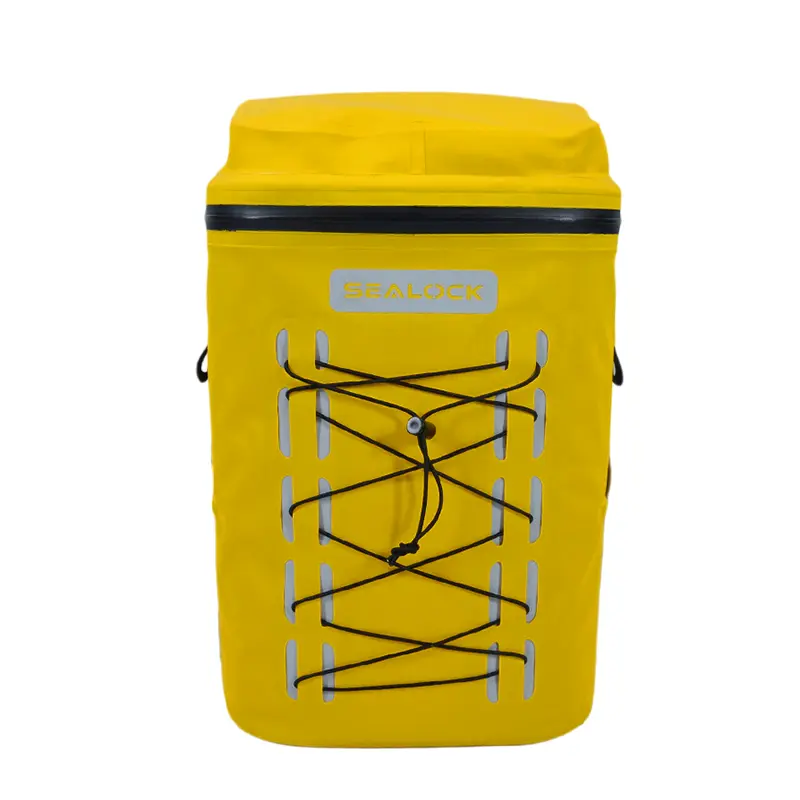
45L roll-top backpack cooler SL-I270 45L Roll-Top Backpack Cooler (SL-I270) A large-volume roll-top platform with gear webbing and reflective trim View
22L IPX7 cooler backpack SL-I280 22L IPX7 Cooler Backpack (SL-I280) A technical immersion-rated build: 50 mm XPE, IPX7, full harness View
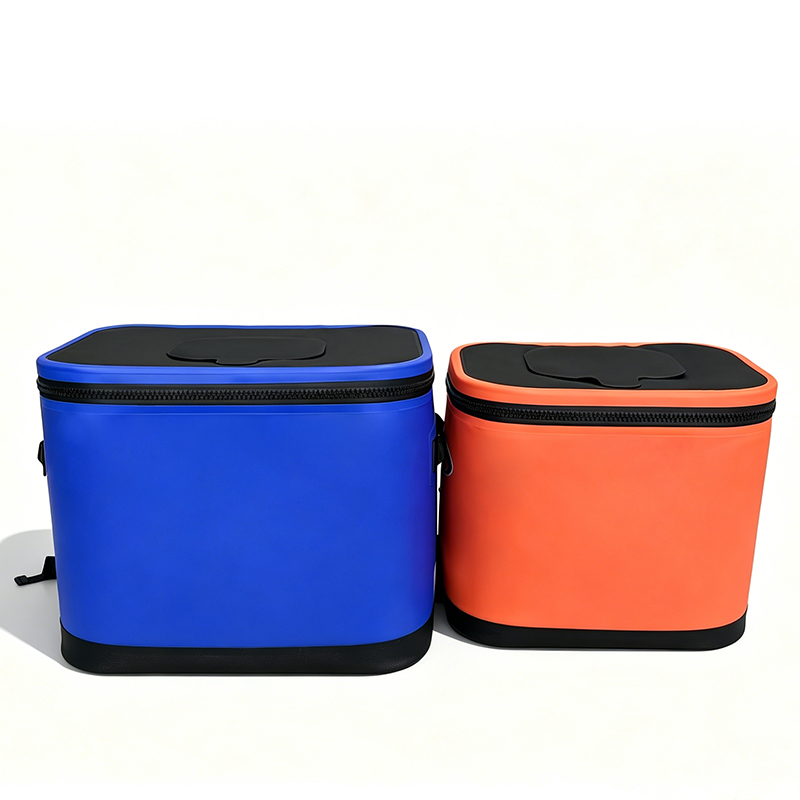
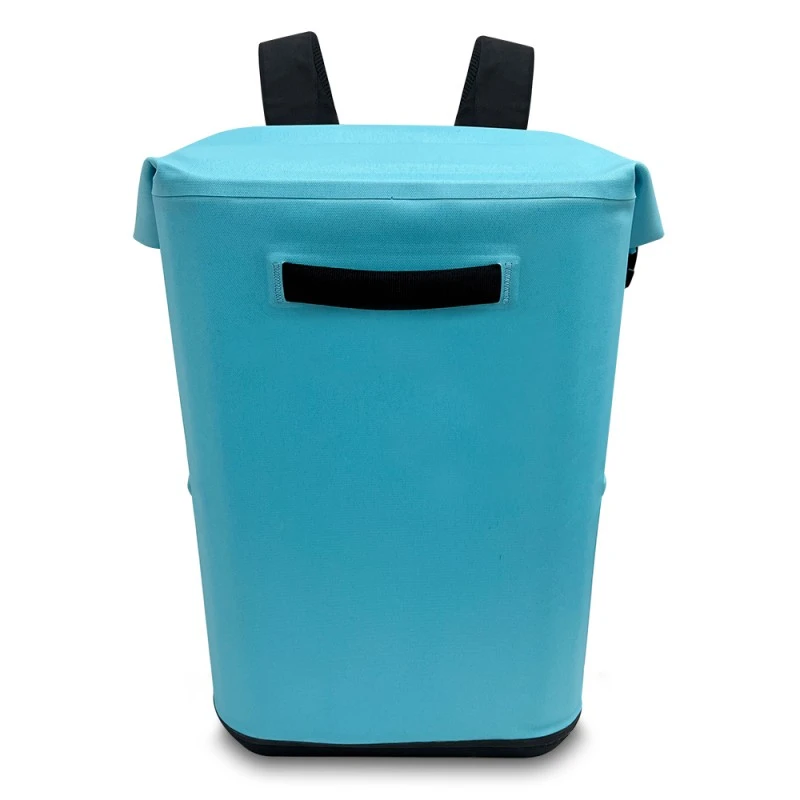
Insulated soft cooler backpack with molded lid SL-E050B Insulated Cooler Backpack, molded lid (SL-E050B) A distinctive fast-access day pack, already offered in two sizes View
Insulated leakproof cooler backpack SL-I075A Insulated Leakproof Cooler Backpack (SL-I075A) A value 36-can platform in PVC tarpaulin for price-led programmes View
decision tree for choosing OEM or ODM cooler backpack manufacturing based on ownership, speed, budget and IP risk

Whichever Model You Choose

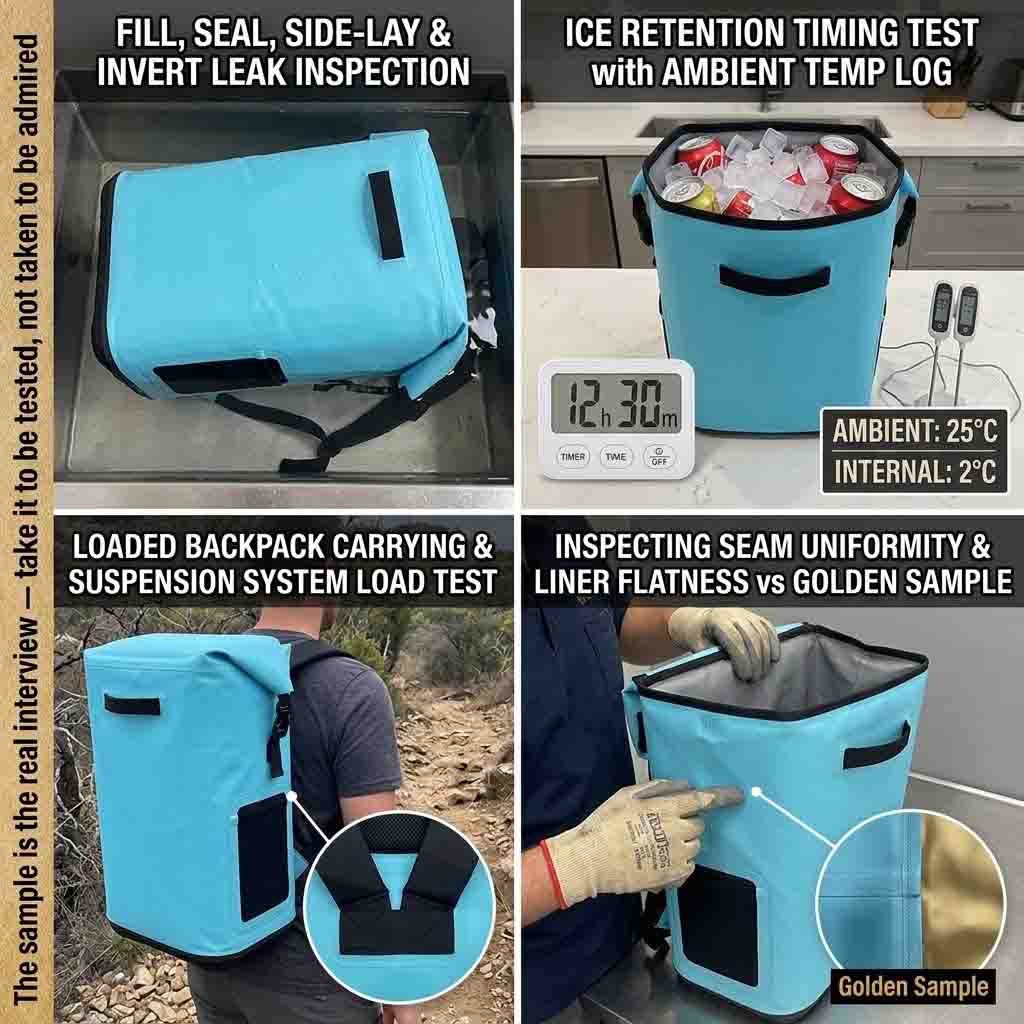
Some things are constant across both, and they are where most sourcing losses actually happen: verify the supplier is a genuine factory before committing (see Choosing an OEM Soft Cooler Backpack Manufacturer: A Buyer's Checklist), approve a physical golden sample rather than a photograph, write the IP and exclusivity terms into the contract, and tie the balance payment to a passed pre-shipment inspection (see Soft Cooler Backpack Supplier: MOQ, Lead Times & FOB Sourcing Explained).

MOQ / lead time 300 pcs per design; samples 7–15 days; production 30–45 days; FOB Guangdong
Development OEM to your specification, or design-led ODM from a concept — including full ground-up work
Validation Full water-immersion and cold-hold testing; AQL sampling; gold-sample sign-off; SGS or QIMA available
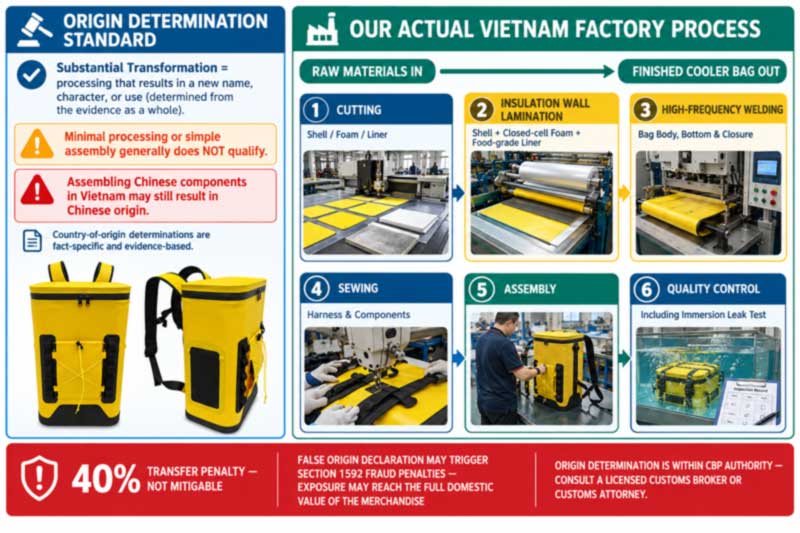
Origin China or Vietnam on the same specification
Certifications ISO9001, BSCI, SMETA P4, GRS, HIGG, SCAN

FAQ: OEM vs ODM Cooler Backpacks

Q: What is the actual difference between OEM and ODM?

A: Who owns the product concept. Under OEM the buyer leads the design and the factory builds to that brief; under ODM the supplier leads the design and the buyer brands and adapts it. Cost structure, timeline, IP risk and control all follow from that single distinction.

Q: Who owns the design in each model?

A: Under OEM the buyer usually retains design rights, which also makes it easier to move production elsewhere. Under ODM the manufacturer typically holds the IP in the base platform unless exclusivity or transfer is granted contractually. In both cases ownership is not automatic — the signed agreement must state who owns the IP, tooling, modifications and derivative work.

Q: Will the factory sell my ODM cooler design to competitors?

A: It can, unless you have agreed otherwise in writing — ODM manufacturers may sell the same or similar products to several buyers absent an exclusivity agreement. If uniqueness matters to your positioning, negotiate exclusivity before development begins, or choose OEM, where the product does not exist without your specification.

Q: Is OEM too expensive for a small brand making cooler backpacks?

A: Less than you might think in this category. The heavy tooling costs that dominate OEM in hard goods largely do not apply to soft coolers — custom patterns, capacities, foam tiers and closures are engineering and sampling work rather than moulds. Tooling only enters if you want bespoke moulded hardware. The real OEM costs here are development time and sampling rounds.

Q: Can I mix the two models?

A: Yes, and most established brands do — OEM for the hero products where differentiation earns its cost, ODM for the range fillers where it does not. The models are only mutually exclusive within a single product, not across a range.

Q: What is the most common mistake in choosing?

A: Expecting OEM-level differentiation on an ODM-level budget and timeline. As one sourcing consultancy puts it, the wrong model can be more damaging than the wrong supplier, because a capable factory still cannot deliver a bespoke exclusive product on a rebadge budget. Decide the model honestly at the start.

Not sure which model fits? Sealock (YiFuLong Outdoor Gear Co., Ltd.) manufactures welded cooler backpacks under both OEM and design-led ODM from its own lines in China and Vietnam. Tell the team your differentiation goal, budget and launch date, and they will say honestly which route fits — and quote it.

Email: info@sealock.com.hk  |  Phone: +86-13632981825  |  Browse the soft cooler range

Model definitions, cost and ownership conventions cited here reflect publicly available sourcing-industry sources as of mid-2026 and vary by category, contract and jurisdiction. This is general sourcing guidance, not legal advice — have IP, exclusivity and tooling terms reviewed by a qualified adviser before signing.

Related News
Leave me a message
X
We use cookies to offer you a better browsing experience, analyze site traffic and personalize content. By using this site, you agree to our use of cookies.Privacy Policy
RejectAccept