News

How to Choose a Soft Cooler Backpack Manufacturer

2026-08-21 0 Leave me a message
Verifying that a supplier is real and legitimate is one job. Deciding which of several legitimate suppliers is the right one for your product is a different job entirely — and it is the one that determines whether the partnership works. Two factories can both hold valid licences, pass the same audits and quote similar prices, while only one of them can actually weld the seal level your product claims, handle your volume without your order becoming a nuisance, or answer a technical question without a three-day delay. This guide is about that second decision: how to score manufacturers on fit rather than on paperwork. Sealock (YiFuLong Outdoor Gear Co., Ltd.) is used as a worked example of what each criterion should return.


If you have not yet confirmed a supplier is genuinely a factory and legally sound, start with Choosing an OEM Soft Cooler Backpack Manufacturer: A Buyer's Checklist, which covers registry verification, factory-versus-trader tests, audits and deal-breakers. This article picks up where that one ends.

Use a Structured Framework, Not a Gut Feeling

Procurement practice has a well-established answer to "how do I compare suppliers objectively," and it is worth borrowing even for a small brand. The most-used lens is the 10 C's: Competency, Capacity, Commitment, Control, Cash (financial stability), Cost, Consistency, Culture, Clean (ethical and environmental compliance), and Communication — and critically, not every C carries equal weight in every context; customise the framework to reflect your industry and supply chain priorities.

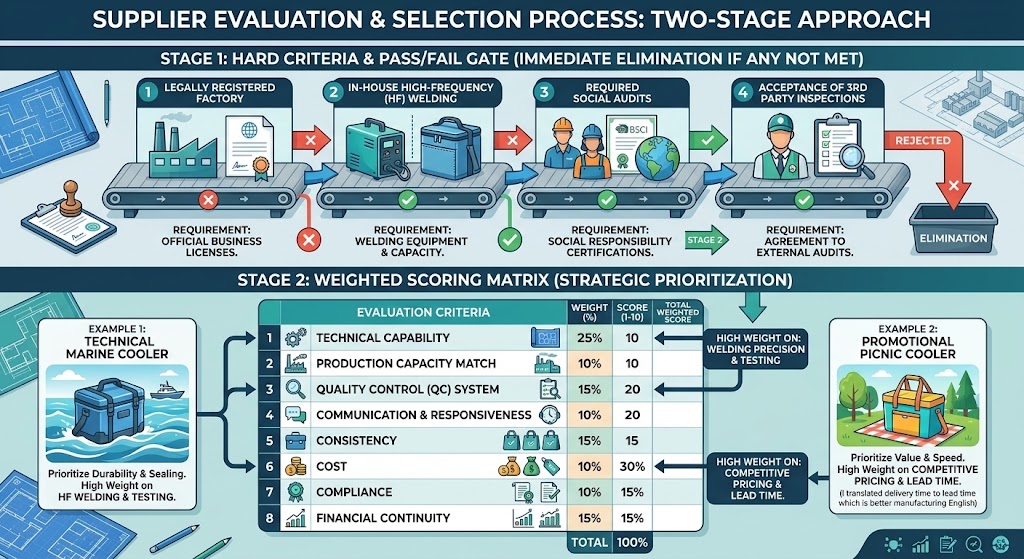
The mechanics that make it useful: effective models use weighted, data-driven scoring aligned with strategy — multiply each criterion by its weight and sum them — which prioritises value over price and prevents the trap of choosing the lowest price. A refinement worth adopting is gating: some organisations first apply hard gates — a supplier must pass minimum thresholds on quality certifications, financial stability and compliance before being scored on weighted criteria — which prevents a high cost score from masking unacceptable compliance gaps.

A practical two-stage approach for cooler sourcing: first apply pass/fail gates (legitimate registered manufacturer, in-house welding capability, required social-compliance audits, willingness to be inspected). Only suppliers that clear all gates get scored. Then weight the criteria below according to what your product actually needs — a technical marine cooler weights welding capability and testing heavily, while a promotional picnic range weights cost and lead time.


The Criteria That Matter for a Soft Cooler Backpack

1. Technical competency — can they build your product?

This is where cooler sourcing differs from generic bag sourcing, and it is the criterion most often skipped. A sewing factory can make a bag; only a factory with its own high-frequency welding lines can make a seam-free, immersion-rated cooler. Ask directly:

  • Is welding done in-house or subcontracted? At what frequency? (27.12 MHz is standard.)
  • Which insulation tiers can you actually build? EPE and XPE are common; PU, VIP vacuum panels, EPP and aerogel indicate a wider capability.
  • Which seal levels have you produced and validated? IPX6, IPX7, IPX8 — and how were they tested?
  • Is the liner food-grade, and can you provide migration test data for my market?
  • How do you attach load-bearing straps and webbing without piercing the sealed chamber?

That last question is a particularly good discriminator, because a factory that genuinely builds welded coolers has an engineered answer to it, and one that assembles sewn bags does not understand why it is being asked. For the underlying engineering, see Waterproof Cooler Backpack Manufacturer: HF-Welded, Seam-Free Builds and Insulated Cooler Backpack Manufacturer: EPE Foam & Cold-Retention Design.

2. Capacity — are you the right size customer?

Fit runs both ways. A factory geared to million-unit contracts will treat a 500-piece order as an inconvenience; a workshop with two machines will struggle with a 20,000-piece season. Ask about typical order sizes, current utilisation, and how your volume sits among their existing customers. Being a mid-sized customer at a factory that wants your business usually beats being the smallest customer at a bigger one.

3. Control — what quality system actually runs?

Ask what happens at incoming inspection, in-line, and outgoing — and specifically how a weld defect is caught, since it becomes invisible once the bag is lined and assembled. Ask whether finished bags are immersion-tested or only visually inspected, and whether third-party inspection is welcomed. A factory that invites an independent inspector onto its outgoing line is behaving the way a buyer should demand.

4. Communication — the criterion that predicts the whole relationship

Procurement guidance treats this as a formal criterion, not a soft one: assess communication capabilities including language skills, cultural awareness and preferred channels, and evaluate reporting capabilities and transparency in sharing performance data and issue information. The useful test is free and immediate — send a genuinely technical question during the quoting stage. How fast, how accurately and how honestly it is answered before you have paid anything is the best available preview of how problems will be handled after you have.

5. Consistency — will order five match order one?

Ask how the approved gold sample is retained and used at outgoing inspection, and how repeat orders are matched to it. This is where quality fade is prevented or permitted.

6. Cost — understood, not just compared

Compare landed cost per unit, not quotes: unit price at the correct break, freight on total CBM, duty on the right classification, inspection, and the cost of capital tied up in a deposit. A quote a few percent cheaper that ships at higher CBM per unit can be the more expensive option. See Wholesale Cooler Backpack Manufacturer: Bulk Pricing & FOB Terms.

7. Clean — compliance your customers will demand

Retail buyers increasingly require social-compliance audits, and food-contact testing is not optional for a product holding food and ice. Confirm which audits are current and verify them with the issuing body rather than accepting a screenshot.

8. Cash and continuity — will they still be there next season?

Research indicates 59% of procurement leaders consider financial stability a critical evaluation factor, since a financially unstable supplier creates substantial operational risk. Years in business, evidence of long-term customers, and multi-site production all speak to continuity. A supplier with production in more than one country also hedges tariff and disruption risk — see Vietnam Cooler Bag Manufacturer: Duty-Friendly Sourcing for Importers.

two-stage supplier selection: pass/fail gates then a weighted scoring matrix for cooler backpack manufacturers

The Sample Is the Real Interview

Everything above is talk until a physical sample arrives. Sampling is the single most informative stage of supplier selection, because it converts claims into an object you can hold, test and compare.

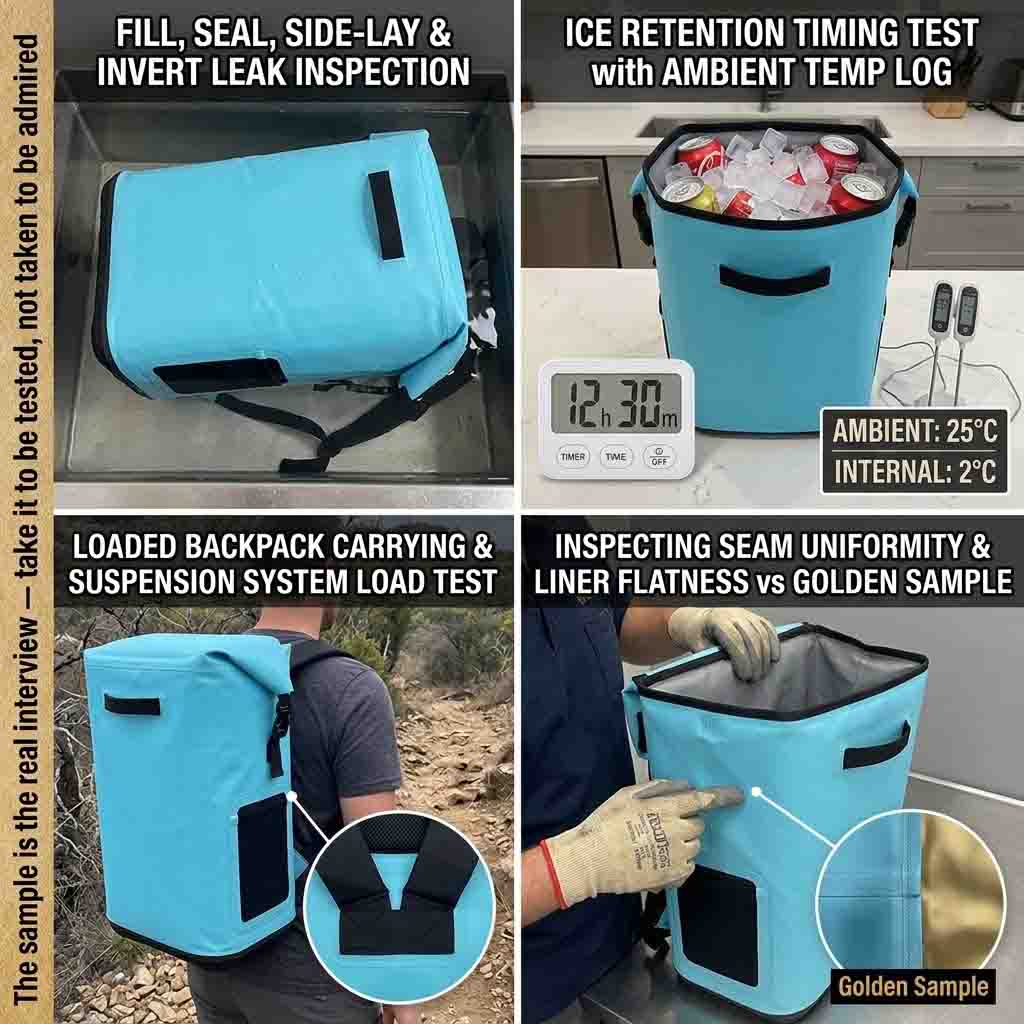
What a sample tells you that a factory tour cannot: whether the welds are even and clean; whether the bag actually holds water when you fill it and turn it over; whether the cold-hold figure survives a test in your own conditions; whether the harness is comfortable loaded; whether the finish quality matches what your customers will accept. Test it rather than admiring it — fill it, tip it, load it, weigh it, and time its ice.

Equally telling is the process around the sample: how many rounds it took to get right, how accurately your brief was interpreted, and how the factory responded to revision requests. A supplier that reads a tech pack precisely and turns a good first sample is demonstrating exactly the capability you are buying. See ODM Soft Cooler Backpack Supplier: Design-Led, Ground-Up Development.

Never approve a sample from a photograph. Pay for the physical golden sample to be shipped, approve it in your hands, and keep it — it becomes the reference every production unit is matched against at final inspection. This single discipline is the most effective protection against a bulk run that quietly differs from what you approved.


Matching the Supplier to Your Product Type

The right manufacturer depends on what you are making. Weight the criteria accordingly:

If your product is... Weight most heavily Because
Technical marine, kayak or fishing cooler Welding capability, IPX validation, hardware specification Immersion sealing and corrosion resistance are pass/fail in the field
Premium multi-day camping cooler Insulation tier range, cold-hold testing, claim honesty The advertised hours have to survive a real test
Volume picnic or promotional range Cost, lead time, capacity, colour consistency Margin and season timing decide the programme
Original design with no in-house designer Design-led ODM capability, pattern engineering, DFM You are buying development, not just manufacturing
Tariff-sensitive US import Multi-country production, origin documentation Origin flexibility is worth more than a small unit-price gap
Retail-account programme Social-compliance audits, food-contact testing, consistency Your retailer will audit you on your supplier's behaviour

What These Criteria Return for Sealock

Run the framework against Sealock and each criterion has a concrete answer rather than a claim:

Competency Welded insulated bags since 2003; three in-house high-frequency welding factories at 27.12 MHz; IPX6–IPX8 builds; insulation from closed-cell EPE and XPE up to PU, VIP vacuum panels, EPP and aerogel
Capacity Three welding factories across two countries; MOQ 300 pcs per design, so small programmes are workable as well as large ones
Control In-house IQC, IPQC and OQC; in-line weld inspection; full water-immersion batch testing; AQL sampling and gold-sample sign-off; SGS or QIMA third-party inspection welcomed
Lab testing Load cycling, tensile, adhesion, salt spray, abrasion, colour fastness, colour difference, full water immersion
Consistency Approved gold sample retained as the production reference at OQC
Clean ISO9001, BSCI, SMETA P4, GRS, HIGG, SCAN; food-grade inner liners across the entire range, with migration testing available for the destination market
Continuity Over 20 years in insulated soft bags; Dongguan, China and Ho Chi Minh City, Vietnam, with a second Vietnam line added 2024 — origin choice on the same specification
Cost & terms FOB Guangdong; MOQ 300 pcs; samples 7–15 days; production 30–45 days; carton and CBM data provided with quotation for landed-cost modelling
Development OEM to your tech pack, or design-led ODM from a sketch, sample or performance target — including complex structures, premium insulation tiers and strict compliance goals

None of that should be taken on trust — the point of the framework is that every line above is something you can ask any supplier to demonstrate on video, in an audit, or in a sample.

buyer testing a cooler backpack sample: leak test, ice retention timing, loaded carry and weld inspection against the gold sample

A Selection Process You Can Run

  1. Define what your product actually requires — seal level, cold-hold, capacity, market, price point — before contacting anyone. Vague briefs get vague suppliers.
  2. Apply hard gates — registered manufacturer, in-house welding, required audits, accepts inspection. Anyone failing is out regardless of price.
  3. Weight and score the survivors on competency, capacity, control, communication, consistency, cost, compliance and continuity.
  4. Test communication with a real technical question before committing.
  5. Sample the shortlist — two or three suppliers, the same brief, and compare what comes back.
  6. Test the samples properly — water, ice, load, weight, finish.
  7. Verify the claims that matter to your market: immersion validation, cold-hold basis, food-contact test data.
  8. Structure the first order safely — staged payment tied to a passed pre-shipment inspection, gold sample as the reference. See Soft Cooler Backpack Supplier: MOQ, Lead Times & FOB Sourcing Explained.

FAQ: Choosing a Soft Cooler Backpack Manufacturer

Q: What is the most important question to ask a cooler backpack manufacturer?

A: "Is the high-frequency welding done in-house, and how do you validate the finished bag?" It separates genuine cooler factories from sewing shops and traders in a single answer. A real welding factory discusses frequency, weld parameters and immersion testing comfortably; anyone else deflects.

Q: How do I compare suppliers objectively rather than by price?

A: Use a weighted scorecard. Apply hard pass/fail gates first — legitimacy, welding capability, required audits — so a low price cannot mask a compliance gap, then score the survivors on weighted criteria such as competency, capacity, control, communication, consistency, cost, compliance and financial continuity, with weights reflecting what your specific product needs.

Q: Does supplier size matter?

A: Fit matters more than size. A factory built for million-unit contracts may treat a small order as an inconvenience, while a two-machine workshop cannot absorb a large seasonal programme. Ask about typical order sizes and where your volume sits among their customers — being a valued mid-sized customer usually beats being the smallest one at a bigger factory.

Q: How much weight should I give communication?

A: A lot, and it is free to test. Send a genuinely technical question during quoting and judge the speed, accuracy and honesty of the reply. Responsiveness before you have paid anything is the best available predictor of how problems will be handled once production is running.

Q: How many suppliers should I sample?

A: Two or three, given the same brief, so you are comparing interpretation as well as build quality. Then test the samples rather than admiring them — fill and invert them for leaks, time the ice retention, load and carry them, and inspect the welds. Never approve from a photograph; get the physical golden sample and keep it as the production reference.

Evaluating manufacturers? Sealock (YiFuLong Outdoor Gear Co., Ltd.) welcomes the scrutiny above — in-house 27.12 MHz welding across three factories in China and Vietnam, immersion and cold-hold validation, verifiable audits, and samples in 7–15 days. Send your specification and market, and the team will answer the technical questions your evaluation needs.

Email: info@sealock.com.hk  |  Phone: +86-13632981825  |  Browse the soft cooler range

Supplier-evaluation frameworks and figures cited here reflect publicly available procurement-industry sources as of mid-2026 and should be adapted to your category and risk profile. This is general sourcing guidance, not legal, financial or procurement advice for a specific transaction.

Related News
Leave me a message
X
We use cookies to offer you a better browsing experience, analyze site traffic and personalize content. By using this site, you agree to our use of cookies.Privacy Policy
RejectAccept