Food Grade Soft Cooler Manufacturing Standards

2026-09-03 0 Leave me a message
A soft cooler holds food and melting ice against its liner for hours at a time. That makes the liner a food-contact material in the regulatory sense, subject to real law in every major market — not a marketing adjective. Yet "food grade" appears on thousands of listings with no standard named, no test report behind it, and no understanding of the fact that compliance in one market does not transfer to another. This guide sets out what the term actually means under US, EU and Chinese rules, what documentation a buyer should demand, and what a manufacturer must do to earn the claim. Sealock (YiFuLong Outdoor Gear Co., Ltd.) uses food-grade inner liners across its entire range.


The Principle Behind Every Framework

All three major regimes rest on the same idea: the material must not transfer its constituents into food in harmful amounts. The EU states it most explicitly — under the framework regulation, materials < cite index="123-1">must not endanger human health or bring any changes in smell, composition, colour or taste to the food, and all food contact materials should be manufactured according to good manufacturing practice. The US applies an equivalent test: < cite index="119-1">every food product must meet the FDA's "reasonable certainty of no harm" standard, meaning it won't pose health risks when used as intended.

Two implications follow that matter for a cooler. First, safety is about migration — what moves from the liner into the food — not about the material's name. Second, the manufacturing process is part of compliance, not just the material.

United States: 21 CFR and the Clearance Mechanisms

The regulatory home is Title 21: < cite index="125-1">the FDA governs food contact materials under 21 CFR Parts 174–178, within the broader < cite index="118-1">21 CFR Parts 170–199 covering the various material categories. Compliance is substance-based rather than product-certified — there is no single "FDA certificate" for a finished cooler bag. Instead, each substance in the food-contact layer must have a legal basis for its use.

New substances go through a defined pathway: < cite index="125-1">the Food Contact Notification (FCN) programme requires manufacturers to submit safety data for new food contact substances, undergoing a 120-day premarket review. Note that an FCN is supplier-specific, so a clearance held by one material supplier does not automatically cover another's version of the same material. A lighter route exists for negligible-exposure substances: < cite index="120-1">a Threshold of Regulation (TOR) exemption applies to food contact materials that pose no health risks, contain no carcinogens, and have a dietary concentration of less than 0.5 parts per billion.

European Union: Framework, GMP, and the Document Buyers Forget

The EU structure is layered, and each layer does a different job:

  • Framework Regulation (EC) 1935/2004 — applies to all food contact materials and sets the general safety requirement.
  • GMP Regulation (EC) 2023/2006 — governs how they are made. It < cite index="126-1">ensures the manufacturing process is well controlled so that specifications remain in conformity with the legislation: premises fit for purpose and staff awareness of critical production stages, and it < cite index="123-1">applies at all stages of production and distribution of food contact materials, excluding the production of raw materials.
  • Regulation (EU) 10/2011 — specific rules for plastics, < cite index="125-1">including overall migration (OM) and specific migration limit (SML) testing.

The migration limits, in numbers

The overall migration limit is concrete and worth knowing: < cite index="119-1">the total amount of substances that can migrate from the material into food is limited to 10 mg per square decimetre of material, or 60 mg per kilogram of food. Testing uses standardised proxies: < cite index="119-1">to replicate real-life food storage and usage conditions, tests use different food simulants, which are liquids designed to behave like actual foods. That is why a test report is only meaningful with its conditions attached — simulant, temperature and duration must match how your product is actually used.

The Declaration of Compliance

This is the document most cooler buyers have never requested and every serious EU retail buyer will eventually require. < cite index="119-1">If the material passes all required tests, a Declaration of Compliance (DoC) can be issued — this document confirms the material meets EU 10/2011 standards and is backed by lab test reports proving its safety, and it is < cite index="119-1">a mandatory document for manufacturers and importers of certain food contact materials in the EU. Its purpose is chain-of-supply transparency: < cite index="121-1">to ensure that retailers and other companies in the supply chain can receive a summary of the compliance status.

Critically, the DoC is not a standalone certificate: < cite index="126-1">the DoC is based on supporting documentation which documents the reasoning on the safety of a plastic food contact material, and which must be provided to enforcement authorities on request — the supporting documentation also provides an important link to the manufacturer's responsibility under GMP. A DoC with no supporting dossier behind it is paperwork, not compliance.

Do not confuse the two "DoC"s. < cite index="119-1">The Declaration of Compliance for food contact materials is not to be confused with the Declaration of Conformity for CE-marked products. They are different documents under different law. Ask for the food-contact DoC by name.


China: The GB 4806 Series

Because most soft coolers are manufactured in China, the Chinese framework is directly relevant to how the product is made — and it is more developed than most buyers realise. The structure mirrors the others: < cite index="118-1">GB 4806.1-2016 is the general safety standard for food contact materials, GB 9685-2016 lists permitted additives, GB 31603-2015 sets Good Manufacturing Practice standards, the GB 4806 series covers specific materials such as plastics, paper, coatings, rubber and glass, and GB 31604.1-2023 gives the general rules for migration testing.

The basic approach is familiar: < cite index="120-1">the basic principle in China is similar to the FDA and EU regulations — only approved substances may be used, and China also requires GMP and migration testing with rules described in separate standards. But the details differ enough to matter: < cite index="125-1">these standards specify testing conditions and simulants that sometimes differ from EU protocols, such as the use of olive oil for high-fat food migration tests. And there is a practical constraint worth knowing: < cite index="120-1">the biggest challenge regarding Chinese food contact material regulations is that some commonly used ingredients have not yet been approved.

The rule that catches exporters: compliance does not transfer between markets. A liner cleared in the US is not automatically compliant in the EU, and neither status covers China. Each regime has its own approved-substance lists, its own migration limits, its own simulants and its own documentation. If you sell into multiple markets, you need test evidence for each — and you should tell your manufacturer your destination markets at the specification stage, not after production.


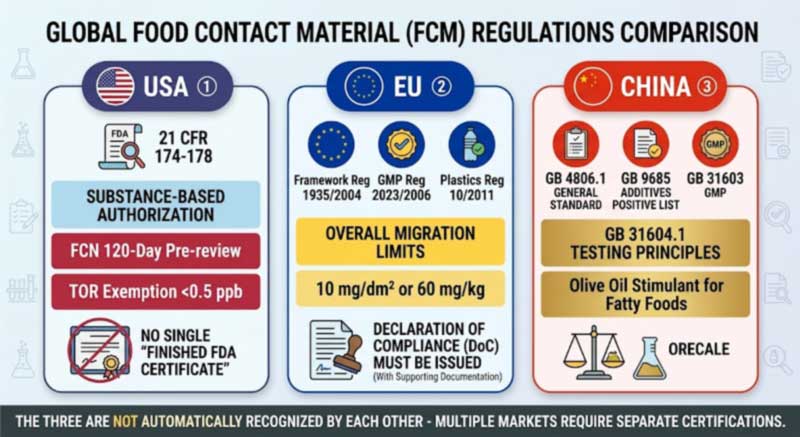
comparison of US 21 CFR, EU 1935/2004 and China GB 4806 food contact material frameworks

What This Means for Cooler Construction

Regulation is about the material that touches food, but a cooler's design determines how well that material performs its job.

The liner is the food-contact surface

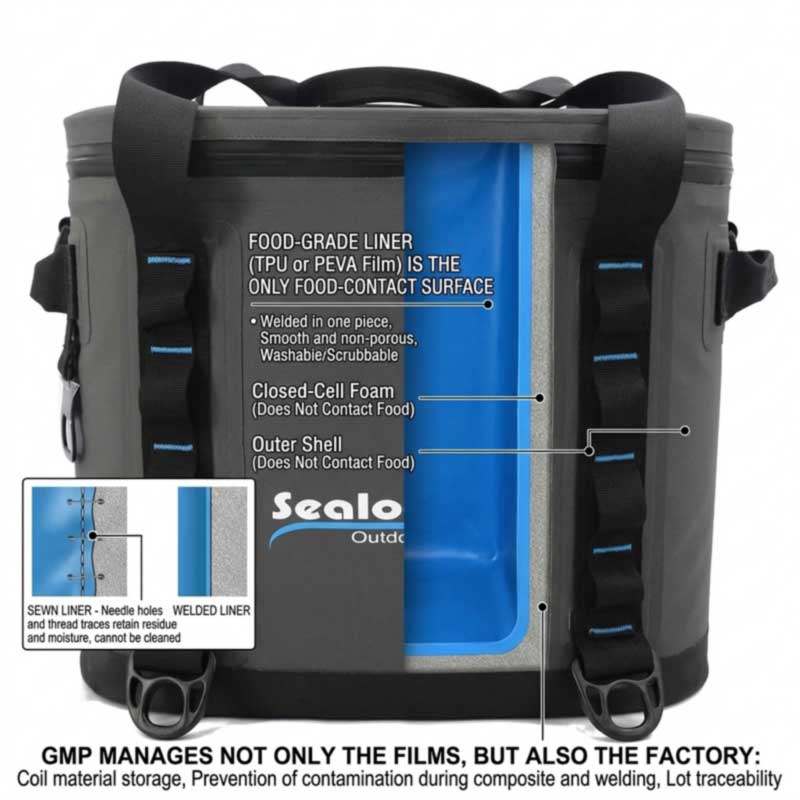
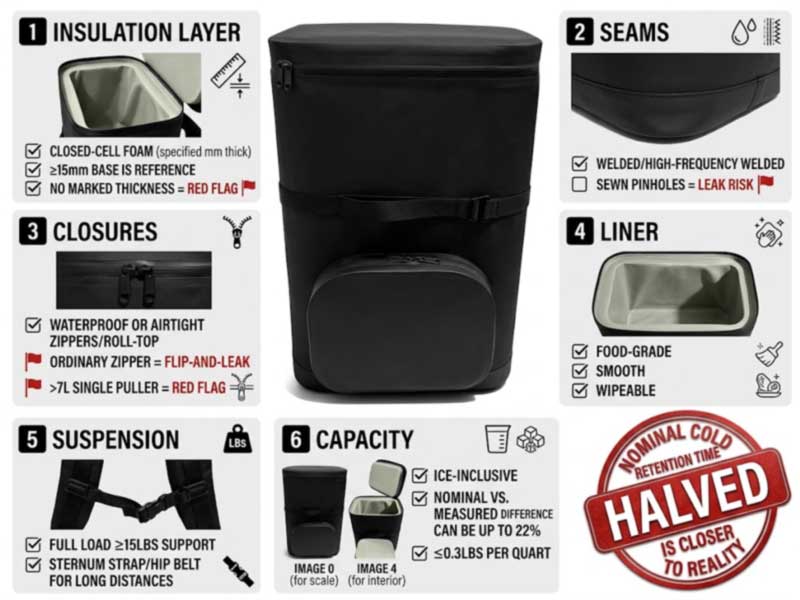
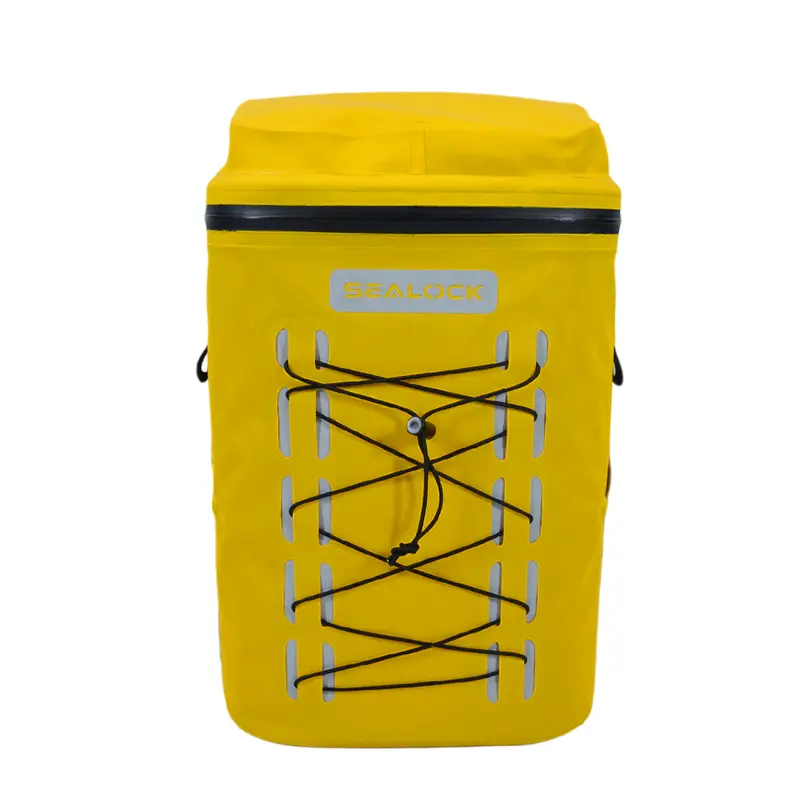
Food-grade TPU and PEVA are the standard liner materials for soft coolers. PVC is cheaper but carries plasticiser-related restrictions in several markets, which is why it is generally avoided for regulated retail liners. Every Sealock insulated bag uses a food-grade inner liner across the range — a TPU membrane, PEVA film or equivalent food-grade waterproof liner depending on the model — and migration testing for a destination market can be arranged. Liner material selection is covered in Custom Insulated Cooler Backpacks: Spec Your Foam, Liner & Capacity.

Welded liners are a hygiene decision, not only a leak decision

A stitched liner has needle holes and thread in the food chamber — places where residue, moisture and bacteria lodge and where cleaning cannot reach. A welded liner is a continuous, smooth, non-porous surface that wipes out. On a product that will hold raw fish one weekend and children's lunches the next, that difference is a food-safety property as much as a leakproofing one. See Leakproof Cooler Backpack Manufacturer: Welded vs Stitched Seams.

GMP applies to the factory, not just the film

Both the EU and China require food-contact materials to be produced under good manufacturing practice. For a cooler factory that means controlled handling and storage of liner rolls, avoiding contamination during lamination and welding, traceability from material lot to finished goods, and staff who understand which production stages are critical. A buyer auditing a factory should ask how liner material is stored, how lots are traced, and who is responsible for food-contact compliance. The audit approach is covered in Soft Cooler Factory Audit Checklist for Importers.

What to Ask Your Supplier For

Market Ask for Check that…
United States Migration test report against 21 CFR for the liner material; the legal basis for the substances used (listed regulation, FCN or TOR) The report covers the exact liner in your bag, not a generic sample; FCN coverage is supplier-specific
European Union Declaration of Compliance for the food-contact material, plus overall and specific migration test reports Supporting documentation exists behind the DoC; simulants and test conditions match your use case
China Test reports against the relevant GB 4806 standard and GB 31604.1 migration rules The correct material-specific standard is cited
All markets Material specification naming the exact liner; GMP evidence; lot traceability Documents name your product and material, are current, and come from an accredited laboratory
Three red flags on a "food grade" claim: a claim with no standard named; a test report for a different material or a different product than yours; and a certificate presented as a screenshot rather than a full report from a named accredited laboratory. Also treat "FDA certified" with caution — the FDA does not certify finished cooler bags, so a supplier using that phrase may not understand the framework it is claiming compliance with.


How Sealock Handles Food-Contact Compliance

Liners Food-grade inner liners across the entire range — TPU membrane, PEVA film or equivalent food-grade waterproof liner by model
Construction Welded, seamless liners — smooth non-porous food chamber with no stitch holes to trap residue
Testing Migration testing available for the destination market; SGS or QIMA third-party testing and inspection on request
Quality system IQC verification of liner material and documentation; IPQC; OQC with AQL sampling and gold-sample sign-off
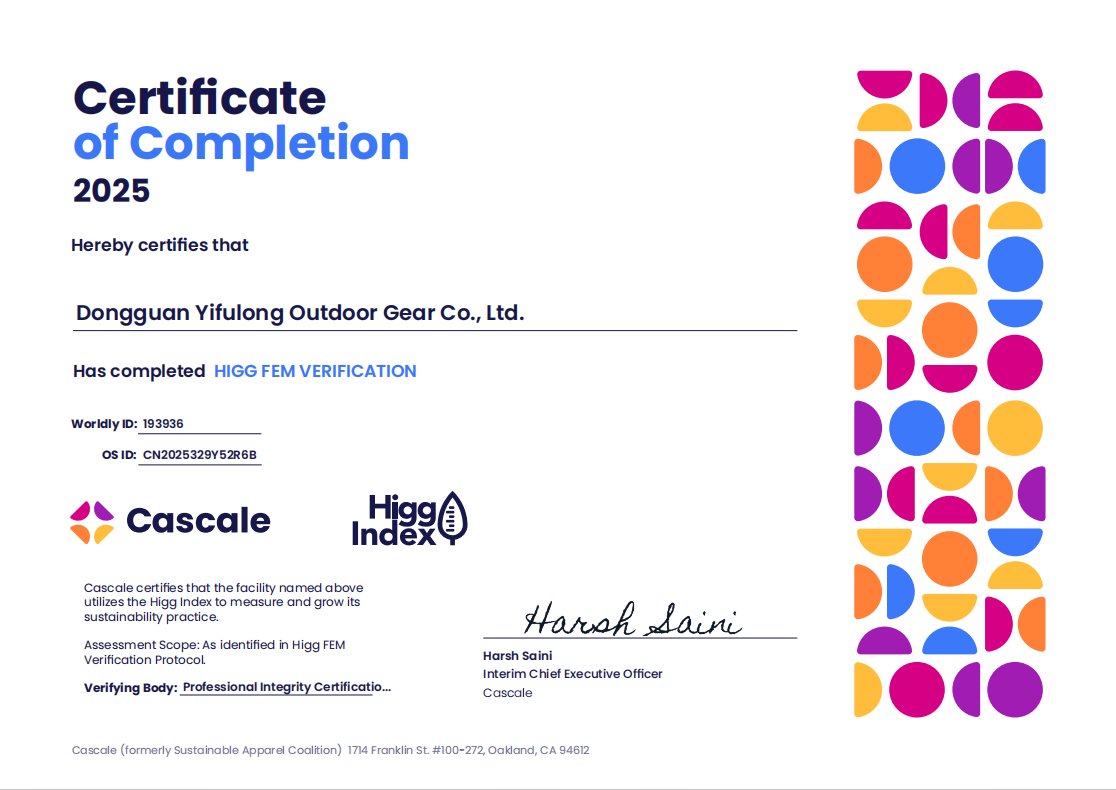
Certifications ISO9001, BSCI, SMETA P4, GRS, HIGG, SCAN
Manufacturing 27.12 MHz high-frequency welding, in-house across three factories in Dongguan, China and Ho Chi Minh City, Vietnam
Terms MOQ 300 pcs per design; samples 7–15 days; production 30–45 days; FOB Guangdong

Products Built With Food-Grade Liners

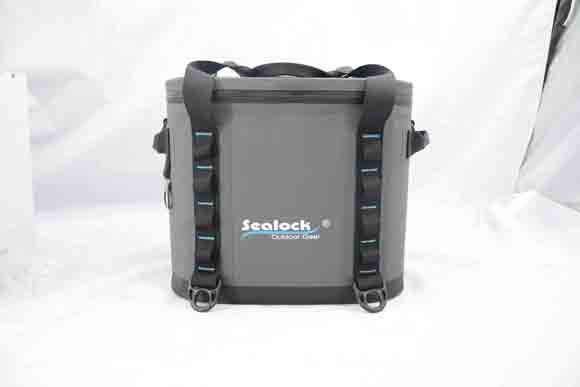
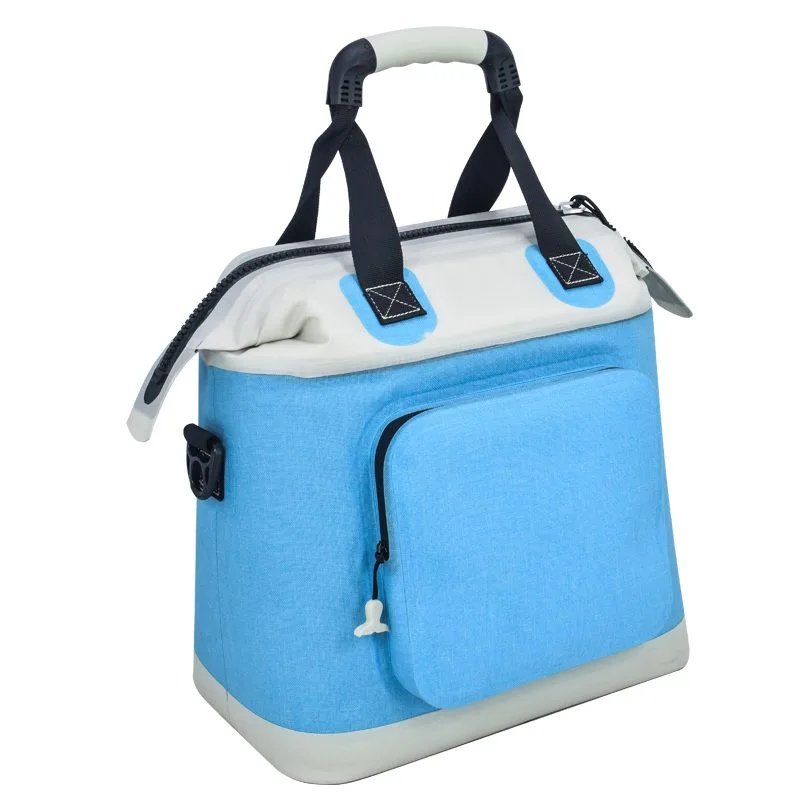
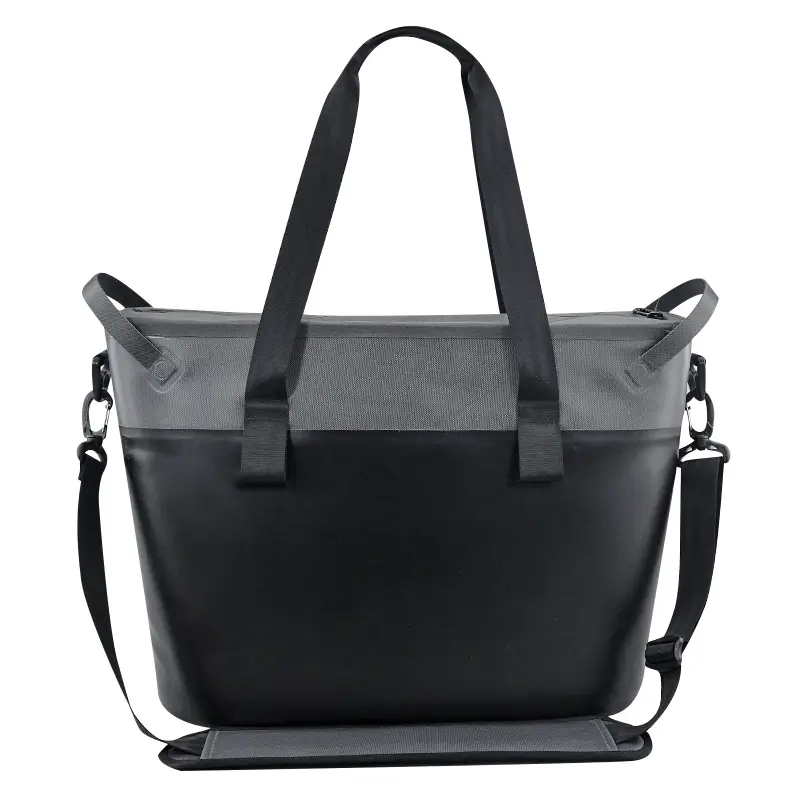
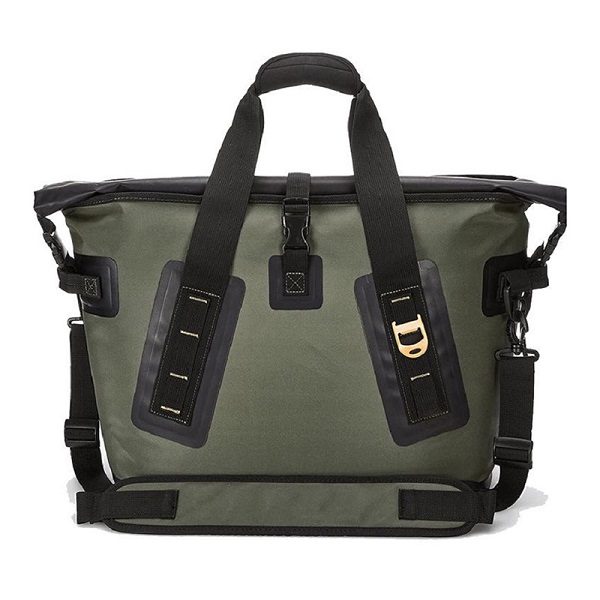
Real Sealock builds across form factors, chosen by fit rather than rank:

Image Model Liner & build Link
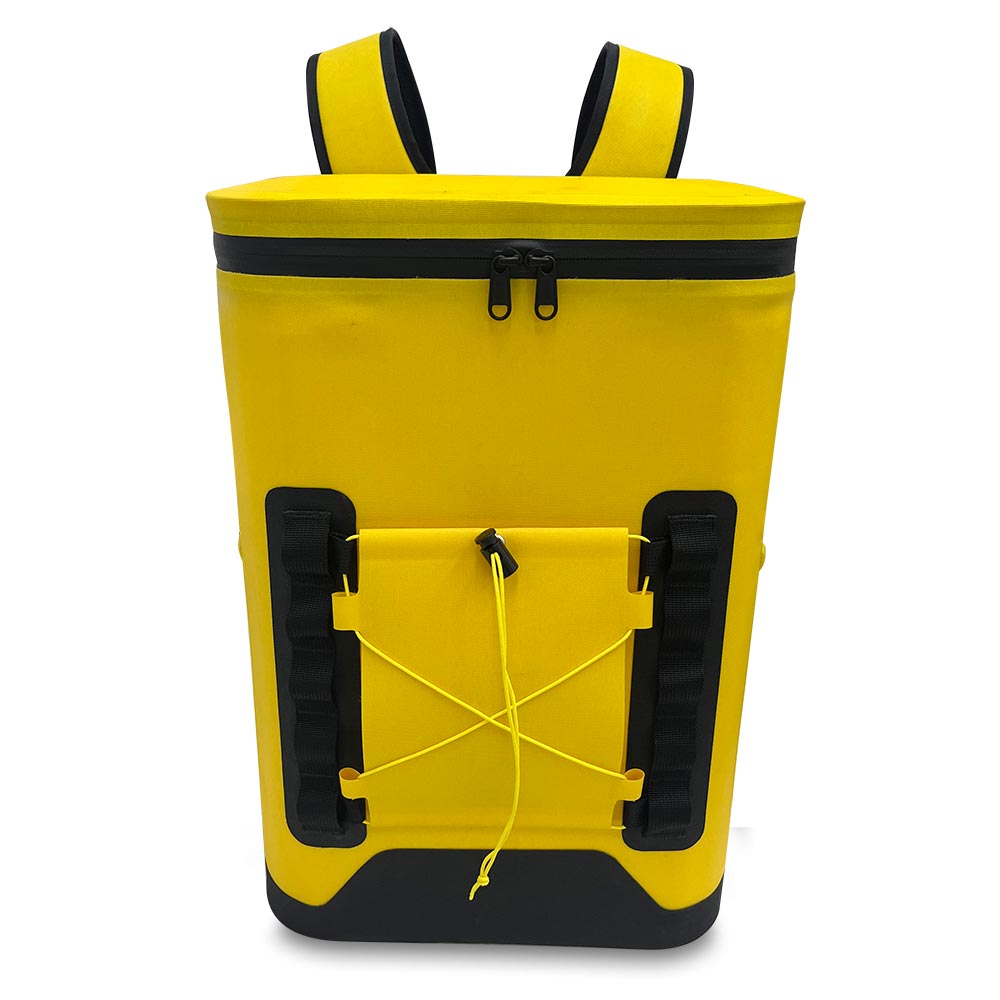
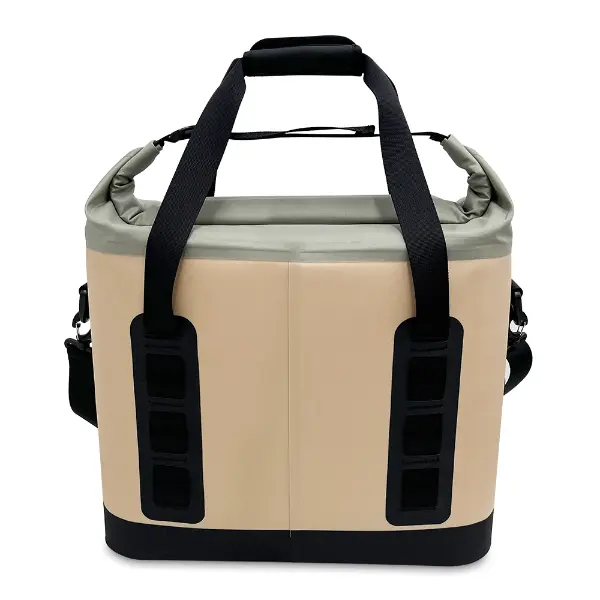
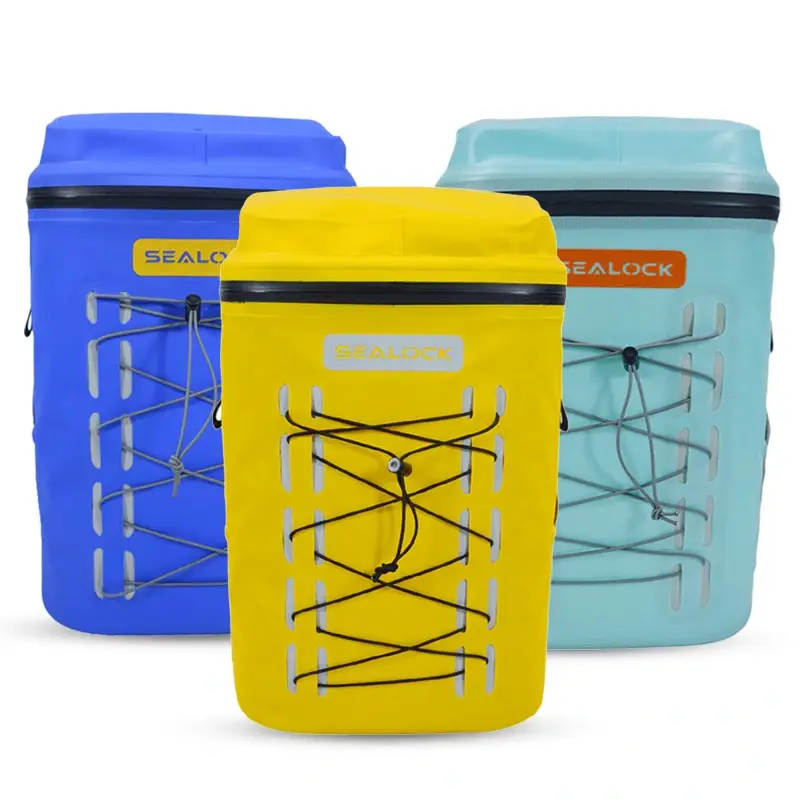
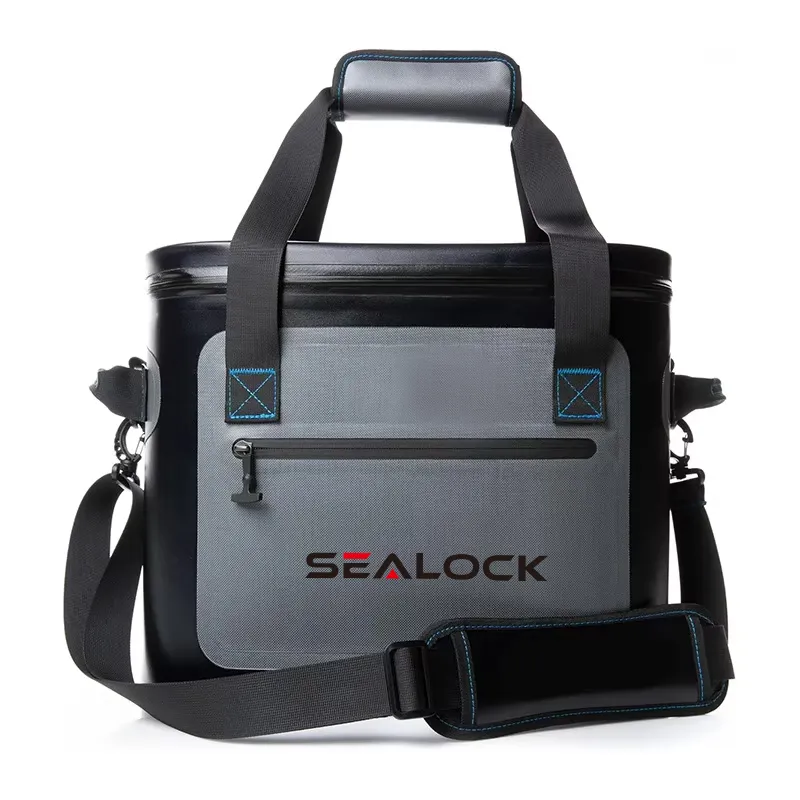
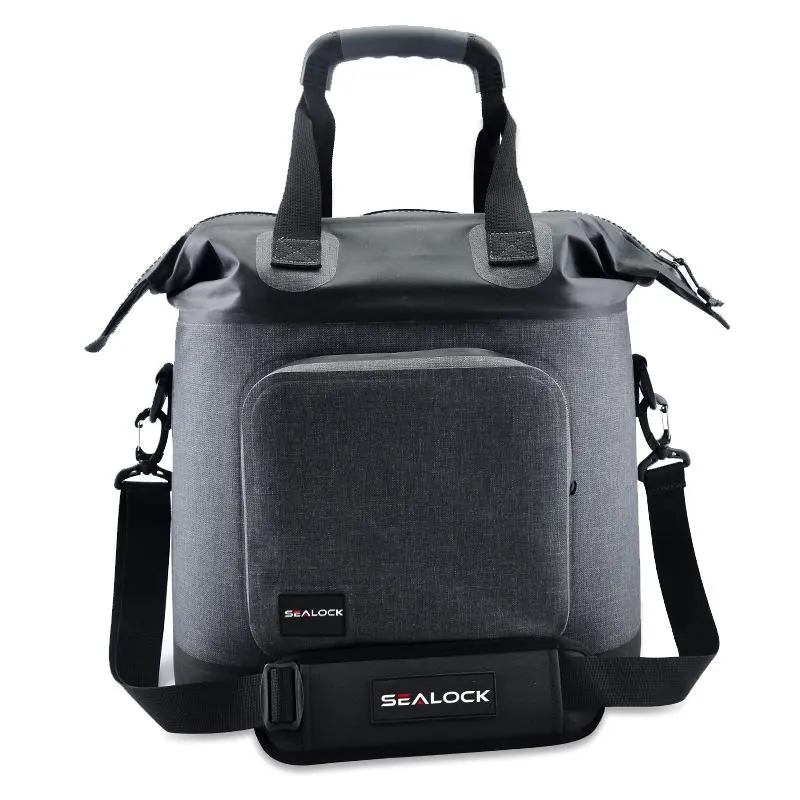
28L airtight-zipper insulated backpack cooler SL-I274 28L Airtight-Zipper Backpack Cooler (SL-I274) Food-grade TPU membrane, 840D TPU shell, EVA core, HF welded View
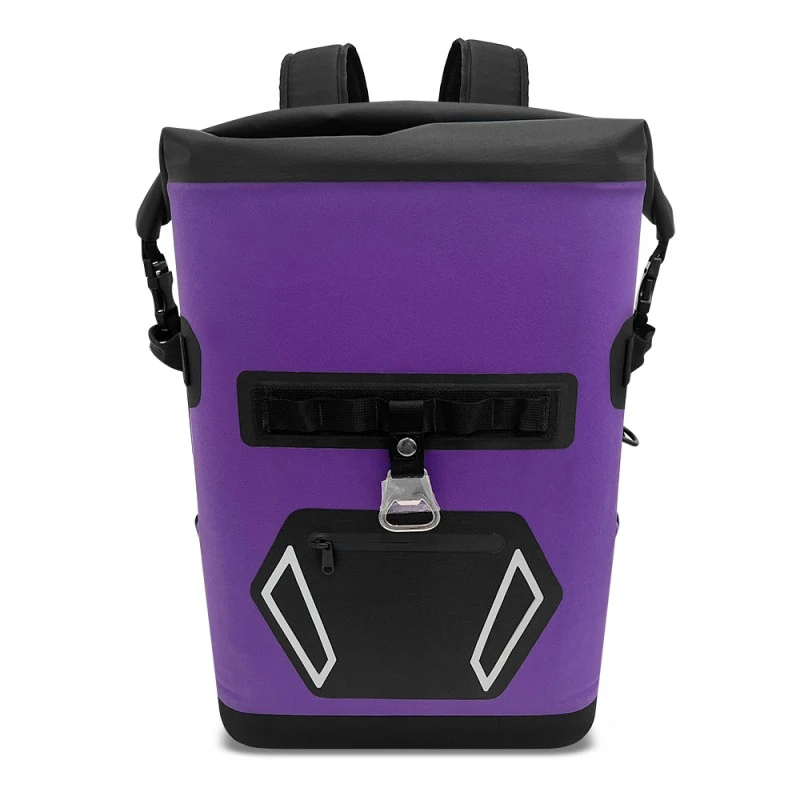
45L roll-top backpack cooler SL-I270 45L Roll-Top Backpack Cooler (SL-I270) Food-grade TPU liner, 600D TPU shell, EVA foam, welded roll-top View
Roll-top leakproof soft cooler SL-I288 Roll-Top Leakproof Soft Cooler (SL-I288) Food-grade waterproof liner, 840D TPU, closed-cell EPE, HF welded seamless View
Insulated leakproof cooler backpack SL-I075A Insulated Leakproof Cooler Backpack (SL-I075A) PEVA film liner, 840D PVC tarpaulin shell, EPE foam View
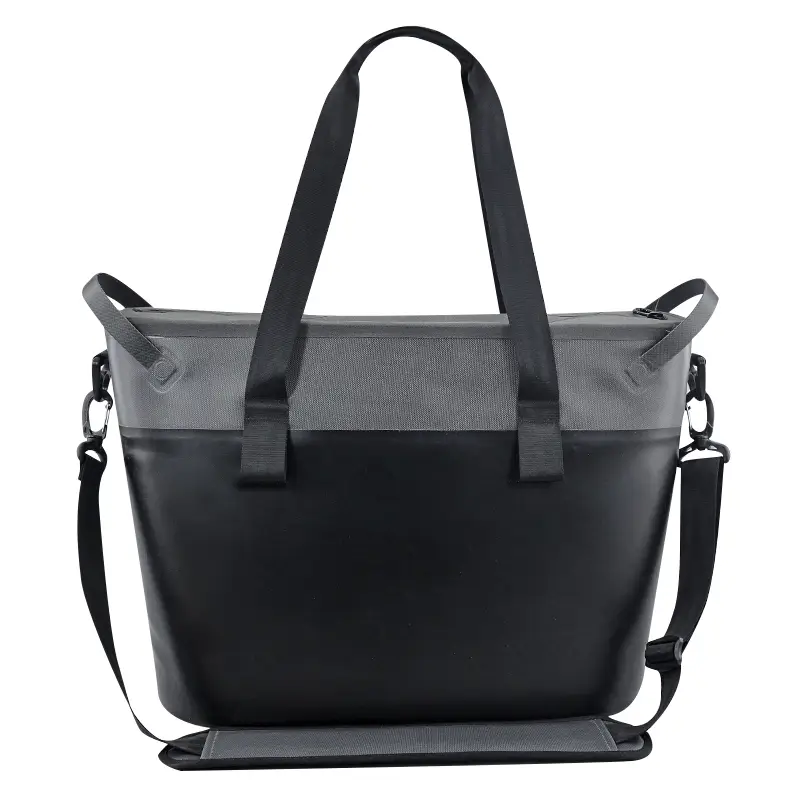
24L soft cooler tote SL-I230 24L Soft Cooler Tote (SL-I230) Food-grade liner, 840D TPU, 20 mm XPE, IPX7, HF welded View
cross-section showing the welded food-grade liner as the food contact surface versus a stitched liner

FAQ: Food Grade Cooler Bag Standards

Q: What does "food grade" actually mean on a cooler bag?

A: That the food-contact liner complies with the food-contact regulations of the market it is sold into — principally 21 CFR Parts 174–178 in the US, Regulation 1935/2004 with GMP Regulation 2023/2006 and, for plastics, 10/2011 in the EU, and the GB 4806 series in China. All rest on the same principle: the material must not transfer constituents into food in harmful amounts. Without a named standard and a test report, the phrase means nothing.

Q: Is there such a thing as an "FDA certified" cooler bag?

A: No. The FDA system is substance-based rather than product-certifying — each substance in the food-contact layer needs a legal basis, whether a listed regulation, a Food Contact Notification or a Threshold of Regulation exemption. What you should request is a migration test report against 21 CFR for the specific liner in your product, not a certificate for the bag.

Q: What is a Declaration of Compliance and do I need one?

A: It is the EU document confirming a food-contact material meets the applicable requirements, backed by lab test reports, and it is mandatory for certain food-contact materials. It exists so everyone down the supply chain can see the compliance status. Note it must sit on supporting documentation available to enforcement authorities — and do not confuse it with the Declaration of Conformity used for CE-marked products.

Q: If my liner is FDA compliant, is it also EU compliant?

A: No. Compliance does not transfer between markets. Each regime has its own approved-substance lists, migration limits, test simulants and documentation requirements — China's migration testing even uses different simulants from the EU in some cases, such as olive oil for high-fat foods. Selling into several markets means obtaining evidence for each.

Q: What are the EU migration limits?

A: The overall migration limit is 10 mg per square decimetre of material or 60 mg per kilogram of food, with specific migration limits applying to individual substances. Testing uses food simulants chosen to behave like real foods, so a report is only meaningful when the simulant, temperature and duration match how the product is actually used.

Q: Does the way the liner is attached affect food safety?

A: Yes, in practice. A stitched liner puts needle holes and thread inside the food chamber, where residue and moisture lodge and cleaning cannot reach; a welded liner is a continuous, smooth, non-porous surface that wipes clean. Good manufacturing practice requirements also extend to the factory — material handling, contamination control during production, and lot traceability — not only to the film itself.

Need food-contact documentation for your market? Sealock (YiFuLong Outdoor Gear Co., Ltd.) builds welded soft coolers with food-grade liners across the entire range, with migration testing available for your destination market and third-party testing on request. Tell the team where you sell, and they will confirm what documentation your programme needs.

Email: info@sealock.com.hk  |  Phone: +86-13632981825  |  Browse the soft cooler range

Regulations, limits and standard references cited here reflect publicly available regulatory and testing-industry sources as of mid-2026; food-contact legislation is amended regularly and requirements differ by market and material. This is general information, not regulatory or legal advice — confirm current requirements for your destination markets with an accredited laboratory or qualified regulatory adviser before production.

Related News
Leave me a message
X
We use cookies to offer you a better browsing experience, analyze site traffic and personalize content. By using this site, you agree to our use of cookies.Privacy Policy