Most "best soft cooler bag" lists rank coolers by how long they held ice in one test. That number matters, but it is rarely why a soft cooler disappoints its owner. Reviews and returns tell a different story: zippers that leak along their whole length, closures so stiff that people leave them half open, handles that tear out of the shell, liners that start to smell, and bags that tip over the moment they are set down. Each of these is a construction fault, and each can be spotted before you buy if you know where to look. This guide lists the eight faults we check for when we design, sample and inspect soft coolers, and how to check each one in a few minutes. It is written by Sealock (YiFuLong Outdoor Gear Co., Ltd.), which has manufactured soft cooler bags and cooler backpacks with both high-frequency welded and sewn construction for over 20 years, for brands including Stanley, YETI, Hydro Flask, Osprey and Simms.
1. A Closure That Leaks Along Its Length
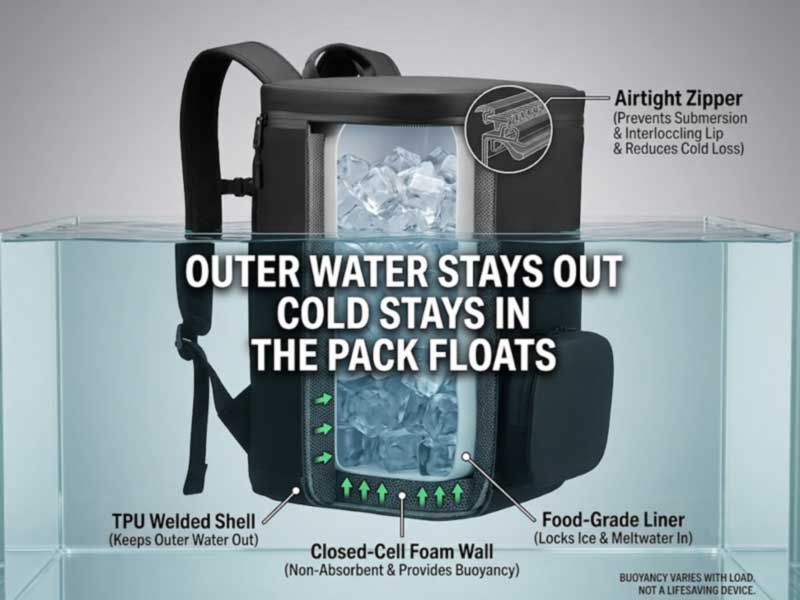
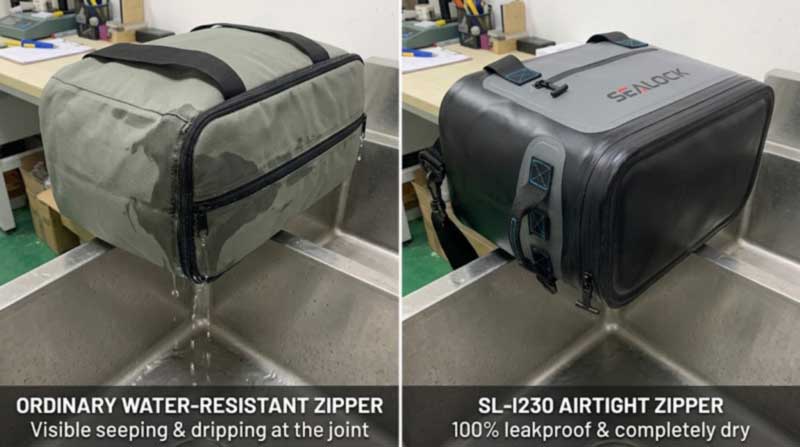
In published soft cooler tests, the most common failure is not the insulation but the closure: zippers that let water through anywhere along the track, small leaks between the two sliders of a double zipper, and magnetic or roll-top closures that only seal when shut with care. There are three levels of zipper: water-resistant coil zippers that slow water down, waterproof zippers with a coated tape, and airtight zippers with interlocking moulded teeth that seal against air and water. Only the last behaves like a gasketed lid.
How to check: fill the closed cooler with water to just below the zipper, turn it on its side over a sink and hold it for a minute. Then look at where the two ends of the zipper meet the body, which is where leaks usually start. Our article on waterproof and airtight zippers explains the differences in detail.
2. A Zipper So Stiff You Leave It Open
The flip side of a good seal is resistance. Airtight zippers are tight by design, and testers regularly note coolers whose zippers are hard to run one-handed or need two hands and a firm pull. A closure that is hard to use gets left half open, and a half-open cooler loses both its seal and its cold. A good airtight zipper is stiff but even along its length, has a large pull you can grip with a wet hand, and comes with a zipper lubricant, which most makers of airtight zippers recommend applying regularly.
How to check: open and close it ten times one-handed. It should feel consistent from end to end, with no point where it catches or needs the bag held steady.
3. Thin Insulation at the Top and Base
Side walls are easy to insulate. The lid, the rolled top of a roll-top cooler and the base are not, and those are where cold escapes and where the foam is compressed by the weight of ice. Testers have noted roll-top coolers losing ice fastest at the top for exactly this reason. Non-crosslinked foam at the base can also crush flat over a season and lose much of its insulation without any visible damage.
How to check: pinch the lid, the top roll and the base between thumb and finger and compare them with the side wall. Press a thumb into the base for ten seconds: crosslinked foam springs back at once, cheaper foam recovers slowly. Our guides to soft cooler ice retention and XPE foam versus EPE explain why.
4. A Sewn Liner
The liner is the waterproof wall that holds meltwater and touches food. If it is assembled by sewing, every stitch is a hole, and over time meltwater finds its way through and into the foam, where it cannot drain or dry. That is the origin of most "my cooler smells" and "there is water in the walls" complaints. A liner joined with high-frequency welded seams forms a sealed chamber. It should also be food-grade, smooth and free of deep creases where crumbs collect.
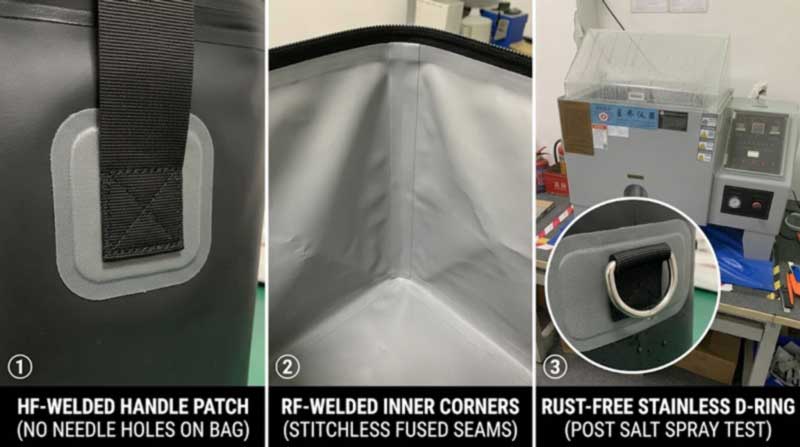
How to check: look inside at the corners and along the bottom. Welded seams appear as flat, fused bands with no thread; sewn seams show stitches, often covered with tape.
5. Handles and Straps Stitched Through the Shell
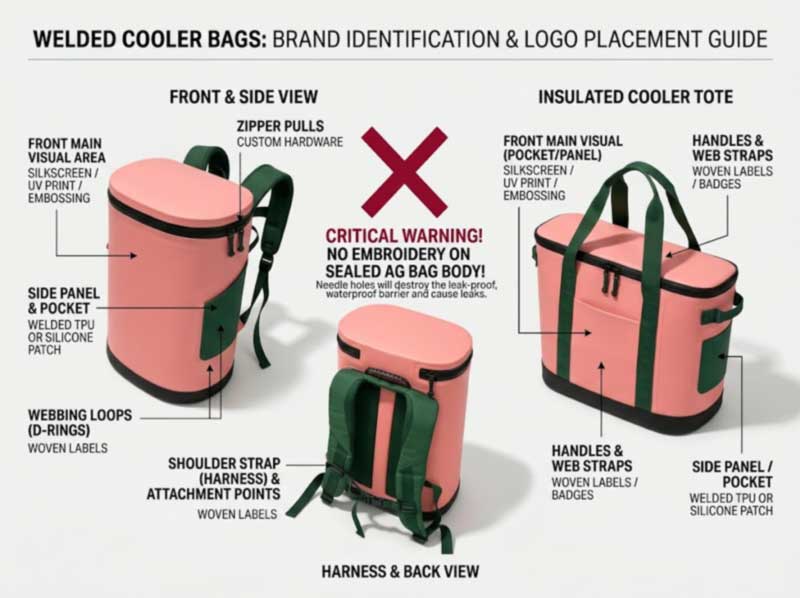
A full 20-litre cooler of ice and drinks can weigh well over 15 kg, and all of it hangs from the handle and strap anchors. If the anchors are simply sewn through the waterproof shell, two things go wrong: the stitch holes become leak paths, and under repeated load the stitching tears out of the fabric. The reliable approach is to sew webbing to a reinforcing patch and weld the patch to the shell, or to weld the anchor directly, so the load spreads across a wide area and the waterproof layer is never pierced.
How to check: look at where the handles and strap rings meet the body. Look for a wide reinforcing patch rather than a narrow line of stitching through the outer fabric. On a cooler backpack, check the shoulder strap anchors in the same way.
6. Mistaking Condensation for a Leak
On a warm, humid day, the outside of a well-sealed soft cooler can feel damp, and a small wet patch may appear under it. Testers have reported exactly this and traced it to condensation rather than a leak. It happens where the cold inside reaches the outer surface, usually at the base or at thin points in the insulation. A little condensation under the base is normal. A cooler that sweats across its whole surface has thin or compressed insulation.
How to check: after a few hours with ice in it, wipe the outside dry and feel it again ten minutes later. Moisture concentrated in one place shows where the insulation is weakest.
7. A Bag That Tips Over
Soft coolers that collapse flat when empty are convenient to store, but without some structure they slump when half full, tip over when set down, and spill when opened on uneven ground. A reinforced base, a moulded lid or rigid side panels keep the bag upright and make it easier to pack and unload.
How to check: put a few cans in the empty cooler and stand it on the floor. It should stay upright with the lid open.
8. Hardware That Corrodes
Coolers spend their lives around meltwater, beaches and boats. Buckles, D-rings, zipper sliders and bottle openers made from plain steel or low-grade alloy start to rust within a season by the sea, staining the fabric and seizing the zipper. Marine-grade hardware and plastic or coated components last; we salt-spray test metal parts for this reason.
How to check: look for rust marks on display samples and ask what the metal hardware is made of. Stainless steel or coated components should be specified on anything intended for the beach or boat.
Which Type of Soft Cooler Bag for Which Use
| Use | What to look for | Typical retention class |
|---|---|---|
| Grocery runs, lunch, short outings | Light tote, closed-cell foam, food-grade liner, wipe-clean | Up to about a day |
| Beach, picnics, day trips | Leakproof liner, structured base, shell that rinses clean, corrosion-proof hardware | About a day |
| Hiking, festivals, long walks | Cooler backpack with padded straps and sternum strap; heavy load kept close to the back | One to two days, depending on build |
| Fishing, boating, overnight trips | High-frequency welded shell and liner, airtight zipper or welded roll-top, thick crosslinked foam, IPX7 rating | About two days |
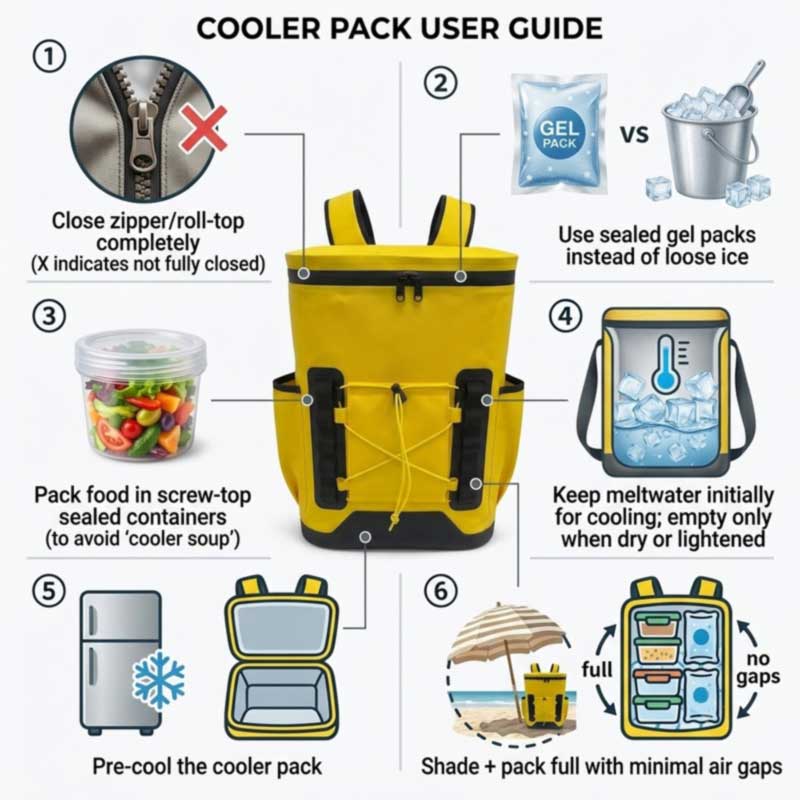
Whatever you choose, packing makes as much difference as the cooler itself; see how to pack a cooler.
For Brands: Build These Checks Into the Spec
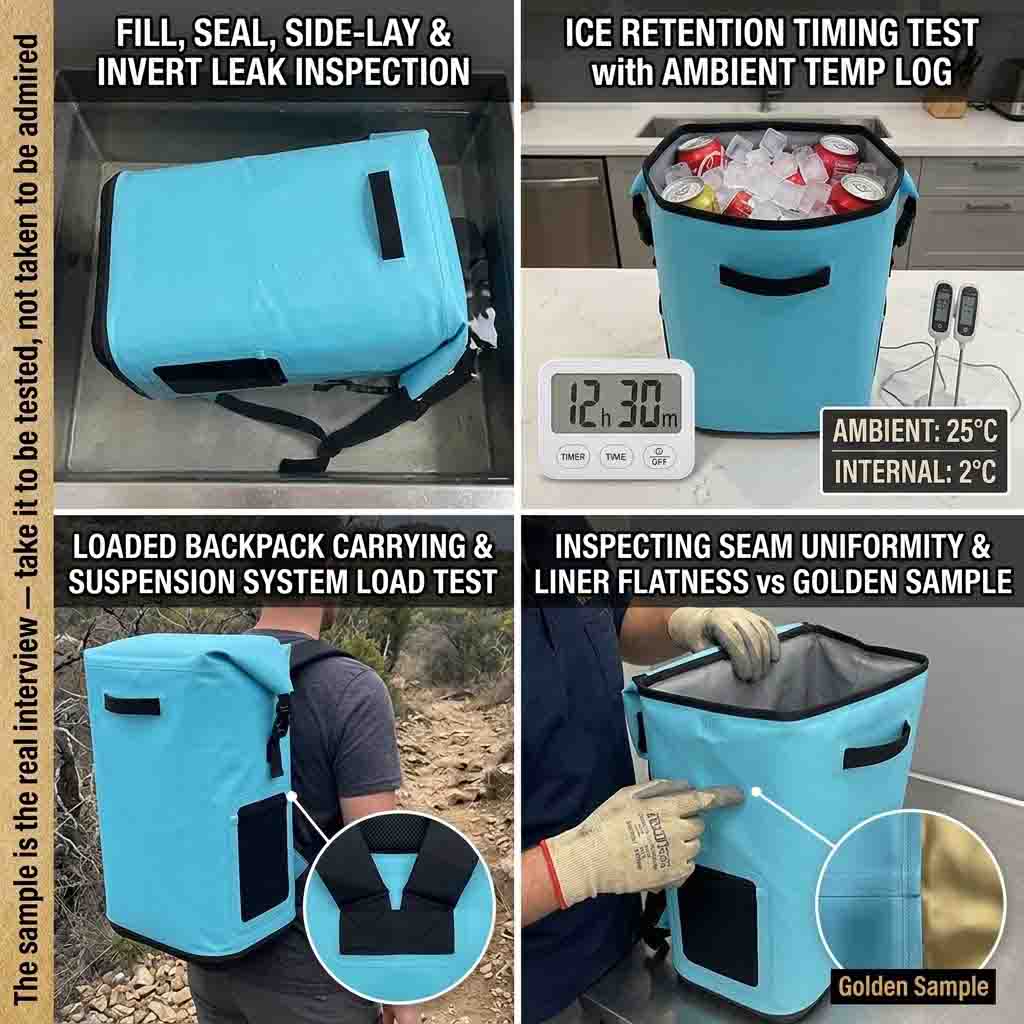
Every fault above can be designed out at the specification stage, and every one can be checked at sampling. When we develop a soft cooler for a brand, the spec sheet names the zipper type and supplier, foam type, density and thickness per panel, liner material and seam method, strap anchor construction and hardware grade. The sample then goes through the same tests as production: leak testing (full water-immersion for 2+ hours on IPX7 models, heavy rain and water-jet testing on non-submersible ones), load testing to 1,500-plus cycles on handles and straps, zipper fatigue to 3,000 cycles, tensile and bonding strength on welds, salt spray on hardware, abrasion and colour fastness, and multi-probe cold-hold logging. IQC, IPQC and OQC run through production, with SGS or QIMA third-party inspection available on request.
Soft Cooler Bags in Our Range
| Image | Model | Build | Link |
|---|---|---|---|
|
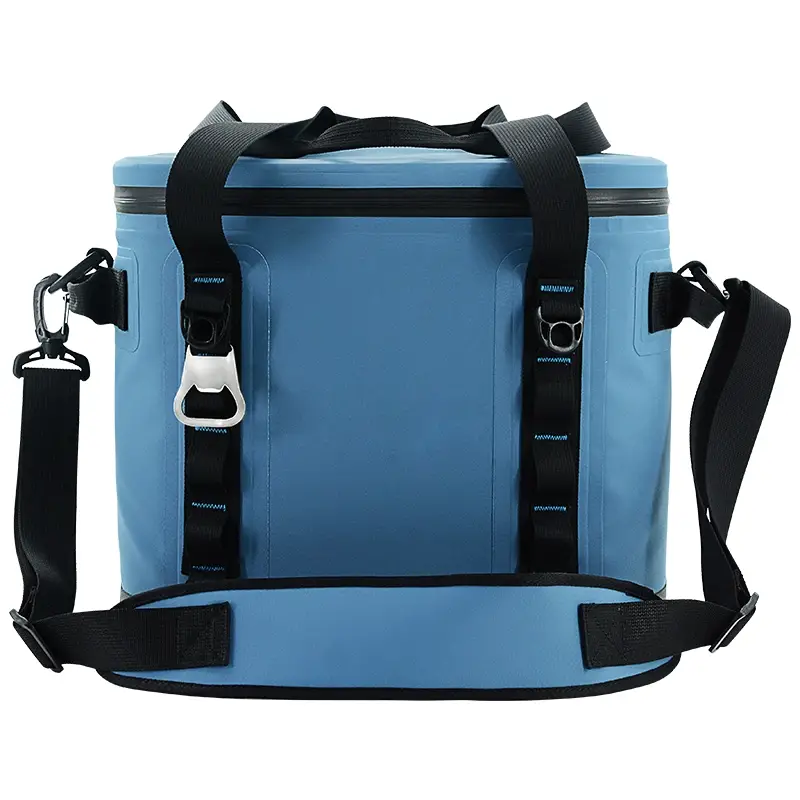
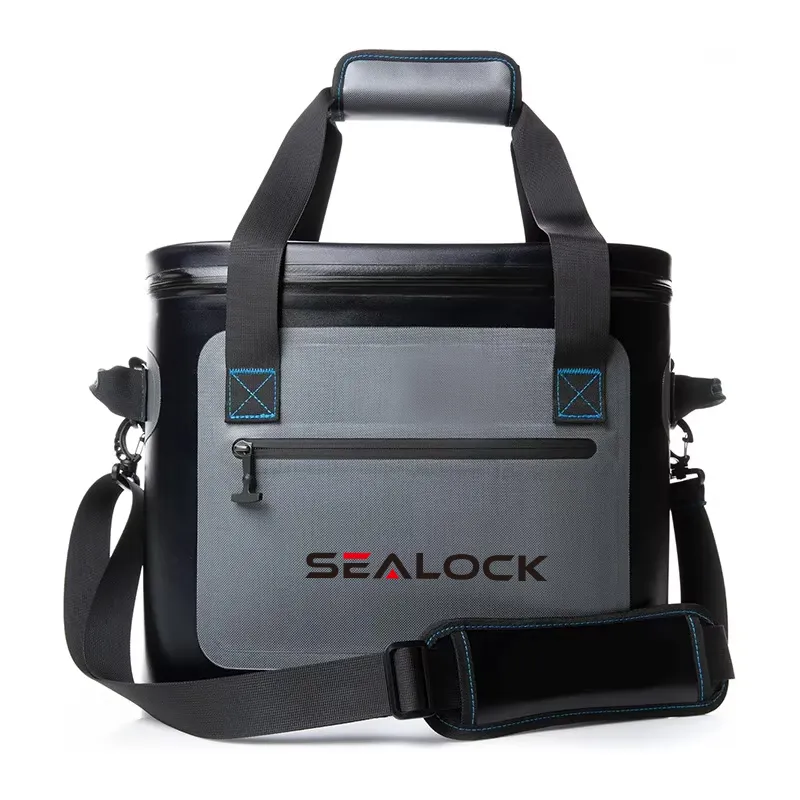
24L Soft Cooler Tote (SL-I230) | 840D TPU, 20 mm XPE, airtight zipper, IPX7, high-frequency welded, up to 48 hr | View |
|
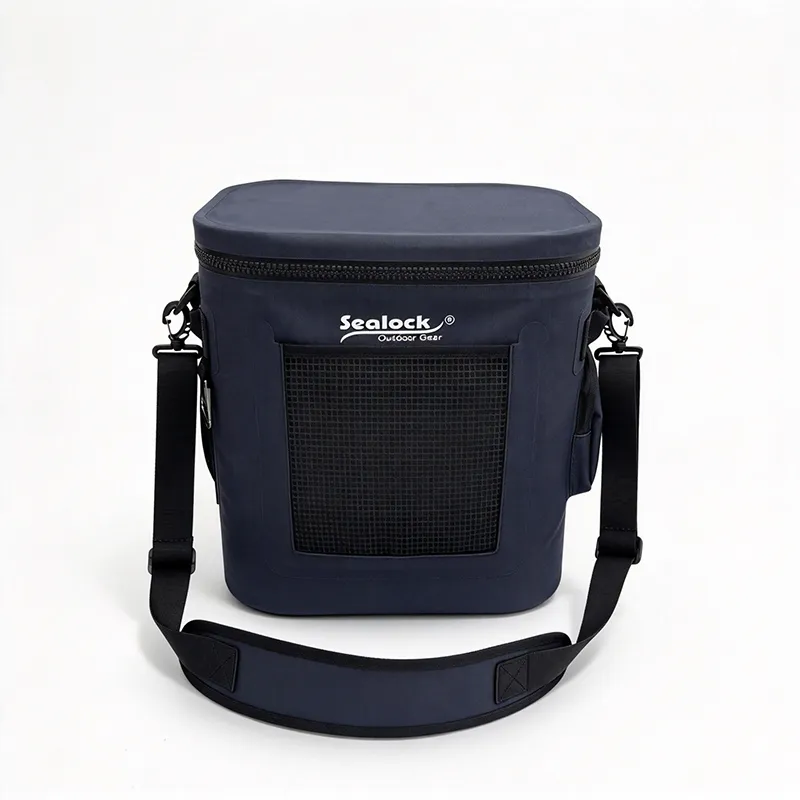
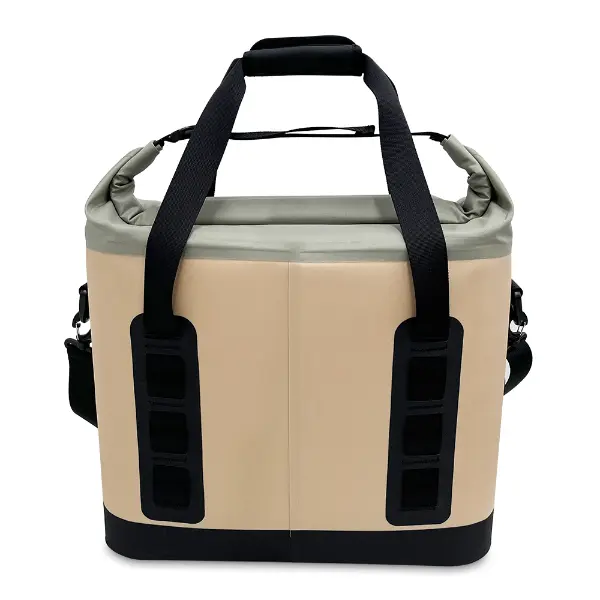
20L Roll-Top Leakproof Cooler (SL-I288) | 840D TPU, closed-cell EPE, welded roll-top, reinforced base, waterproof front pocket, up to 48 hr | View |
|
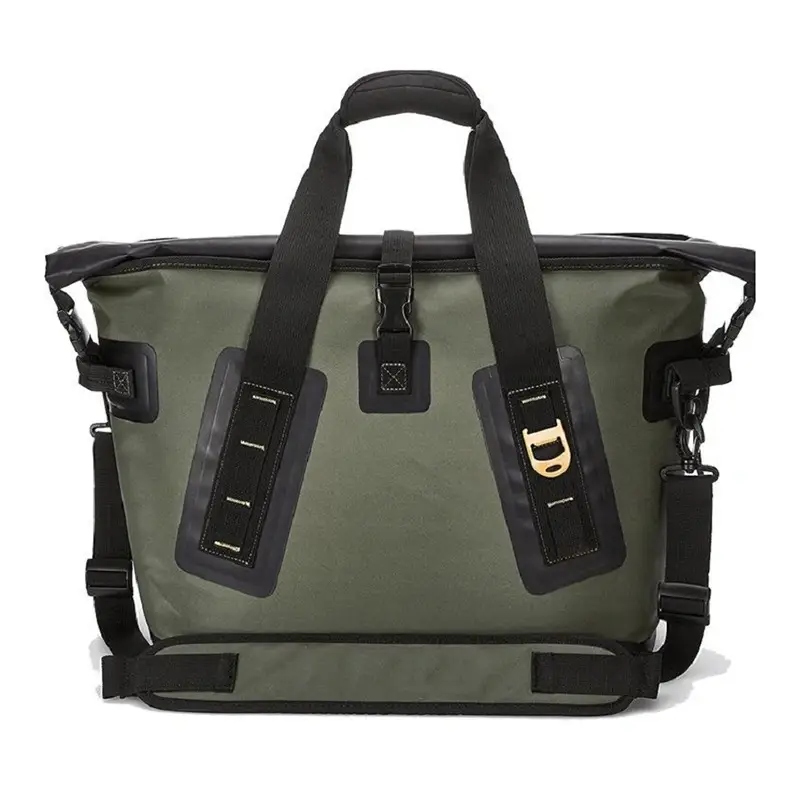
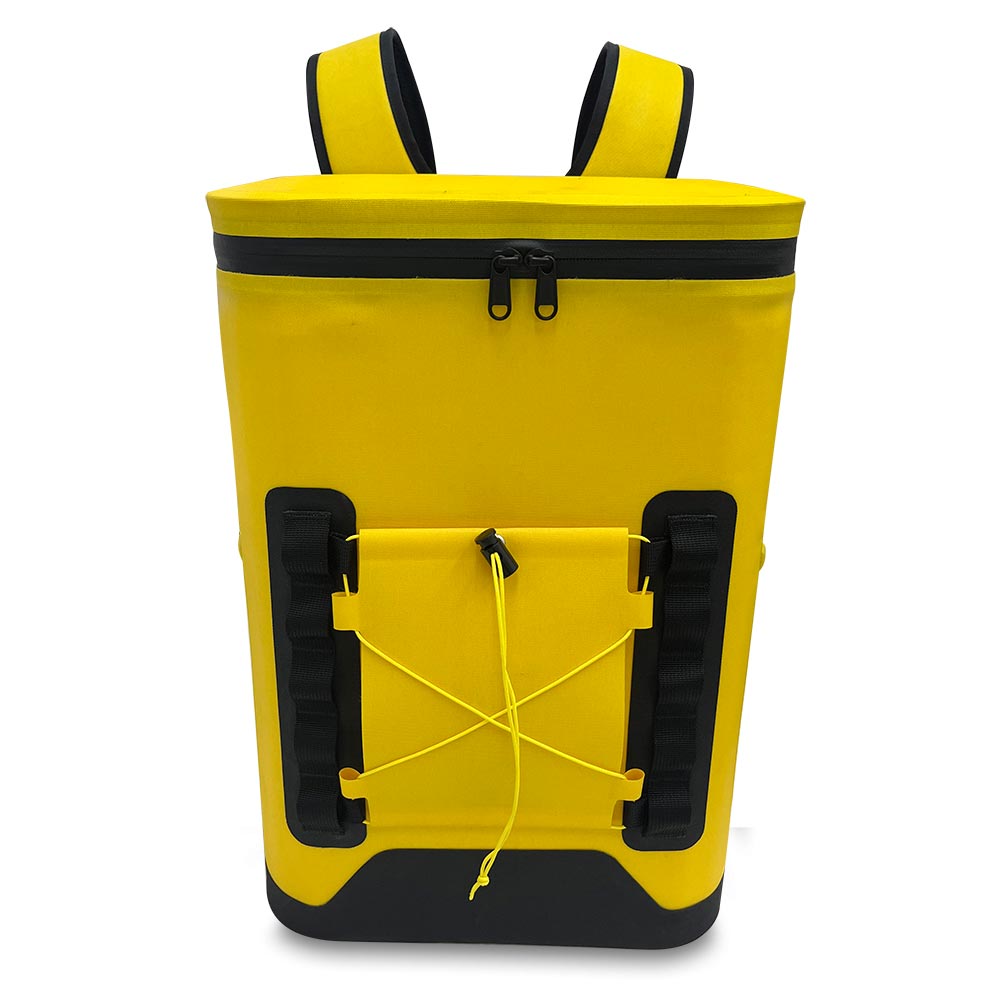
28L Airtight-Zipper Cooler Backpack (SL-I274) | 840D TPU, 3 cm EVA core, food-grade TPU membrane, airtight zipper, ergonomic harness, up to 48 hr | View |
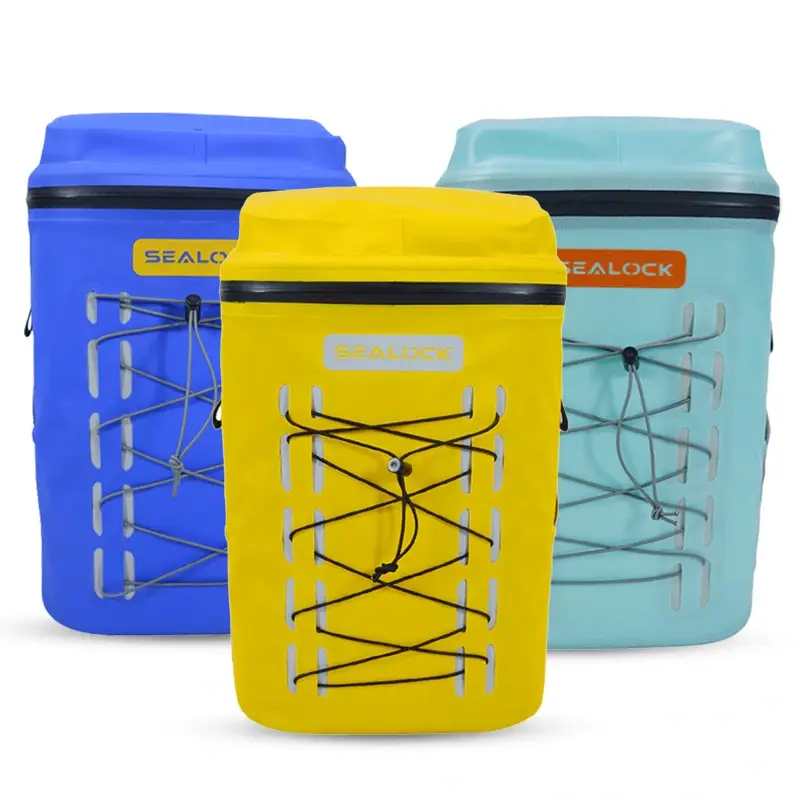
|
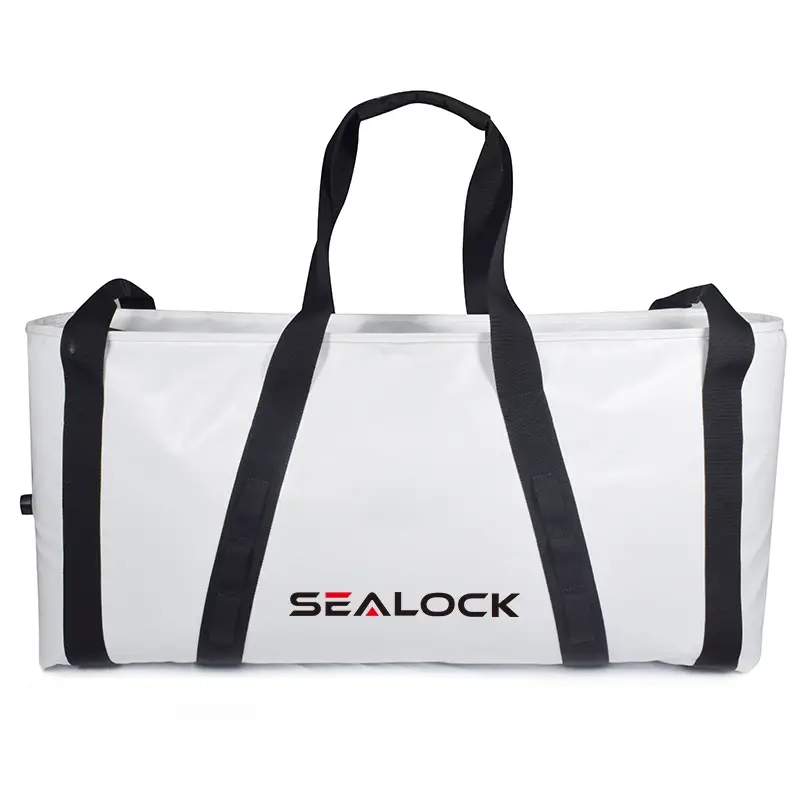
Insulated Cooler Backpack (SL-I075A) | 840D PVC tarpaulin, EPE foam, PEVA liner, 36 cans | View |
All are available for OEM and ODM with your logo, colours and specification. MOQ starts at 300 pieces, samples take 7–15 days and bulk production 30–45 days.
FAQ
Q: What is the best soft cooler bag?
A: The one built for how you will use it, without the faults above: a closure that seals along its whole length and is easy enough to close every time, insulation as thick on the top and base as on the sides, a welded liner, strap anchors that do not pierce the shell, a structured base and corrosion-resistant hardware.
Q: Why is my soft cooler wet on the outside?
A: Usually condensation, not a leak. On a humid day, cold that reaches the outer surface makes moisture condense, typically under the base. Widespread sweating means the insulation is thin or compressed in places.
Q: Why is my soft cooler zipper so hard to close?
A: Airtight zippers are tight by design so they can seal. Keep the teeth clean, apply the zipper lubricant supplied with the cooler, and close it on a flat surface without overfilling the bag.
Q: Are soft cooler bags leakproof?
A: Only some. Leakproof soft coolers use a welded liner and a waterproof or airtight closure. Many soft coolers are water-resistant only and will leak meltwater through the zipper if tipped.
Q: How long does a good soft cooler bag keep ice?
A: A basic soft cooler keeps ice for about a day in mild conditions. A well-built welded cooler with an airtight closure can reach about two days. Heat, sun and frequent opening shorten both.
Q: Can you make a soft cooler bag to our specification?
A: Yes. We develop soft coolers and cooler backpacks from your spec or ours, with welded or sewn construction as the design requires, and test the sample to the same standard as production before bulk.
Developing a soft cooler for your brand? Send us the use, capacity and price point. We will propose the construction, build a sample in 7–15 days and test it against the faults that cause returns.
Email: info@sealock.com.hk · Phone: +86-13632981825 · MOQ 300 pcs
Observations about common faults draw on published soft cooler reviews and on our own sampling and inspection experience. Brand customers are named as manufacturing clients only; no endorsement is implied.