The best lunch bag is the one that still has your food below 40°F (4°C) when you open it at lunchtime, does not leak on the way, fits the containers you actually use and survives a year of daily handling. That sounds obvious, but the numbers show how often lunch bags miss it. In lunch cooler tests by Reviewed, bags that relied on ice packs kept their contents below 40°F for roughly 2.5 to 6.5 hours. If you pack at 7 a.m. and eat at 12:30, the weaker end of that range does not get you to lunch. This guide sets out the seven things we check when we design and test a lunch bag, so you can judge any lunch bag on what matters rather than on looks. It is written by Sealock (YiFuLong Outdoor Gear Co., Ltd.), which has manufactured insulated bags and lunch boxes for over 20 years at its factories in Dongguan, China and Ho Chi Minh City, Vietnam.
1. Will It Keep Food Cold Until Lunchtime?
Start with your own day, not the label. Count the hours from packing to eating, and add any time the bag sits in a warm car or a sunny site cabin. That is the number the lunch bag has to beat. US food-safety guidance treats 40°F as the upper limit for perishable food and advises that a packed lunch with perishables such as meat sandwiches, yogurt or salad should travel in an insulated bag with at least two cold sources, such as two gel packs or a gel pack and a frozen drink. A brown paper bag, by the same guidance, is unsafe for perishables after two hours.
What decides cold-hold in a lunch bag is the same as in any cooler: the thickness and continuity of the insulation, how well the closure seals, how cold the contents were to start with, and how many cold sources go in. A lunch bag is a short-duration product. Our own molded lunch boxes are rated up to 6 hours with a gel pack, which covers a morning-to-lunch commute; for anything longer, or for a hot day outdoors, add a second cold source or step up to a small soft cooler.
2. Hard Shell or Soft Bag?
Lunch bags come in two broad constructions, and the choice shapes everything else.
| Molded hard-shell lunch box | Soft insulated lunch bag | |
|---|---|---|
| Shell | Compression-molded EVA with a fabric face; holds its shape | Fabric outer over foam; flexible |
| Protects food from crushing | Yes — sandwiches and fruit arrive intact | Less, unless packed with rigid containers |
| Opening | Usually a full-perimeter zipper that opens flat like a case | Usually a top zip or flap |
| Storage when empty | Keeps its size | Folds or squashes into a bag |
| Cleaning | Smooth liner, few creases | More seams and corners where crumbs collect |
| Best for | Office, site work, anyone who carries the bag inside a backpack or tote | People who want a bag that packs away flat or expands |
A molded shell is built differently from a fabric bag. The EVA sheet is compression-molded against its fabric face in a heated tool, which gives it its rigid shape, and the liner, zipper, binding and handle are then sewn in. On a molded case, sewn and bound edges are the correct construction: they give the shell a clean perimeter and keep the hinge durable through thousands of openings.
3. Does It Fit Your Containers?
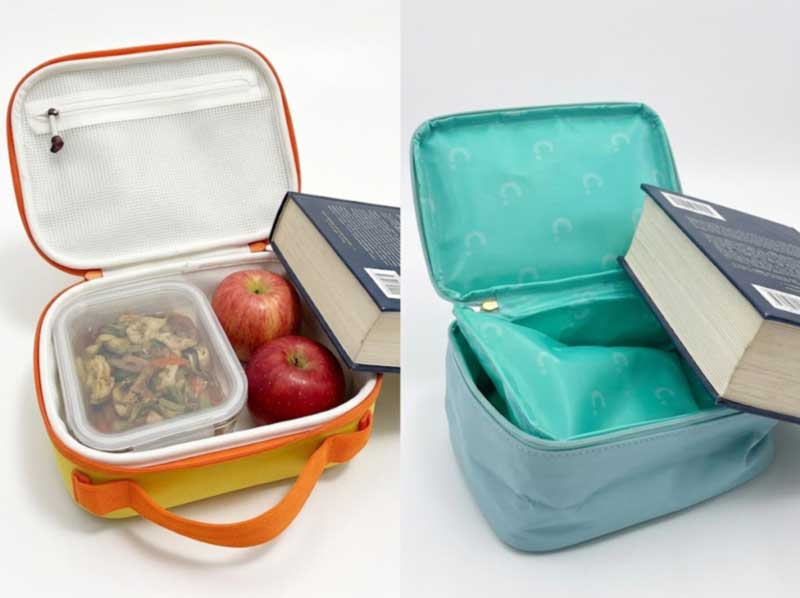
One of the most common complaints in lunch bag reviews is a bag that looks roomy online but will not take a standard meal-prep container flat, or that forces a container on its side so the sauce ends up in the bag. Before buying, measure the containers and the drink you carry, and compare them with the bag's internal dimensions, not just its capacity in litres. A wide, shallow case suits flat containers laid side by side; a taller bag suits stacked containers and an upright bottle.
4. What Is the Liner Made Of, and Can You Clean It?
The liner is the only part of the bag that touches food, so it should be a food-grade material such as PEVA, and it should be smooth and wipe-clean. Look at the corners and seams: deep creases and loose stitching are where crumbs and spills collect and where odour starts. USDA advice is simple: wash the inside with hot soapy water after use and let it air-dry. A bag stored zipped shut while still damp is the most frequent cause of a lunch bag that smells.
5. Splash-Resistant or Leakproof?
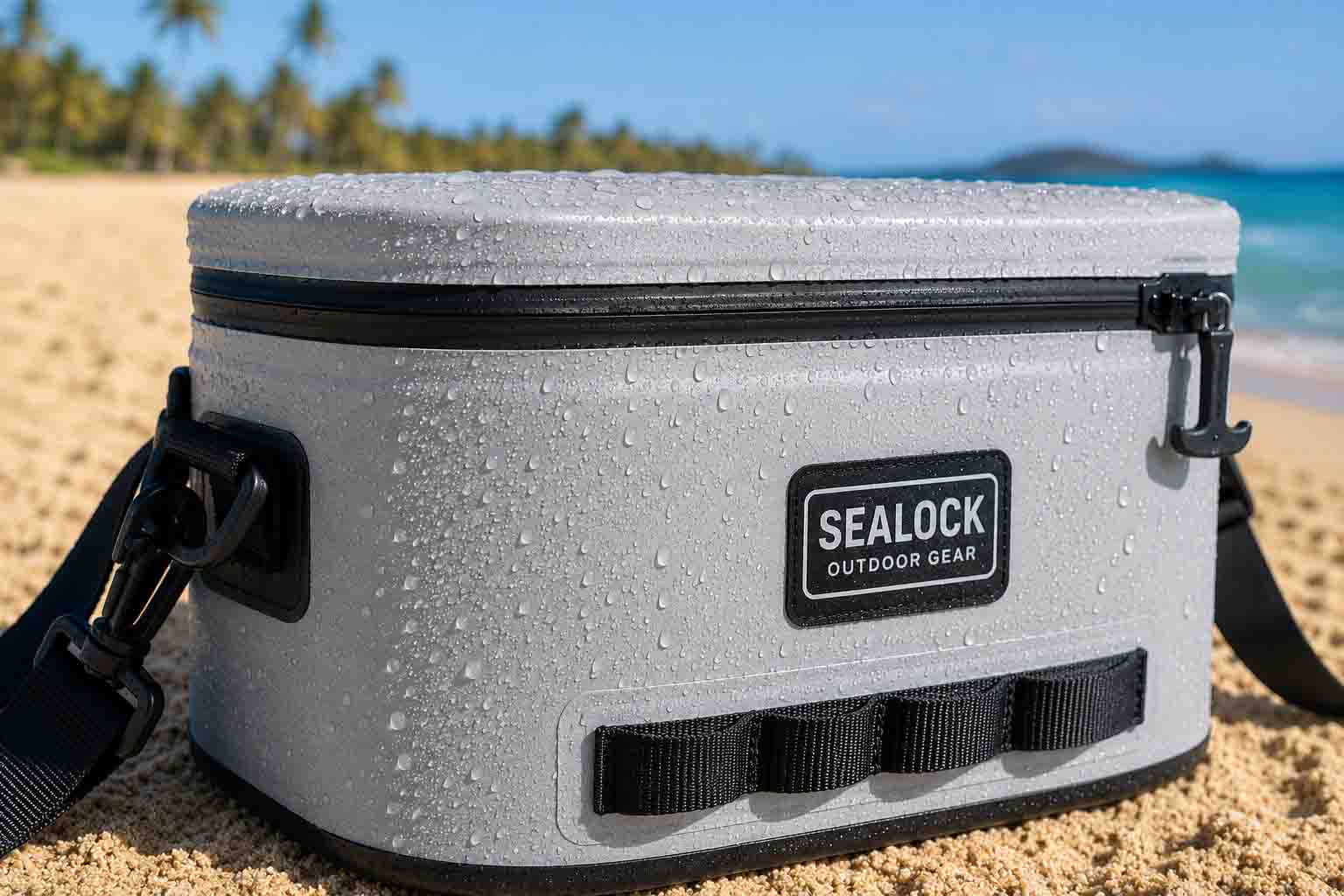
Most lunch bags, including our molded lunch boxes, are splash-resistant and wipe-clean, not waterproof. That is the right construction for a lunch bag carried upright, with food in sealed containers, but it means a tipped soup flask will find its way out through the zipper. If you need a truly leakproof bag, for example one that will lie on its side in a work bag or carry loose ice, the requirement is a liner sealed with high-frequency welded seams and a waterproof closure, which is the construction of a small soft cooler rather than a lunch bag. Check which of the two you are buying; "leak-resistant" on a label usually means the former.
6. How Does It Open and Close?
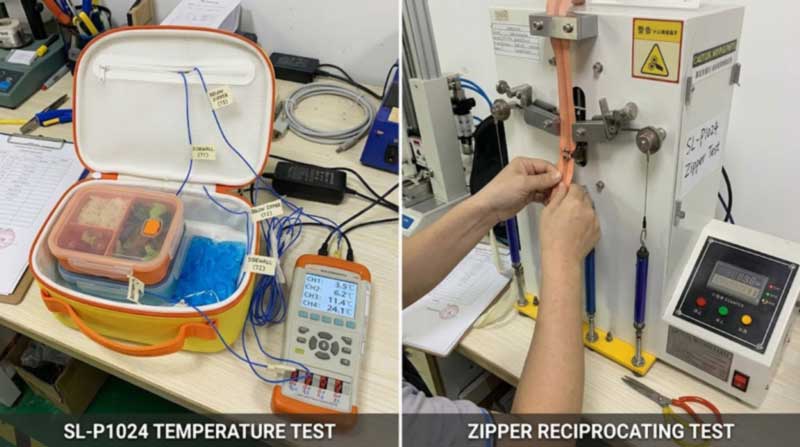
A full-perimeter zipper that opens the case flat lets you see and reach everything without lifting containers out, and closes more evenly than a top zip. Twin zipper pulls make it easy to open from either side and to close the case without forcing the last few centimetres. A zip mesh pocket in the lid is useful for cutlery, napkins or a flat gel pack, which then sits above the food where cold air sinks onto it. The closure is also the part that wears out first, which is why we fatigue-test zippers to 3,000 cycles: a lunch bag opened twice a working day goes through that in about six years.
7. Will It Last a Year of Daily Use?
A lunch bag is used more often than almost anything else you own: twice a day, five days a week, carried, dropped onto car seats and squeezed into bags. Check the handle attachment, the stitching at the hinge and the base, and the weight. A bag around 0.4 kg is light enough to disappear into a backpack. In our own production, lunch boxes go through the same standing test suite as our coolers: load testing to 1,500-plus cycles, zipper fatigue to 3,000 cycles, tensile and bonding strength, abrasion, colour fastness and colour difference, with cold-hold logged on a multi-channel thermocouple rig using probes at the base, the wall and under the zipper line.
Best Lunch Bag for Men, or Anyone With a Bigger Appetite
Searches for the best lunch bag for men usually come down to three practical needs rather than a style: capacity for a full meal plus snacks, a tougher shell for site, field or warehouse work, and a design that looks at home in a work bag. In practice that means a case of about 4.5 litres or more with room for two containers, a molded or heavy-fabric shell that does not crush when something heavy lands on it, a strong webbing handle, and a neutral or custom colour. The same checks above still decide whether it is a good lunch bag. For a long shift in a hot vehicle, pack two cold sources and consider a small soft cooler instead, because a lunch bag is designed for a morning, not a full day in the heat.
How to Get the Most From Any Lunch Bag
Pack the lunch straight from the refrigerator in the morning rather than the night before at room temperature. Use two cold sources for perishables; a frozen water bottle counts as one and is a drink by lunchtime. Put the gel pack on top of the food, since cold air sinks. Keep the bag out of direct sun and off the dashboard. At home, empty it, wipe the liner, and leave it open to dry. Our guides on how to pack a cooler and soft cooler ice retention cover the same principles for longer trips.
For Brands, Retailers and Corporate Programmes
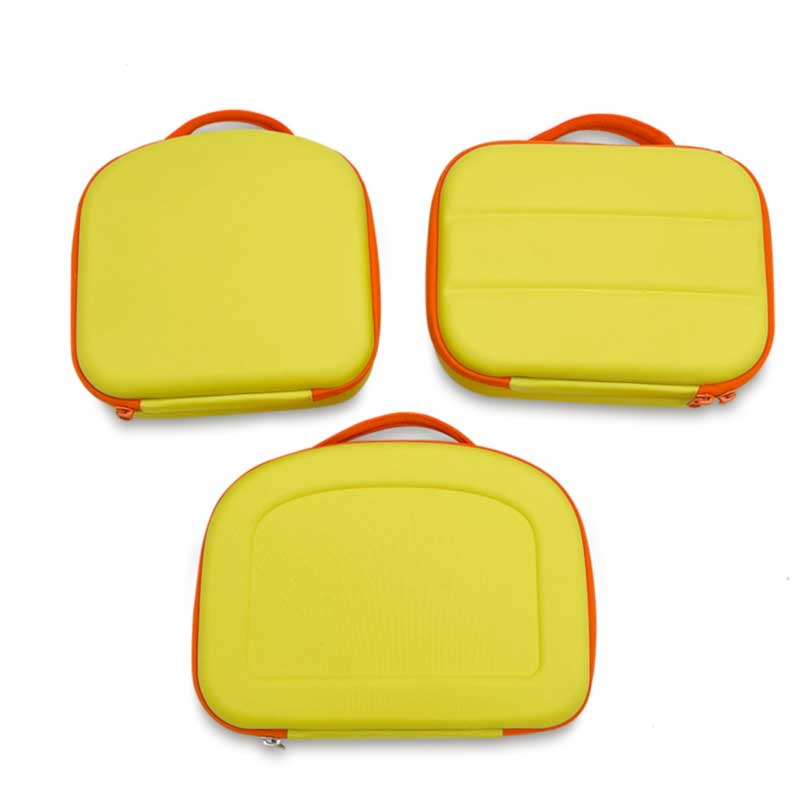
Lunch bags are among the most common products in corporate gifting, school and employee programmes and private-label retail, and the logo is part of the product. Our molded lunch boxes carry a recessed logo panel cut into the lid tool, so the branding position is designed in: artwork sits square in the frame, slightly below the surrounding surface where it is protected from scuffing. It can be filled by silk-screen, heat-transfer, digital or UV print or a rubber or woven patch, or the mark can be debossed or embossed directly in the tool for branding with no printed layer at all. Because the panel is tooled, we confirm logo proportions against the frame at sample stage. Existing molds start at 300 pieces per size, with samples in 7–15 days and production in 30–45 days; new mold development for a custom shape is supported and takes longer.
Lunch Boxes and Lunch Bags in Our Range
| Image | Model | Specification | Link |
|---|---|---|---|
|
Molded Lunch Box Cooler (SL-P1021 / SL-P1024) | Two sizes: 26 × 20 × 9 cm, approx. 4 L, 0.40 kg / 26 × 20.8 × 10 cm, approx. 4.5 L, 0.45 kg; compression-molded EVA, food-grade PEVA liner, perimeter zipper with twin pulls, recessed logo panel, up to 6 hr with a gel pack | View |
|
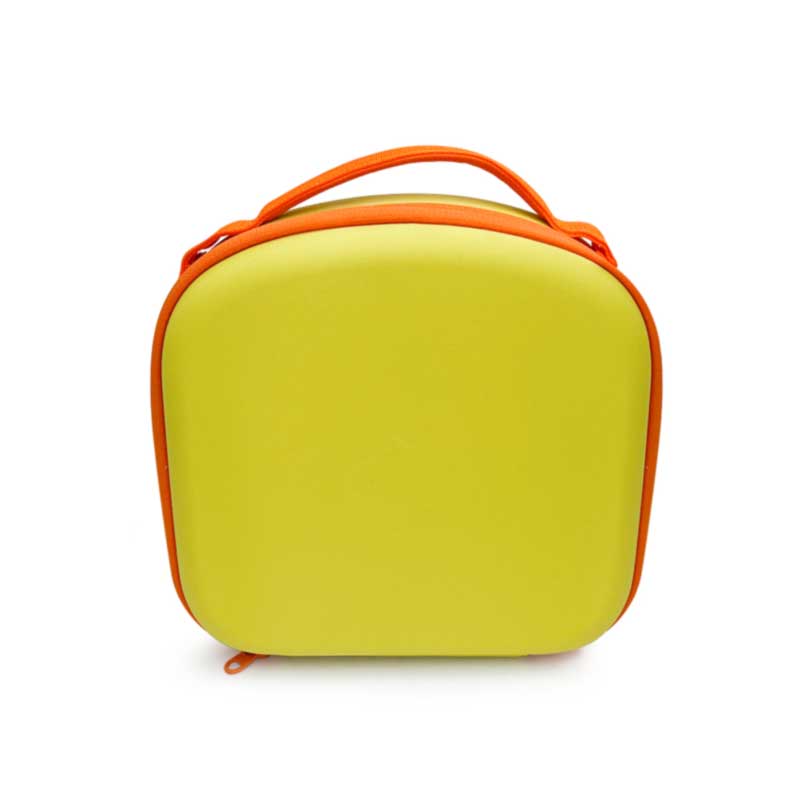
EVA Hard-Shell Insulated Lunch Box (SL-P1023) | 23 × 22 × 9 cm, approx. 4 L, 0.4 kg; compression-molded EVA, food-grade PEVA liner, opens flat, zip mesh lid pocket, up to 6 hr with a gel pack | View |

|
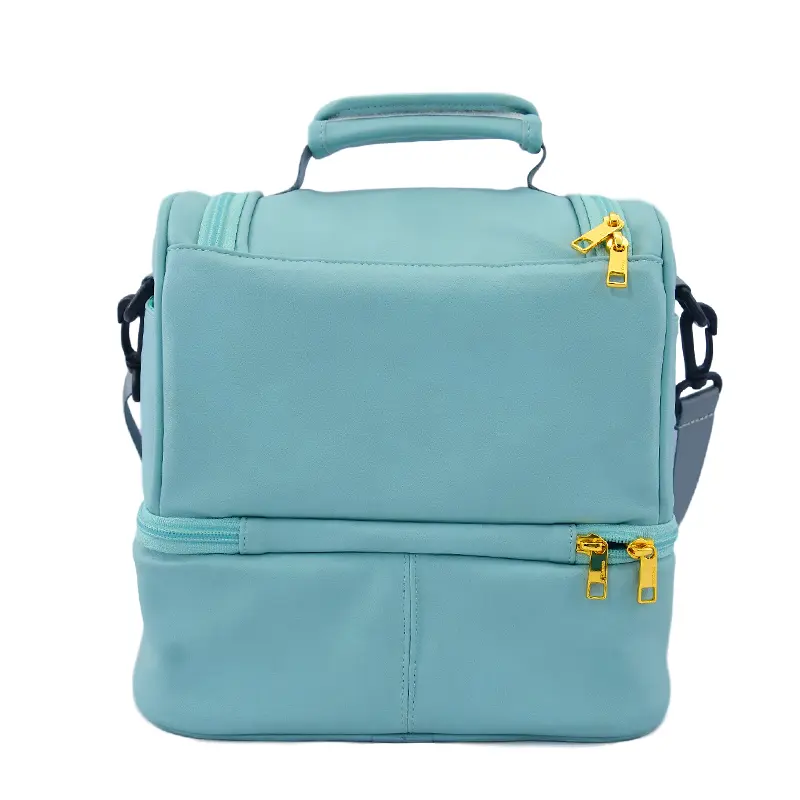
Insulated Lunch Bag (SL-H109) | Soft construction; recycled polyester with TPU coating and PU leather trim; insulated; custom colours | View |
FAQ
Q: What is the best lunch bag for keeping food cold?
A: One with continuous insulation, a closure that seals evenly all the way round, and room for two cold sources. Even a good lunch bag is designed for a few hours, so pack food cold from the refrigerator and add two gel packs or a gel pack and a frozen drink for perishables.
Q: How long does an insulated lunch bag keep food cold?
A: Typically a few hours to around six hours with ice packs, depending on the bag and the conditions. In Reviewed's tests, ice-pack lunch coolers held contents below 40°F for about 2.5 to 6.5 hours. Our molded lunch boxes are rated up to 6 hours with a gel pack.
Q: Is a hard-shell lunch box better than a soft lunch bag?
A: For protecting food and keeping its shape, yes: a molded shell stops sandwiches and fruit being crushed and opens flat for easy access. A soft bag is better if you want it to fold away when empty.
Q: Are lunch bags waterproof?
A: Most are splash-resistant and wipe-clean rather than waterproof, including ours. Keep liquids in sealed containers and carry the bag upright. A fully leakproof bag needs a welded liner and a waterproof closure.
Q: How do I stop my lunch bag from smelling?
A: Empty it every day, wash the liner with warm soapy water, and leave it open to dry completely before closing it. Odour almost always comes from a bag zipped shut while damp.
Q: What size lunch bag should a man get?
A: Measure what you carry. For a full meal plus snacks, about 4.5 litres or more with room for two flat containers is a practical size, in a shell tough enough for your workplace.
Q: Can you make custom lunch boxes with our logo?
A: Yes. Our molded lunch boxes have a recessed logo panel in the lid for print, patch, deboss or emboss, and the shell can also be printed or carry a woven label. MOQ is 300 pieces per size on existing molds, with samples in 7–15 days.
Planning a lunch box programme? Tell us the quantity, sizes and how you want the logo applied. We will confirm the artwork against the molded panel and send samples within 7–15 days.
Email: info@sealock.com.hk · Phone: +86-13632981825 · MOQ 300 pcs per size
Food-safety guidance follows USDA advice; follow local rules where you are. Test figures quoted are from Reviewed's published lunch cooler testing. Cold-hold depends on starting temperature, number of cold sources and ambient conditions.