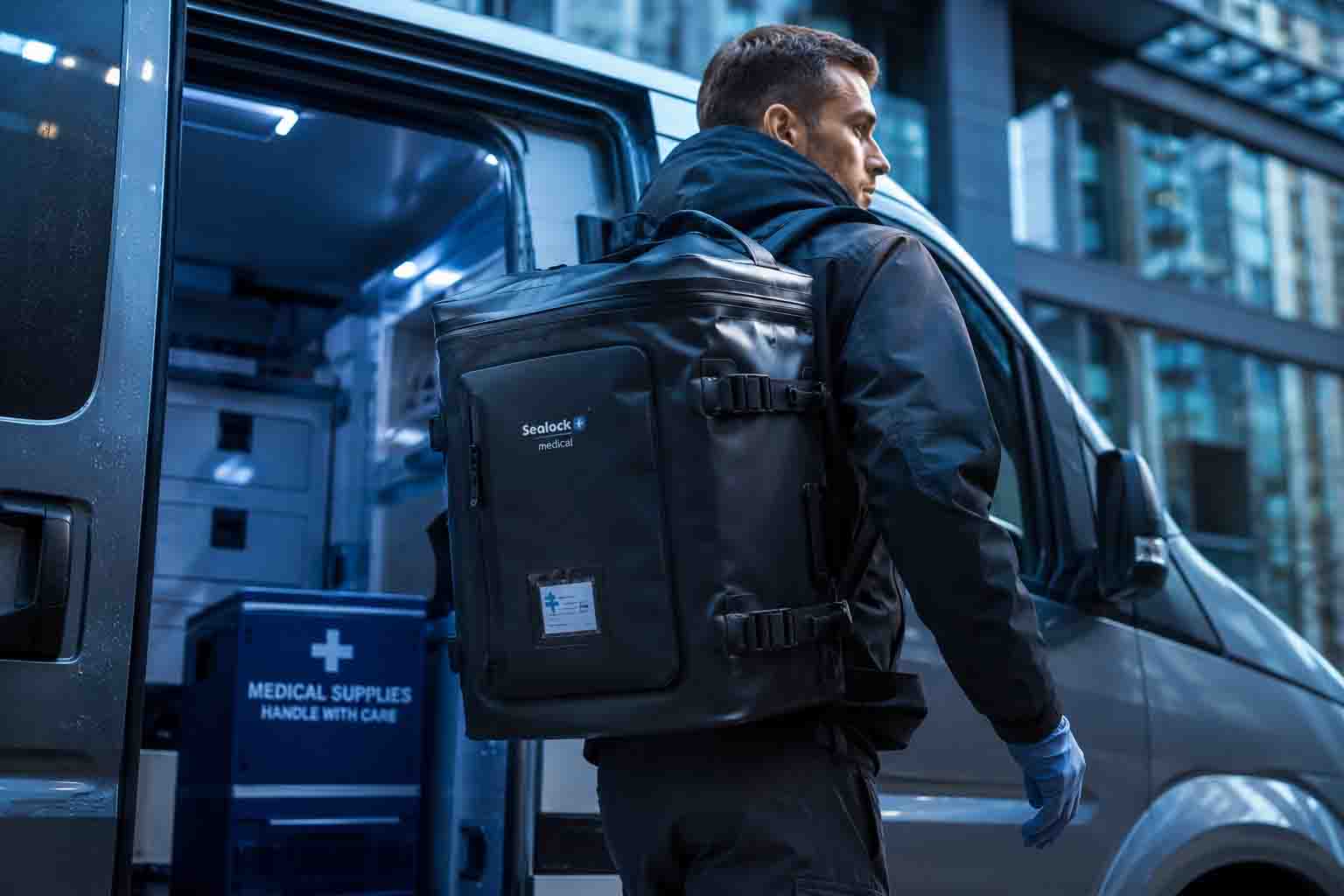
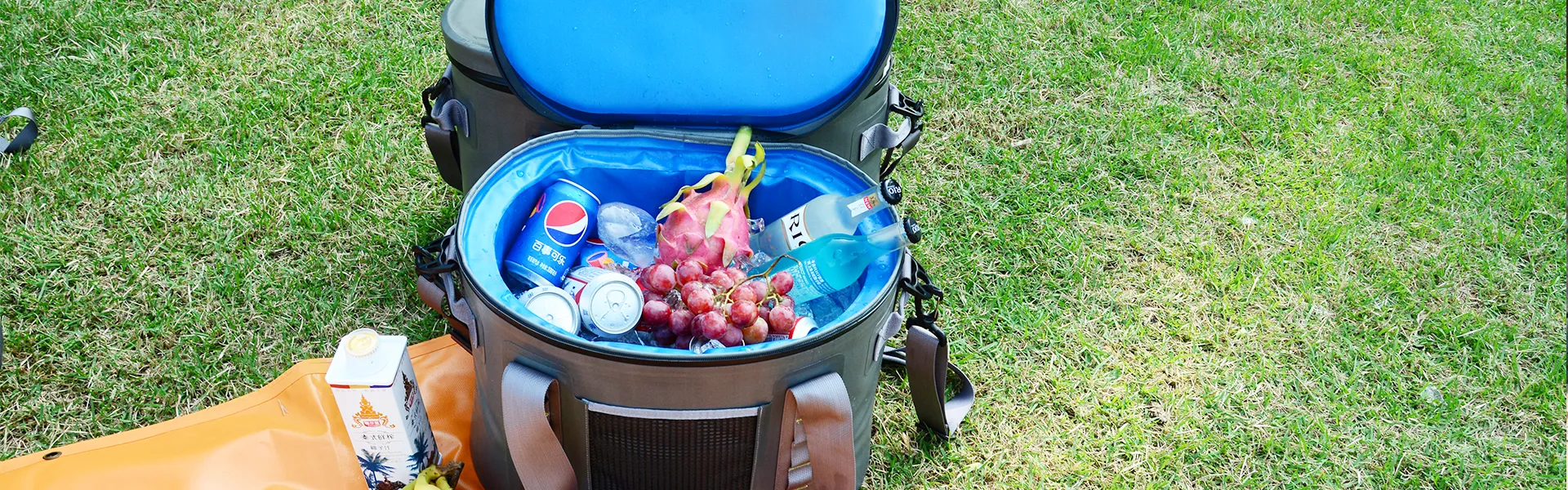
A cooler backpack lives a harder life than the ice it carries. It gets dragged over gravel and boat decks, thrown into truck beds, packed past its sensible capacity with cans and ice, and hauled by one strap when it is heaviest. "Heavy-duty" is the claim that addresses all of that — but it is also the claim most casually made and least often engineered. A tough-looking fabric proves nothing if the strap tears out of a thin shell on the first overloaded trip. This guide separates the two real dimensions of heavy-duty — abrasion resistance in the material and overload resistance in the structure — with the test standards and construction details that tell an engineered cooler from a marketed one. Sealock (YiFuLong Outdoor Gear Co., Ltd.) builds welded cooler backpacks for this kind of use.
Two Different Problems Hiding in One Word
"Heavy-duty" bundles two failure modes that have almost nothing to do with each other. Abrasion is surface wear — the fabric rubbing through against rock, concrete and repeated scuffing. Overload is structural — straps, seams, base and hardware carrying more weight than they were built for, especially the concentrated weight of ice. A cooler can be excellent at one and fail at the other: a bombproof abrasion-resistant shell with an under-built strap junction will still dump its contents when the strap rips out. A genuine heavy-duty supplier engineers both, separately, because they are solved by different means.
Abrasion: What the Numbers Actually Mean
Abrasion resistance is measurable, and two standardised tests dominate — which is why a serious supplier can quote figures rather than adjectives. They are not interchangeable. The Martindale test (ISO 12947) rubs the fabric in a figure-eight motion against an abradant and records cycles until wear; the Wyzenbeek test (ASTM D4157), preferred in North America, uses a straight back-and-forth motion and reports double rubs. The thresholds that define "heavy-duty" are published: heavy-duty usage is generally 30,000 double rubs by the Wyzenbeek method, or 40,000 cycles by the Martindale method.
Two cautions a straight supplier will volunteer. First, the tests do not convert into each other — success in one test does not infer success in the other, so a figure is only meaningful with its method attached. Second, and more important, abrasion resistance is not durability. The industry body responsible for the tests is explicit: abrasion resistance is only one component of durability, and actual performance is determined by many factors including seam slippage, tensile strength and usage. A high rub count on a spec sheet says the fabric surface is tough; it says nothing about whether the strap will stay attached. That is the overload question, and it is the one that actually generates returns.
Overload: Where Cooler Backpacks Actually Break
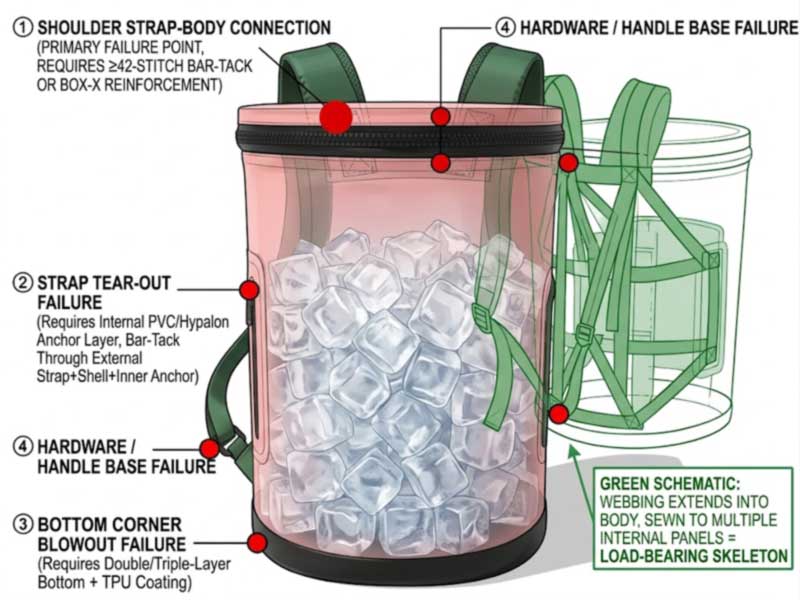
Structural failure is not random — it concentrates at a few predictable points, and every one of them is worse on a cooler because ice is dense, concentrated weight. The failure map:
The strap-to-body junction — failure point number one
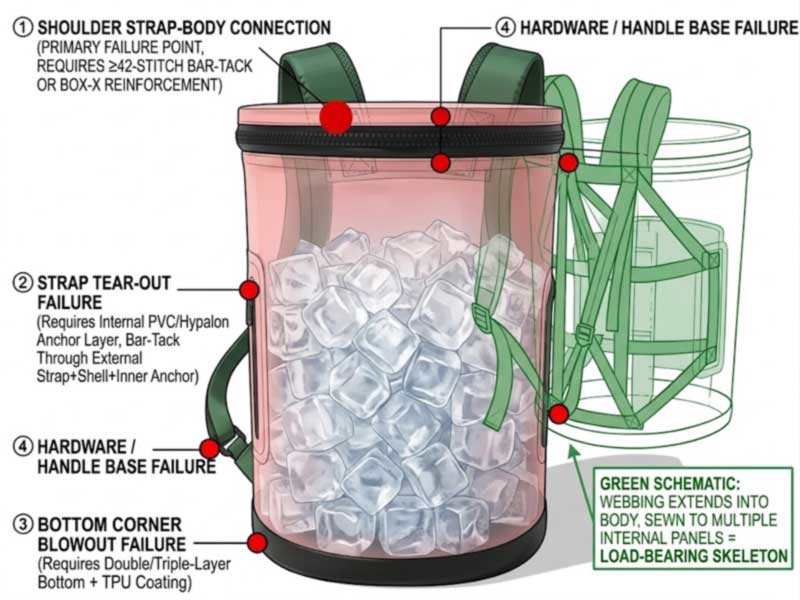
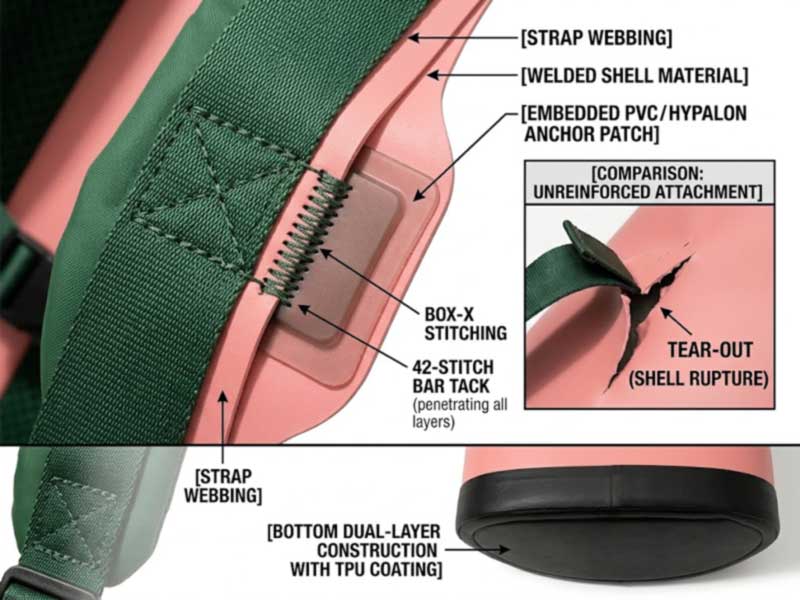
This is the classic catastrophic failure. Quality-control practice names it directly: the transition between the shoulder strap and the bag body is the primary point of failure, and without bar-tacking the seam experiences "needle-hole elongation," eventually leading to the strap detaching entirely. The reinforcement standard for load-bearing straps is specific — the strap-to-body junction requires a minimum of 42-stitch bar-tacks or cross-stitching (X-in-box), and bar-tacking at stress points is non-negotiable for bags carrying loads over 5 kg. A loaded cooler is well over 5 kg.
The trap that defeats bar-tacking: tear-out
Here is the detail that separates factories that understand load from factories that just sew tightly. A perfect bar-tack on a weak shell fails anyway — if you bar-tack a heavy nylon strap directly onto a thin shell, the bar-tack itself holds, but the thin fabric around it shreds instantly under weight; the stitching remains intact while the base fabric rips around the puncture holes. This is "tear-out," and it is why heavy-duty construction works in layers rather than stitches alone. The fix is an engineering standard, not a guess: insert a hidden square of heavy-duty material — PVC, Hypalon or thick nylon webbing — inside the bag directly behind the shell, and drive the bar-tack through the strap, the shell and the hidden internal anchor, distributing the pulling force across a much wider area. As the same source puts it: you cannot sew a strong seam into a weak foundation.
Webbing as the load-bearing skeleton
The strongest packs do not rely on the shell to carry load at all — they route it into webbing. In premium construction, webbing acts as the load-bearing bones of a backpack: shoulder-strap webbing continues inside the bag, is stitched to multiple panels, and distributes load across the whole body, a method drawn from hiking and military packs. Instead of one seam bearing the weight, the load is spread across the structure.
The base — where overload and abrasion meet
The bottom of a cooler takes the ice weight and the ground abrasion, which is why it is reinforced twice. Heavy-duty base construction uses double- or triple-layer bottom construction to prevent corner blowout under weight, with PVC or TPU coatings on the bottom fabric to resist abrasion. On a welded cooler, a reinforced TPU base handles both jobs at once — it is the abrasion layer and the structural floor.
Bar-tack and box-X, and why stitch spacing is its own discipline
The reinforcement stitches themselves have to be executed correctly, and there is a real trade-off in density. Box-plus-X stitching spreads tension in multiple directions and is widely used in backpacks, tote handles and load-bearing straps, while bar-tack stitching creates a dense stitch zone at webbing loops and high-stress anchors. But denser is not always better — if stitches are too far apart the seam will not hold under tension, and if they are too close they perforate the fabric like a tear line, so correct spacing, thread tension and needle size are a genuine manufacturing control, not a default.
The Welded Cooler's Advantage — and Its Special Case
A welded cooler backpack starts ahead on one axis and needs care on another. On the containment side it is inherently tougher: the body is a fused TPU skin with no stitched seams to slip or wick, so the whole class of seam-slippage failures that afflict sewn bags under load simply does not apply to the welded envelope. The reinforced TPU base doubles as abrasion armour.
The special case is that load-bearing hardware — straps, handles, compression points — must attach to a welded, coated shell rather than a bare woven fabric. That attachment has to be engineered so the pulling force is carried into welded-on reinforcement zones and internal anchors, not into a single point of the containment skin. Done right, the strap loads spread into the structure while the welded chamber stays sealed and unpunctured — the load path and the water barrier are kept separate by design. This is the same principle behind keeping needles out of the containment envelope, covered in Leakproof Cooler Backpack Manufacturer: Welded vs Stitched Seams.
- What is the shell's abrasion rating — and by which test, Martindale or Wyzenbeek?
- What denier is the base and corners versus the body?
- How are the shoulder straps anchored — bar-tack or box-X, and is there an internal anchor layer behind the shell to prevent tear-out?
- Is the base single-, double- or triple-layer, and is it TPU-reinforced?
- What load has the finished bag been tested to, and how?
How Sealock Builds for Abrasion and Overload
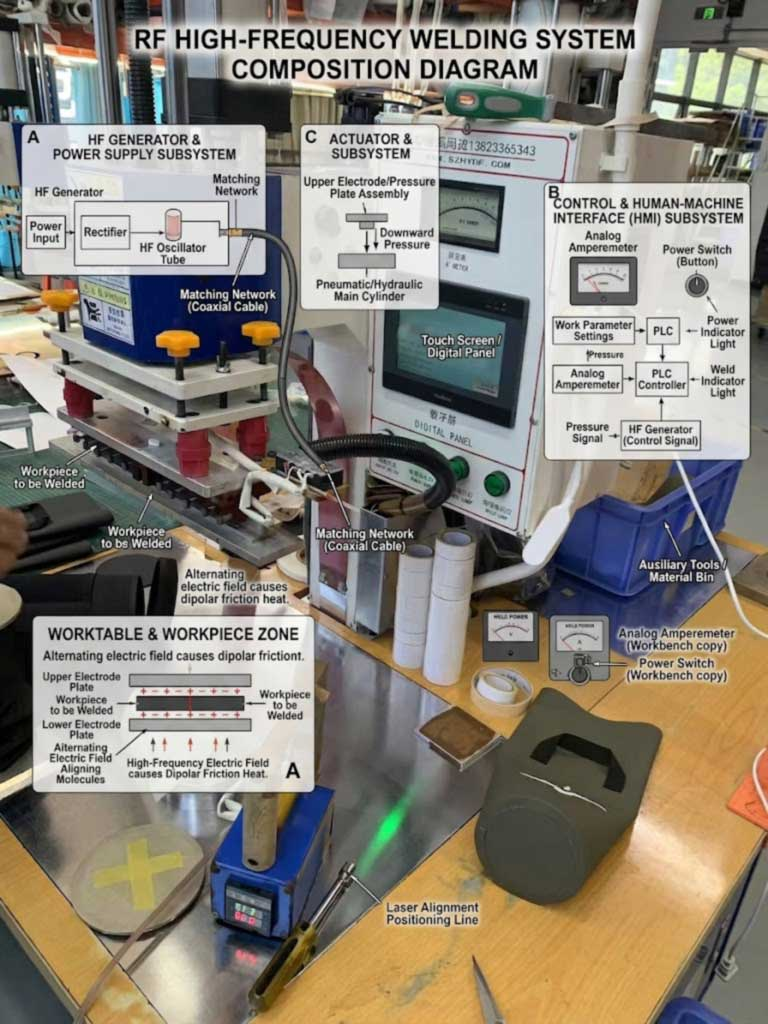
Sealock welds insulated cooler bags at 27.12 MHz across three factories in Dongguan, China and Ho Chi Minh City, Vietnam. The heavy-duty construction levers it controls:
| Shell | TPU-laminated 600D / 840D bodies; 1680D reinforcement at base and wear zones |
|---|---|
| Base | Reinforced TPU base — abrasion armour and structural floor in one |
| Body seams | HF-welded, seam-free — no stitched seams to slip under load |
| Load-bearing attachment | Reinforced strap junctions with internal anchoring so loads spread into the structure, not the containment skin |
| Harness | Padded straps, plus sternum and waist straps on larger builds to distribute overload |
| Hardware | POM / UTX buckles, seawater-resistant clips and D-rings; MOLLE webbing on select builds |
| QC | IQC / IPQC / OQC, AQL sampling, load and immersion testing, gold-sample sign-off; SGS / QIMA available |
| Certifications | ISO9001, BSCI, SMETA P4, GRS, HIGG, SCAN |
Sealock's own quality suite includes load-cycle testing among its lab methods, so a heavy-duty claim is validated rather than asserted. To vet these claims on any supplier, see Choosing an OEM Soft Cooler Backpack Manufacturer: A Buyer's Checklist.
Heavy-Duty Builds
Real welded builds suited to hard use, chosen by fit rather than rank:
| Image | Model | Heavy-duty features | Link |
|---|---|---|---|
|
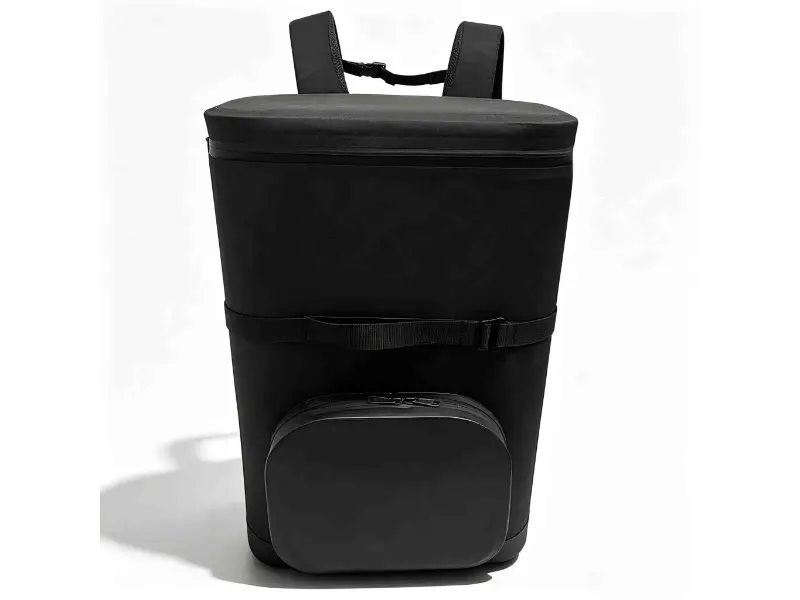
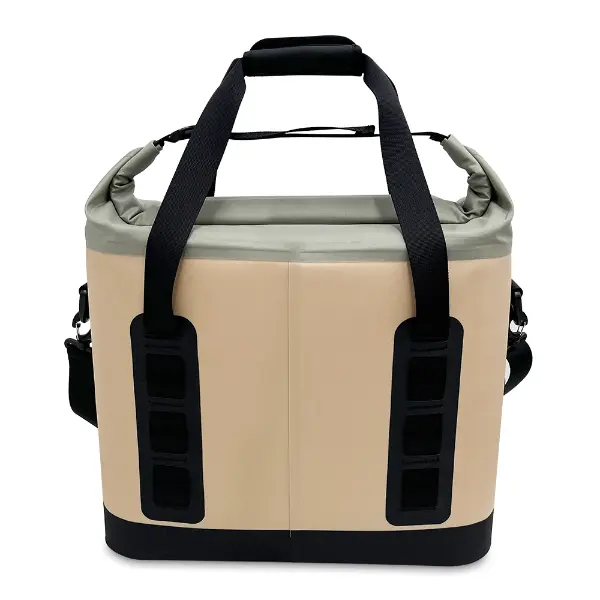
22L IPX7 Cooler Backpack (SL-I280) | Reinforced TPU base, full sternum + waist harness, welded body, IPX7 | View |
|
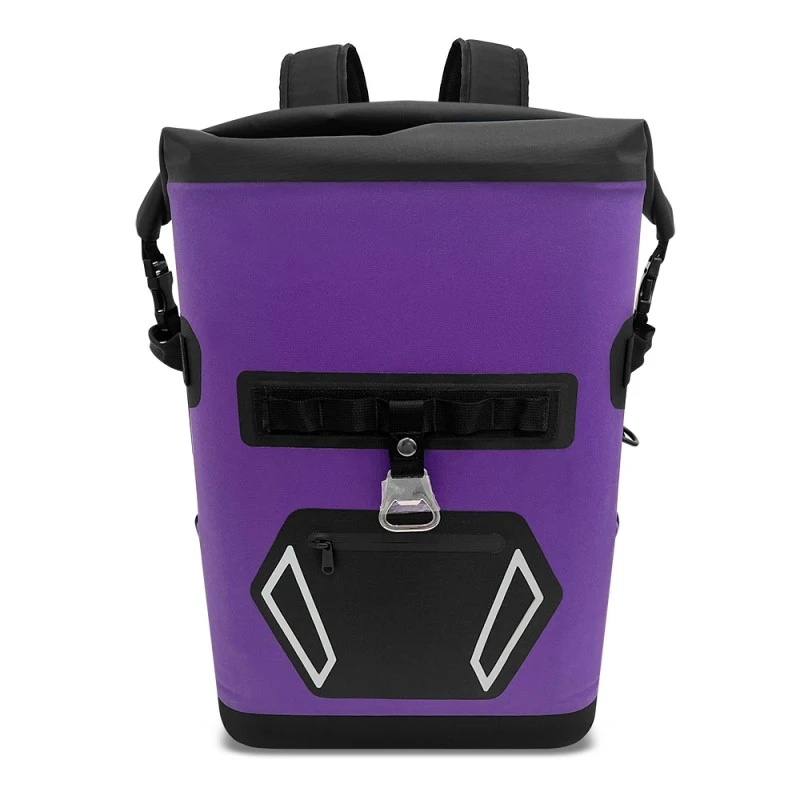
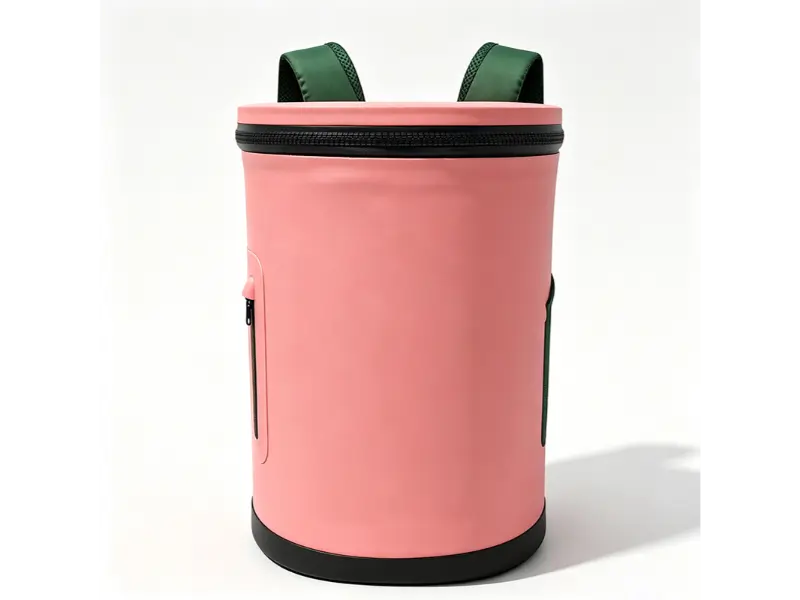
Roll-Top Leakproof Soft Cooler (SL-I288) | 840D TPU, reinforced base, side compression straps, side MOLLE webbing | View |
|
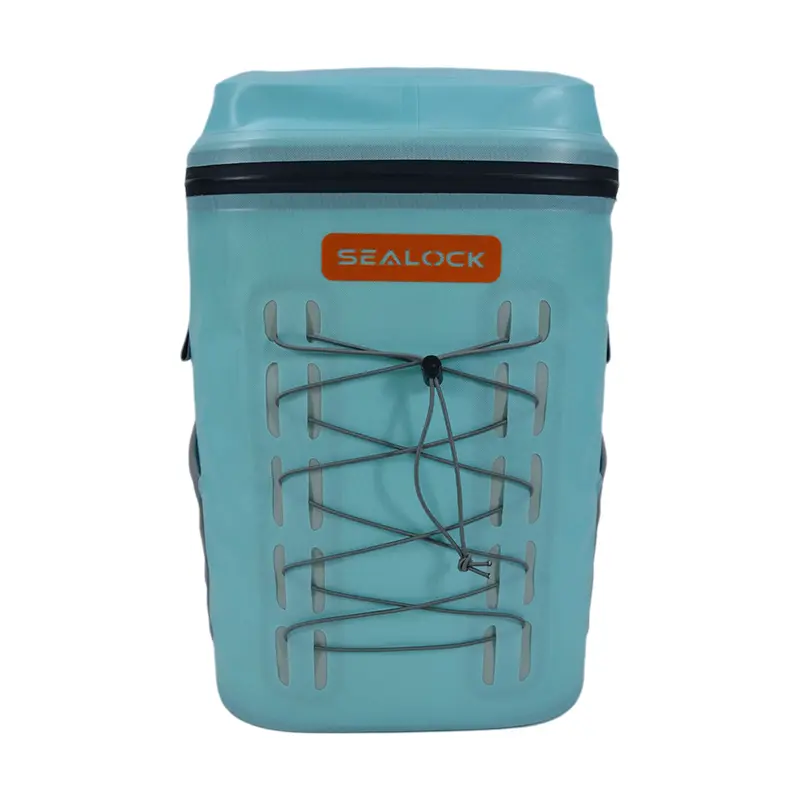
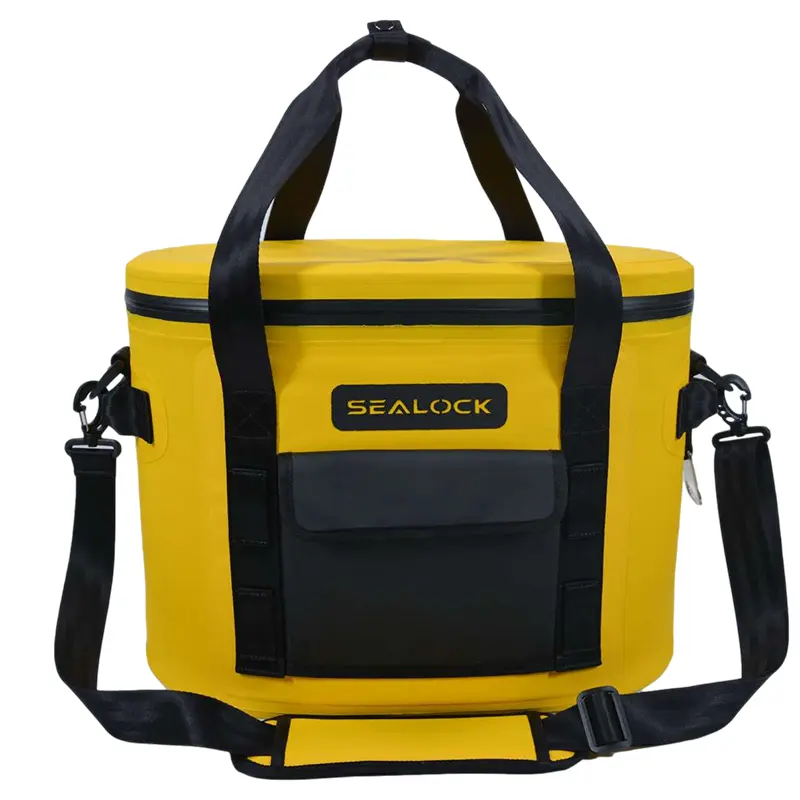
Barrel Insulated Cooler Backpack (SL-I309) | Reinforced base, sternum + waist straps, front slip pocket | View |
|
Waterproof Soft Cooler Backpack | Fully welded TPU body for rugged waterproof use | View |
OEM & ODM: Engineered to Your Load Spec
Heavy-duty is a specification, and a demanding one is welcome. Beyond colour and logo, Sealock develops ground-up from a sketch, sample or performance target: the shell denier and reinforcement zones, the strap-anchoring method and internal reinforcement, the base construction, the harness for the intended load, and the hardware grade are all engineered to a stated use, then validated by load and immersion testing before production. Complex reinforced structures, tactical MOLLE builds, premium insulation tiers and strict compliance targets are all in scope — a genuinely hard brief is what an in-house welding and development team is for. Ground-up work runs longer at sampling, so book against a launch. See OEM Soft Cooler Backpacks: What You Can Customize Beyond Logo & Color and Custom Soft Cooler Backpacks: Materials, Sizes & Branding Options.
FAQ: Heavy-Duty Cooler Backpacks
Q: What makes a cooler backpack genuinely "heavy-duty"?
A: Two separate things: abrasion resistance in the shell (a high-denier, TPU-laminated fabric that resists rubbing through) and overload resistance in the structure (strap junctions, base and hardware engineered to carry concentrated ice weight). A bag can pass one and fail the other, so both have to be built in deliberately — a tough fabric with a weak strap anchor is not heavy-duty.
Q: What abrasion rating counts as heavy-duty?
A: Roughly 30,000 double rubs by the Wyzenbeek method (ASTM D4157) or 40,000 cycles by the Martindale method (ISO 12947) is the heavy-duty threshold. The two tests are not interchangeable, so always ask which method a figure refers to — and remember abrasion resistance is only one part of durability, not the whole of it.
Q: Where do overloaded cooler backpacks usually fail?
A: Most often at the shoulder-strap-to-body junction, where without proper bar-tacking the seam elongates and the strap eventually detaches. A related failure is "tear-out," where the stitching holds but the shell fabric rips around it — prevented by an internal anchor layer behind the shell. The base is the other hotspot, taking both ice weight and ground abrasion.
Q: How should shoulder straps be attached for heavy loads?
A: With bar-tack or box-X reinforcement (a load-bearing junction wants a substantial bar-tack, not a straight stitch), and critically with a hidden internal anchor of PVC, Hypalon or heavy webbing behind the shell so the pulling force spreads across a wide area instead of tearing the fabric. The strongest packs route strap webbing into the body and stitch it to multiple panels so the load is distributed across the structure.
Q: Is a welded cooler stronger than a stitched one under load?
A: For the containment body, yes — a fused TPU skin has no stitched seams to slip or wick under the weight of ice and water. The point to engineer is the load-bearing hardware, which must anchor into welded-on reinforcement and internal layers rather than a single point of the sealed skin, keeping the load path and the water barrier separate.
Sourcing heavy-duty cooler backpacks? Sealock (YiFuLong Outdoor Gear Co., Ltd.) builds welded cooler backpacks engineered for abrasion and overload — reinforced TPU bases, anchored strap junctions, and load-tested construction — from its own lines in China and Vietnam. Tell the team your load, use environment and market, and they will spec the shell, reinforcement and harness to match.
Email: info@sealock.com.hk | Phone: +86-13632981825 | Browse the soft cooler range
Test standards, thresholds and construction guidance cited here reflect publicly available textile-testing and bag-engineering sources as of mid-2026; abrasion figures depend on the test method used, and real-world durability depends on construction, load and use. Define abrasion method, reinforcement and load-test criteria in your specification before production.