News

Cooler Bag Outer Fabric: 420D vs 600D vs 840D & Coating Explained

2026-06-22 0 Leave me a message

Ask most buyers to spec a cooler bag shell and they answer with a single number — the denier — and assume a higher number means a tougher bag. It is the most common sourcing mistake in the bag industry, and it leads to two opposite errors: overpaying for a heavy 840D shell a lunch cooler never needed, or accepting a "600D" quote that wears out in a season because the other three variables were quietly downgraded.

Denier is real and useful, but it is only one of four variables that decide how a fabric actually wears. Getting the shell right means understanding all four — and, for a cooler specifically, paying as much attention to the coating as to the yarn, because a cooler shell lives a harder life than a tote bag: it sweats with condensation, it gets folded, and it is wiped down constantly. This guide breaks down what the deniers mean, why the coating is half the decision, and how to write a spec that delivers the durability you pay for.

Why "what denier is it?" is the wrong first question

Denier (D) measures the thickness of the yarn — technically the weight of a 9,000-metre strand. A higher denier means a thicker, heavier yarn, which usually means more abrasion resistance. But finished-fabric durability is the product of four things working together, and denier is just the first:

Variable What it controls
Denier Yarn thickness — baseline abrasion resistance and weight
Weave density How tightly the yarns are packed — tear strength and how well a coating adheres
Fibre type Polyester vs nylon — nylon is stronger per denier; polyester prints better and costs less
Coating PU / PVC / TPU — water resistance, stiffness, weldability, and folding durability

The practical consequence: a tightly woven, well-coated 600D fabric can outlast a thinly coated 840D one. So a quote that names only "600D" has left three of the four variables open — and those are exactly where a supplier can cut cost without you seeing it on the spec sheet. If a supplier quotes denier alone, ask for the other three before comparing prices.

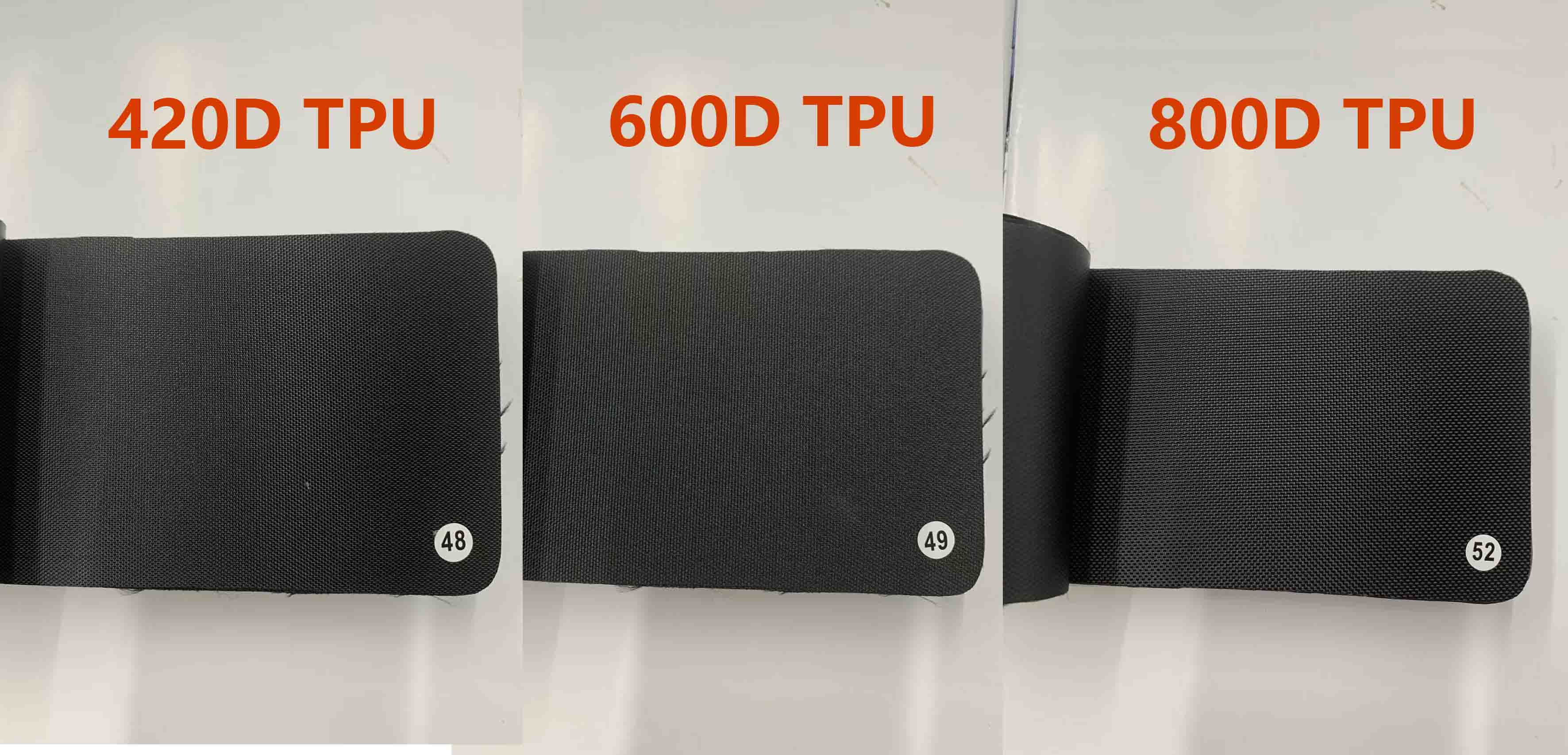
Cooler bag shell fabric swatches in 420D, 600D and 840D

Figure 1:Side-by-side comparison chart of three shell fabric swatches: 420D / 600D / 840D

The cooler-bag denier range: 420D, 600D, 840D

Cooler shells sit in a specific denier band. Unlike tactical or ballistic gear that reaches for 1000D–1680D to survive dragging and puncture, a cooler shell optimises a different balance — enough abrasion resistance for daily handling, plus the flexibility to fold and conform, plus low weight. That puts the useful range between 420D and 840D for the great majority of coolers:

Denier Character Best-fit cooler type
420D Lighter, softer, more packable; lower cost Personal lunch bags, compact totes, ultralight coolers
600D All-round workhorse; best durability-to-cost ratio; prints well Everyday cooler totes, picnic coolers, retail volume lines
840D Heavier, tougher abrasion resistance; more structure Fishing coolers, marine, commercial / frequent-handling use

On fibre type within this band: nylon is roughly stronger per denier and resists abrasion better, which is why premium and heavy-duty coolers often use nylon (e.g. 840D nylon). Polyester is more cost-effective, takes print and sublimation far better, and is the right call for branded retail volume — which is why it dominates everyday cooler totes. Neither is "better" in the abstract; they match different priorities. Across the Sealock soft cooler range you will see TPU mesh, polyester, and nylon shells used deliberately by product role.

Coating: the half of the decision most buyers skip

Here is where cooler bags differ most from ordinary bags. A cooler shell faces constant condensation on the outside, repeated folding, and frequent wiping — conditions that punish a weak coating. The same denier fabric performs completely differently depending on what it is coated or laminated with, so the coating is not a footnote to the spec; it is half the decision.

Coating Water resistance Feel & weight Best for
PU (polyurethane) Moderate; can wear with folding Soft, lighter, flexible Flexible everyday consumer coolers
PVC laminate Strong / impermeable Heavier, stiffer, structured Structured boxes; high water exposure
TPU Fully waterproof Flexible yet durable; weldable Waterproof & leakproof coolers (welded seams)

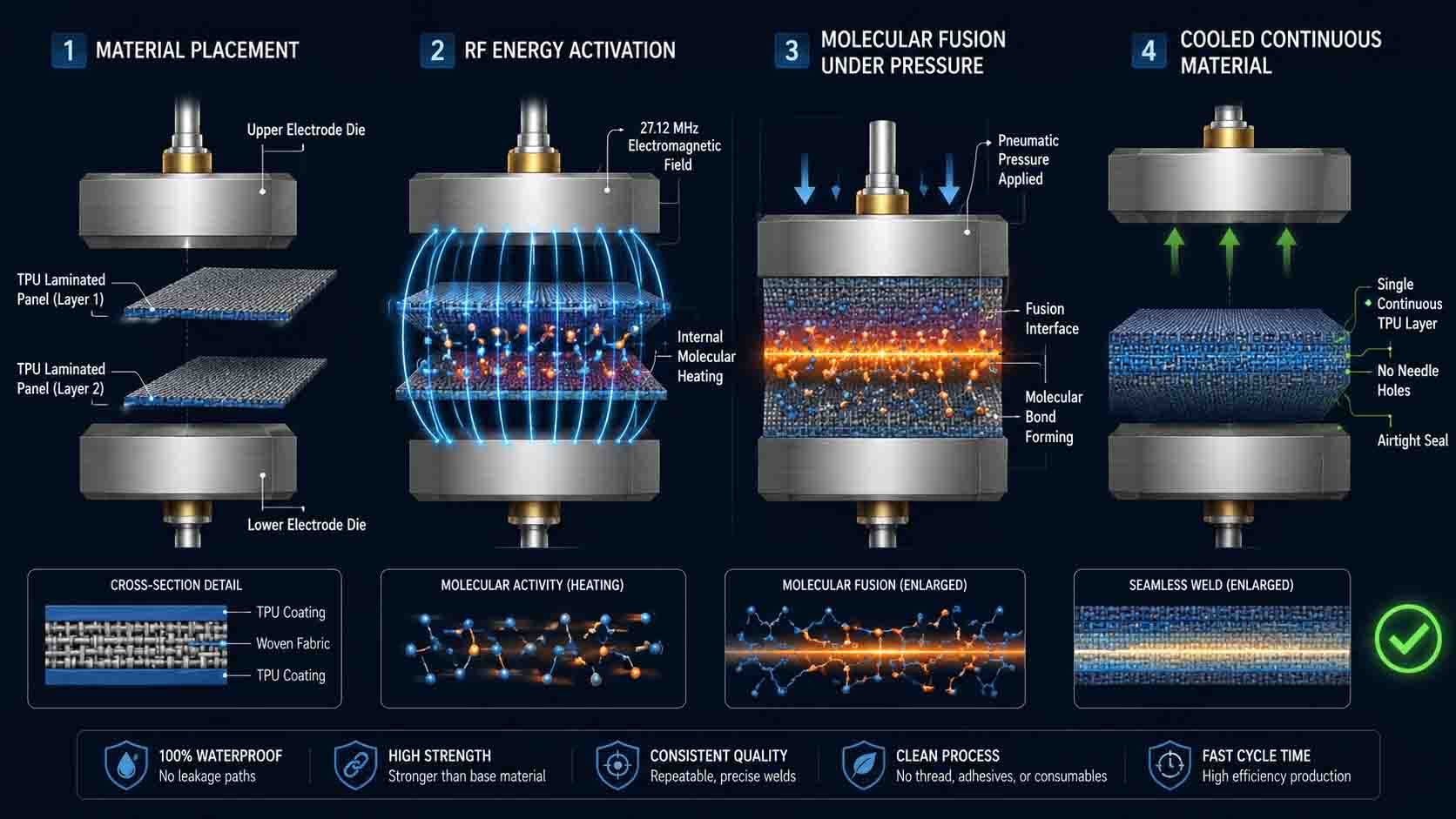
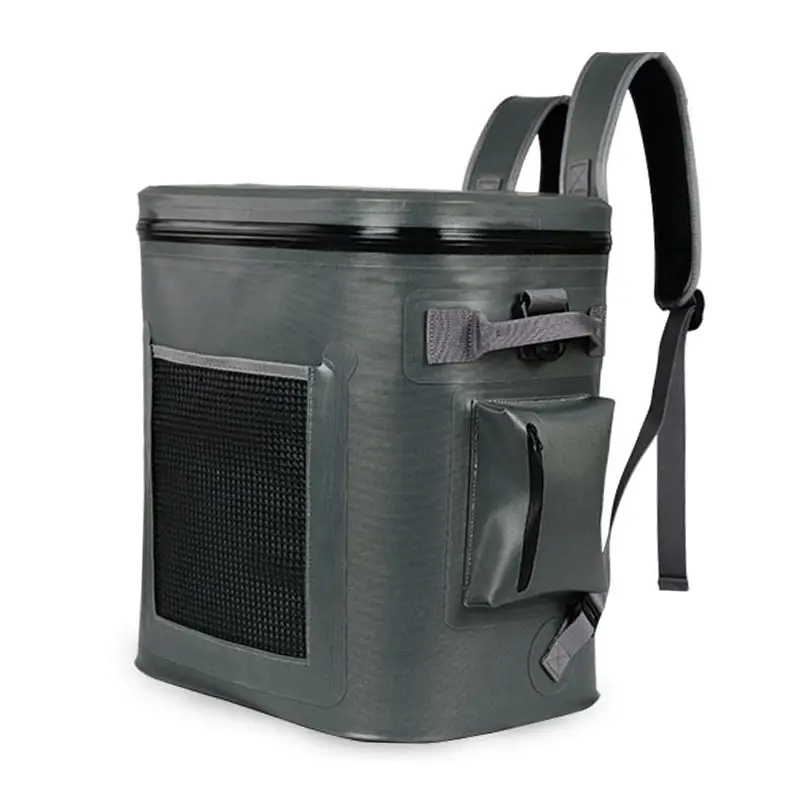
The standout for coolers is TPU. Because it is flexible, fully waterproof, and — critically — weldable, it allows high-frequency welded seams that have no needle holes, which is the foundation of a genuinely leakproof cooler. That is why TPU appears on the waterproof soft cooler and leakproof cooler lines, while a PU-coated polyester is perfectly suited to a softer everyday tote. The point is to match the coating to the cooler's job, not to default to one.

TPU-coated cooler bag shell with high-frequency welded seam and no needle holes

Figure 2: A TPU-coated shell can be high-frequency welded into seamless, needle-hole-free seams — the coating property that makes a cooler genuinely leakproof, not just the denier.

Writing a shell spec that can't be quietly downgraded

Everything above leads to one actionable rule: spec all four variables, not just the denier. A complete cooler shell specification reads like this:

Denier: e.g. 600D (or 420D / 840D to match use)

Fibre type: polyester (print/cost) or nylon (strength) — or TPU mesh for waterproof builds

Weave / GSM: state the fabric weight so weave density is locked, not just denier

Coating: PU, PVC, or TPU — and its weight; this decides waterproofing and weldability

A concrete example from our own line shows how this comes together: the Softe Cooler Tote (SL-C529) uses a TPU mesh shell with a food-safe PEVA lining and EPE foam insulation, sized 50 × 30 × 30 cm with a 40 lb load rating — the shell, lining, and foam each specified by role rather than defaulted. That is the level of detail a shell spec should reach before sampling.

Match the four variables to the cooler's job and you stop both failure modes: you do not overpay for denier you do not need, and you do not get a hollow "600D" that was downgraded on weave and coating. Lock the full spec in the purchase order so the production fabric has to match the approved sample.

If you are unsure which denier-and-coating combination fits your cooler's use case, the practical path is to describe the use (everyday tote, fishing, marine, waterproof) and let the factory propose a matched shell with a sample. You can request fabric swatches and a spec recommendation through our insulated bag catalog.

Materials & Fabric Engineering — SEALOCK COOLER: Published by YiFuLong Outdoor Gear Co., Ltd. (SEALOCK), which set up a laminated-TPU facility in 2013 to support its waterproof and cooler fabric production. Our lines run intelligent cutting, precision welding, and automated assembly that have lifted overall production efficiency by over 30%, with a 280-strong technical team in Dongguan, China and 1,000+ skilled workers across two Vietnam factories.

We hold SMETA P4, HIGG, SCAN, GRS, BSCI, and ISO 9001 certifications, and offer a China + Vietnam dual-origin supply chain for US/EU tariff flexibility. To match a shell fabric — denier, fibre, weave, and coating — to your cooler at our 300-piece baseline MOQ, contact our international trade desk: request fabric swatches & a spec recommendation.

Related News
Leave me a message
X
We use cookies to offer you a better browsing experience, analyze site traffic and personalize content. By using this site, you agree to our use of cookies.Privacy Policy
RejectAccept