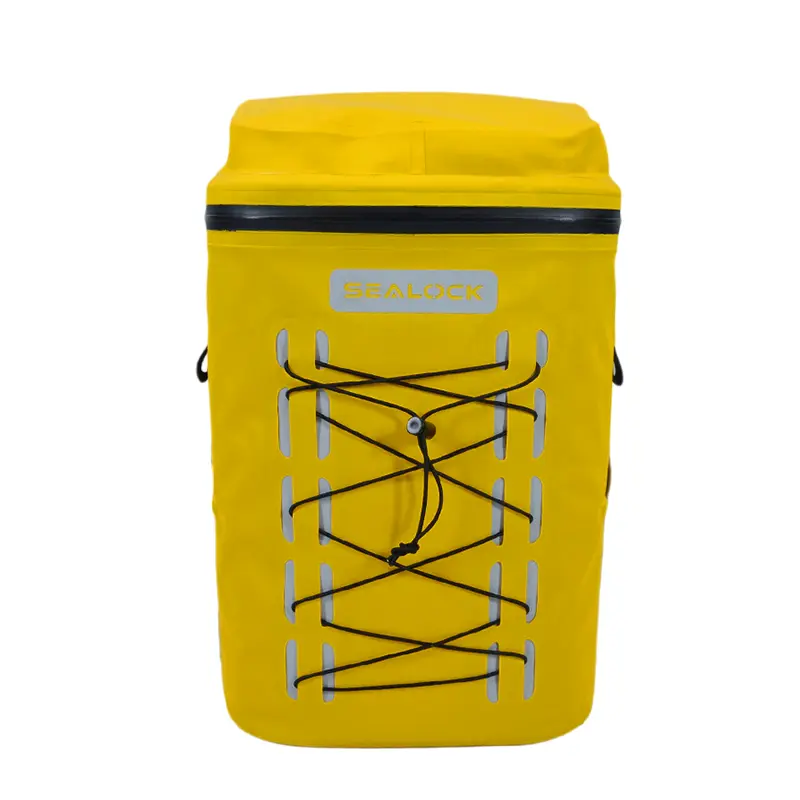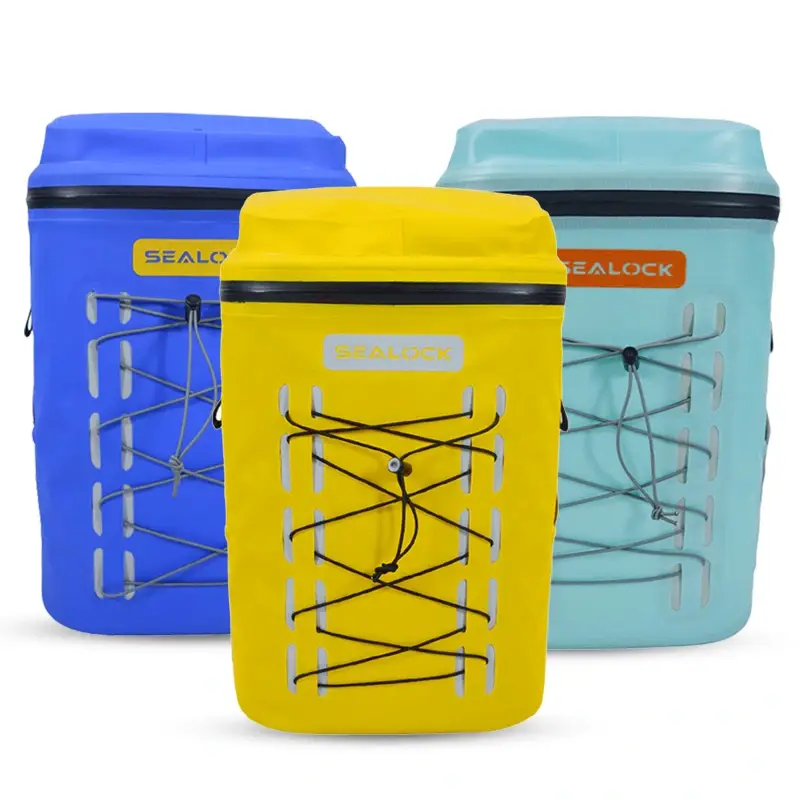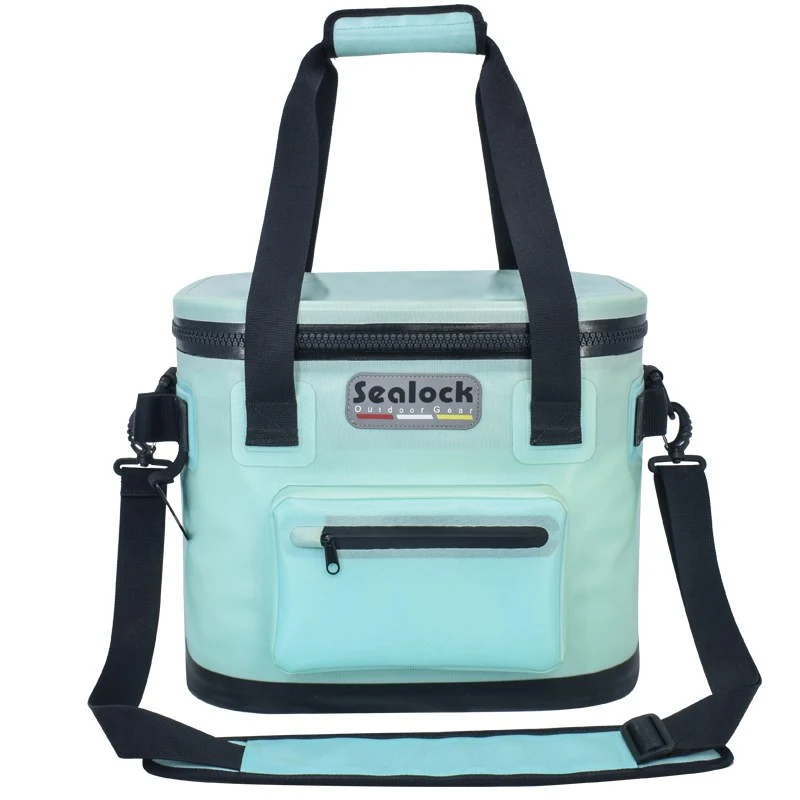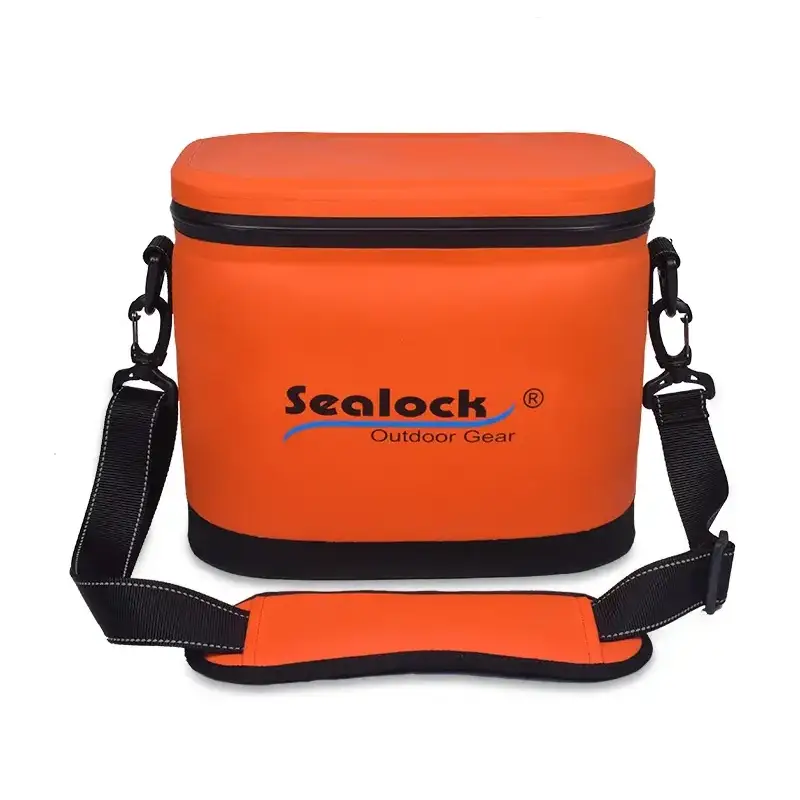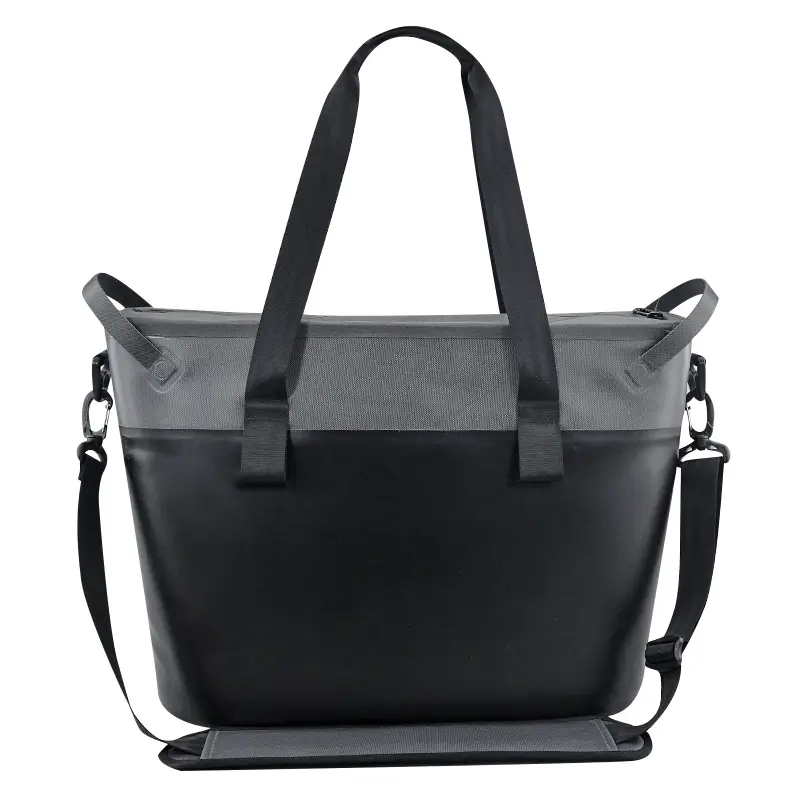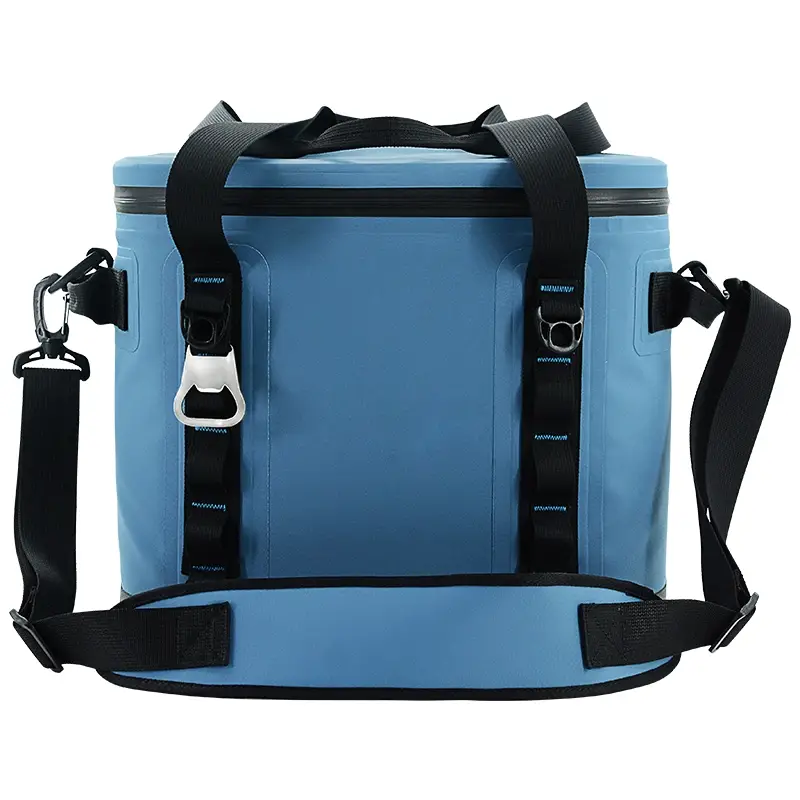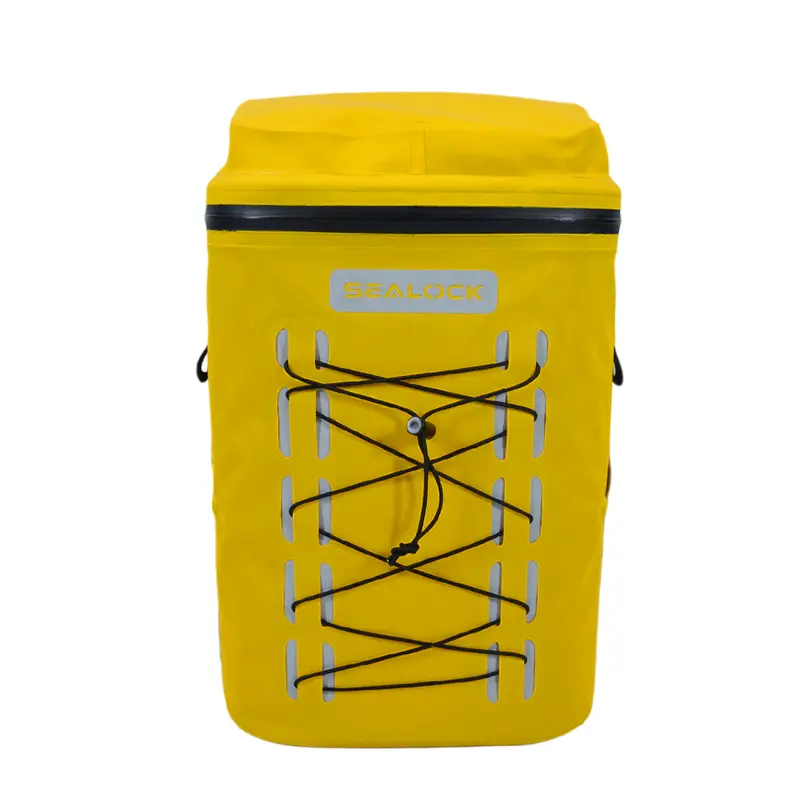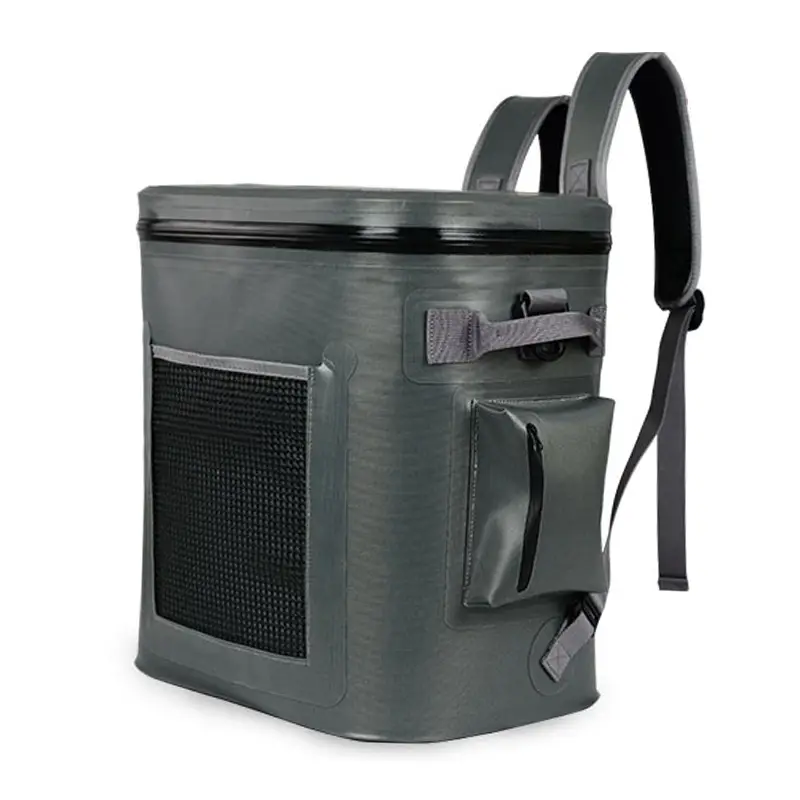
A sample is the only part of sourcing you can hold in your hands before committing money. This page explains what a cooler bag sample costs, how long it takes, what a complete sample request contains, and exactly what to do to the bag when it arrives — written by the factory that makes them.
Sealock (YiFuLong Outdoor Gear Co., Ltd.) · manufacturer since 2003 · China and Vietnam · samples 7–15 days · MOQ 300 pcs.
Start a sample: info@sealock.com.hk · +86-13632981825
Which Sample You Are Actually Asking For
"Can you send a sample" means five different things, at five different costs and timelines. Naming the right one saves a week.
| Type | What it is | When to ask for it |
|---|---|---|
| Stock sample | An existing product taken off the shelf | To judge our build quality, welding and liner before discussing your own design |
| Custom prototype | Made to your specification | Once you know the capacity, insulation, closure and branding you want |
| Counter sample | Built to match a reference you send us | When you have a bag you want replicated in construction (not another brand's design) |
| Pre-production sample | Made with the actual bulk materials and processes | Before authorising production — this is the one that matters |
| Golden sample | The approved, signed, retained reference | The benchmark every production unit is matched against at inspection |
The pre-production sample is the gate: the final sample produced using the actual materials, molds, and processes intended for mass production. This is the "golden sample" that, once approved, serves as the benchmark for the bulk order. It is critical to approve a pre-production sample before authorizing mass production.
What It Costs, and Why
Expect to pay for a custom sample, and read the fee as a normal commercial signal rather than reluctance: a sample fee is professional practice, not reluctance. Costlier goods and anything made to your specification cost the factory real time and money. The underlying reason is simple: a one-off custom piece interrupts production and can cost the factory more labour per unit than a hundred production pieces.
Typical range for soft goods: sample cost is typically $50–$200 per design; most factories offer a refund credit against the bulk order. More complex custom builds cost more, because the factory is running a one-piece production line.
Getting the fee credited
This is negotiable and worth settling in writing before you pay. Conventions vary: the most common arrangement is sample fee credited on bulk order confirmation, meaning the fee is deducted from the deposit invoice or final balance once you proceed. Some factories waive the fee outright for orders above their normal MOQ; others credit it only if the order lands within a stated window, commonly 3–6 months of sample delivery. And the honest part: if you walk away, the fee is not returned — that is the factory's compensation for interrupted production.
Want a sample quoted? Send your capacity, cold-hold target, seal level, closure and branding — or a photo of a bag you want built. We will confirm the sample cost, the lead time and what the fee credits against.
info@sealock.com.hk · +86-13632981825
How Long It Takes — and What Actually Controls That
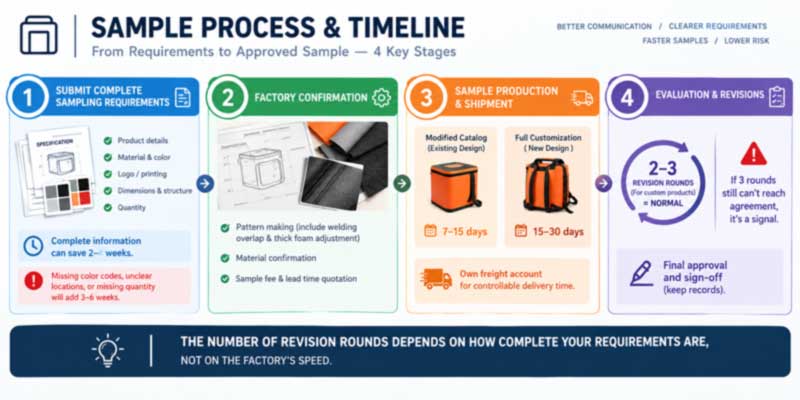
Industry benchmarks: sample lead time: 7–15 days for modified catalogue items, 15–30 days for fully custom items. Our quoted range is 7–15 days, longer for ground-up development where patterns and welding tooling have to be engineered first.
The variable is not the making. It is the number of revision rounds, and that is driven almost entirely by how complete your first request was: a complete sample request reduces total sampling time by 2–4 weeks by eliminating the most common causes of revision cycles: missing color reference, incomplete placement specification, and unclear quantity. The reverse is equally true — an incomplete request produces revision cycles that add 3–6 weeks to your total project timeline.
Multiple rounds on a custom product are normal, not a warning sign: if you're getting a customized product, it's not uncommon to go through two, three, or even more rounds of samples before everything is right. One sourcing consultant describes a custom backpack that took five rounds over two months, and concludes: it felt slow at the time, but those two months saved them from a $30,000 mistake. The principle is worth adopting: it's better to do something right than to do it on time.
There is a limit, though. If a factory cannot converge, that is information: if a supplier keeps failing, after two or three sample revisions, you shall not waste your (or theirs) time. A factory that cannot interpret a clear brief in three attempts is showing you how bulk production will go.
What to Send Us for a First-Time-Right Sample
| Capacity & dimensions | Litres, or external dimensions if you have a constraint such as a carry-on envelope |
|---|---|
| Cold-hold target | The hours you need and the conditions your customers use it in |
| Seal level | Water-resistant, IPX6, IPX7 or IPX8 — and whether you will advertise the rating |
| Closure | Airtight welded zipper, welded roll-top, molded flip lid, zip-around |
| Shell | TPU or PVC, denier, and any recycled-content requirement |
| Liner | Food-grade TPU or PEVA, plus the market you need migration testing for |
| Carry | Backpack, tote or shoulder; harness level; webbing or attachment points |
| Colour | Pantone reference from a physical swatch book, or confirmation you will take a stock colour |
| Branding | Vector logo file, size, placement and method |
| Packaging | Polybag or retail box, hangtags, labelling requirements for your market |
| Quantity view | Your realistic first order and reorder expectation — it affects what we recommend |
If you do not know an answer, say so rather than leaving it blank. We will propose an option and flag it as our assumption, which is far better than guessing silently and building the wrong thing.
What to Do to the Bag When It Arrives
This is the part most buyers skip. A sample admired on a desk tells you nothing; a sample tested tells you everything. Six tests, none of which need equipment:
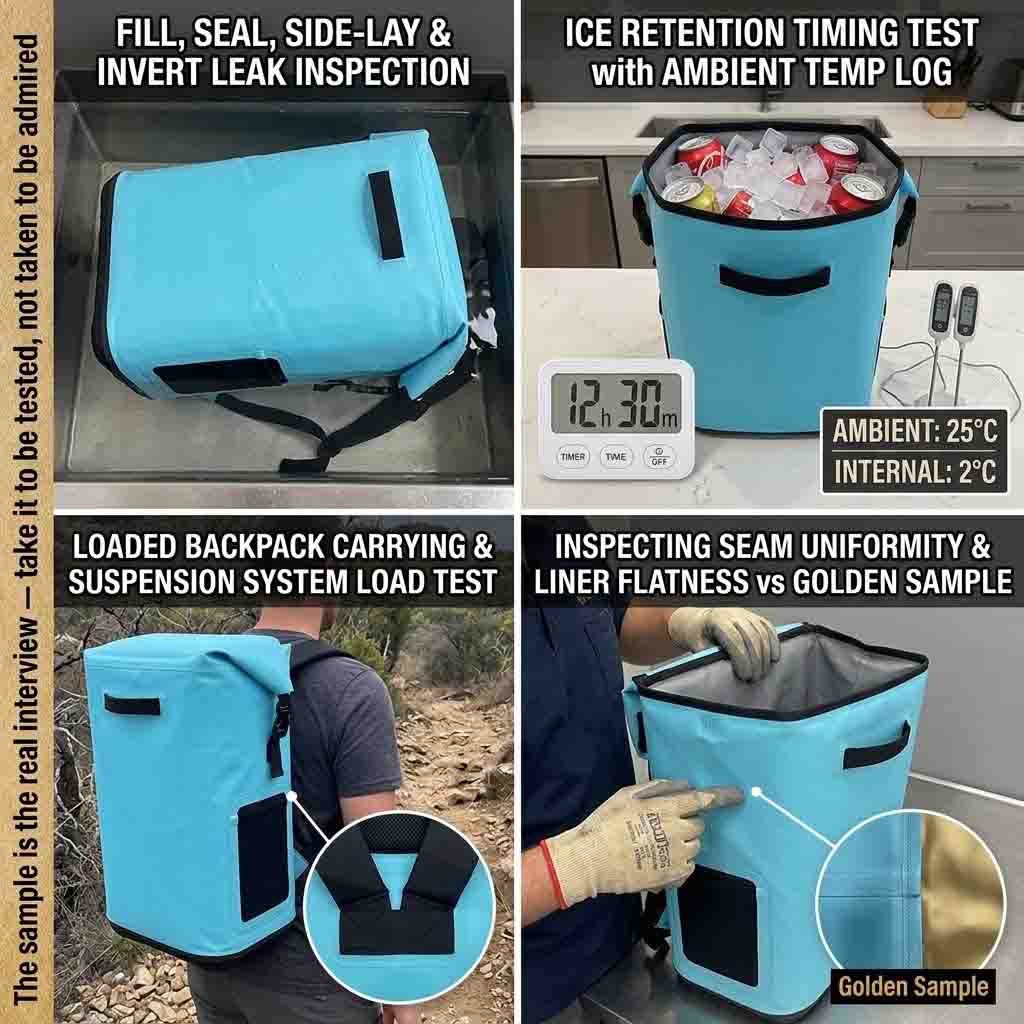
- Leak test. Pour in one to two litres of water, seal it fully, then lay it on its side and upside down over a sink for several minutes each. Watch the base seam, the corners, the zipper ends and the strap anchor points. A bag that only holds water upright is not leakproof.
- Cold-hold test. Pre-chill it, load a known quantity of ice, keep it shut, and check contents temperature against the clock — in conditions like the ones your customers will use. Compare the result to what you intend to advertise.
- Loaded carry test. Fill it to realistic weight and walk with it for ten minutes. Comfort problems appear at ten minutes, not ten seconds. Check the strap junctions afterwards.
- Weld inspection. Run a finger along every seam. Welds should be even in width, with no burning, thinning or short runs. Look inside: no stitching should pass through the sealed chamber.
- Closure cycling. Open and close it thirty times. An airtight zipper should run consistently; a roll-top should fold and buckle cleanly every time.
- Liner check. Wipe it out, then smell it. A welded food-grade liner should clean in seconds and hold no odour. Stitched liners trap residue in the seams — which becomes a hygiene complaint after a season of use.
Specification verification matters too — measure it: does the product meet all your detailed requirements including dimensions, material composition, color codes, and performance criteria.
How to Give Feedback That Gets Fixed in One Round
Vague feedback produces vague revisions. The rule: provide revision feedback as specific measurable changes, not subjective reactions. "The blue is too bright" does not help a factory colorist. "Reduce intensity by 15%, shift toward Pantone 2718C" does.
Also prioritise: if there are multiple issues, indicate which are critical (must be fixed) and which are minor. A list of twelve equal-weight comments takes longer to resolve than five ranked ones. And confirm the commercial terms of the next round — clarify if there will be additional charges for the revised sample.
The Golden Sample Is a Contract Document
Once approved, the sample stops being a prototype and becomes your quality standard. Handle it accordingly: keep the approved physical sample in a safe place. It should be signed and dated by both you and (ideally) the supplier. This sample is your ultimate reference.
Then make it binding: in your purchase agreement or purchase order for the bulk production, explicitly state that the quality of mass-produced goods must conform to the approved pre-production sample (identified by date or sample number). Without that clause, a quality dispute becomes an argument about opinions. With it, it becomes a comparison against an object.
We retain a signed gold sample and use it as the comparison reference at outgoing inspection, alongside AQL sampling. See pre-shipment inspection.
What the Sample Also Tells You About the Factory
Beyond the product, sampling is the most honest audition a supplier gets: receiving a sample provides insight into the supplier's production capabilities, adherence to deadlines, and ability to scale production while maintaining quality. If a manufacturer cannot produce samples that meet your specifications after several revisions, it's a clear indication they may lack the capacity or ability to follow instructions.
Watch for the warning signs while you are at it: poor communication from suppliers during the process suggests future problems. Inability to provide requested modifications shows limited manufacturing capabilities… Missing certifications or compliance documents indicate potential regulatory issues. How a factory behaves before it has your money is the best available preview of how it behaves after.
Start From a Proven Build
The fastest route to a first sample is an existing welded platform in a stock colourway — no pattern development, no dye lot on the critical path:
| Image | Model | Build | Link |
|---|---|---|---|
|
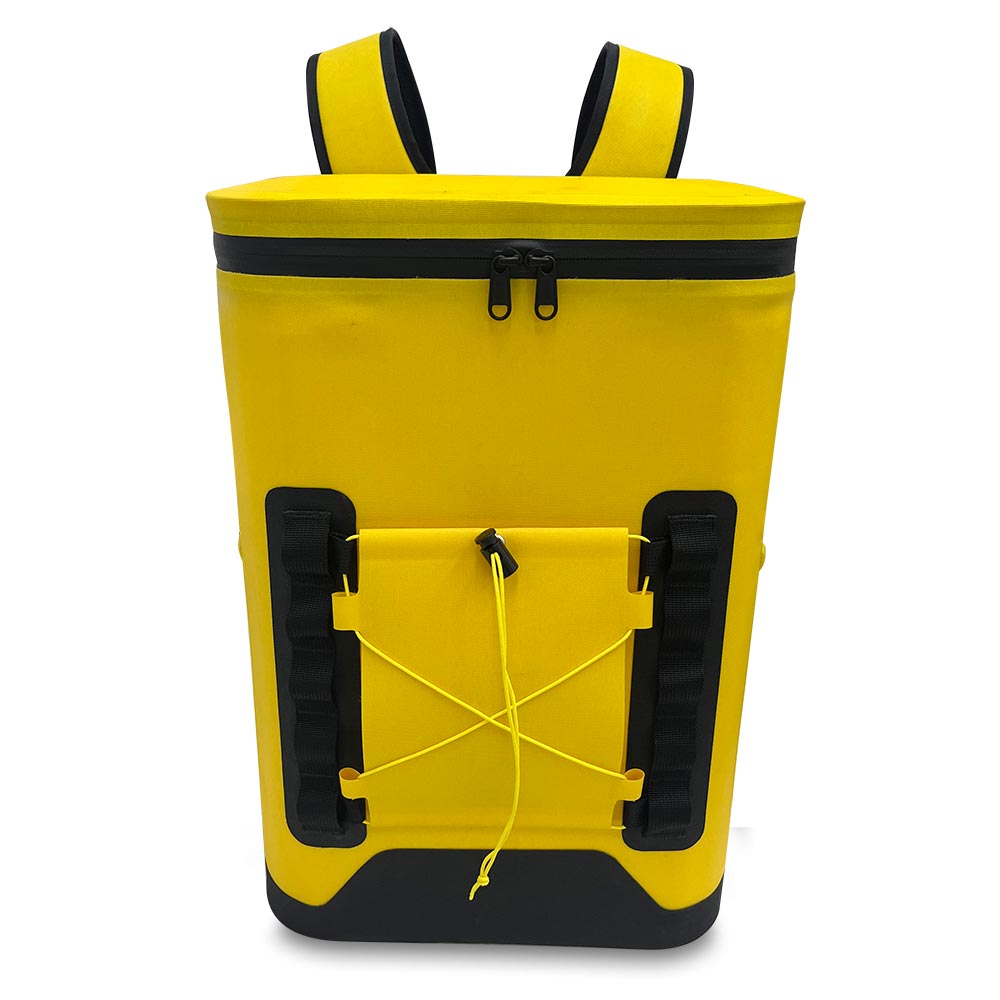
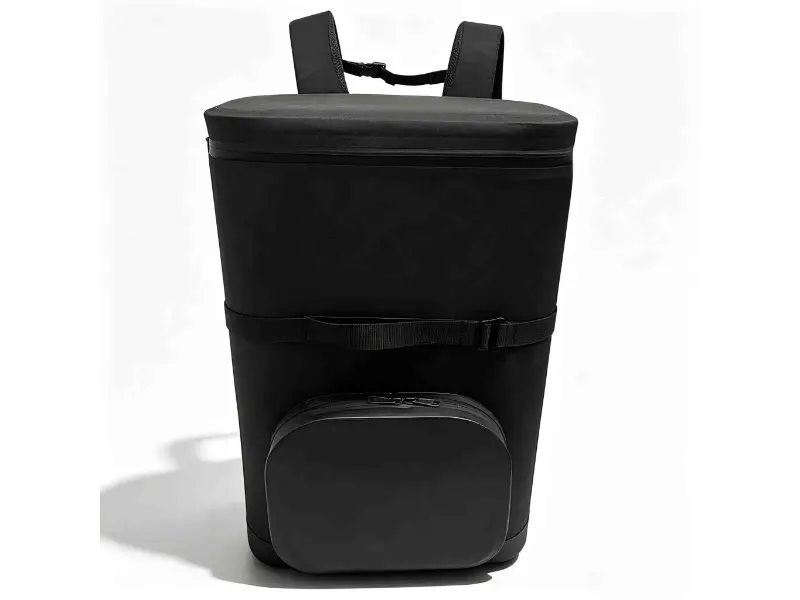
28L Airtight-Zipper Cooler Backpack (SL-I274) | 840D TPU, 3 cm EVA core, food-grade TPU membrane, airtight welded zipper, up to 48 hr; four stock colours | View |
|
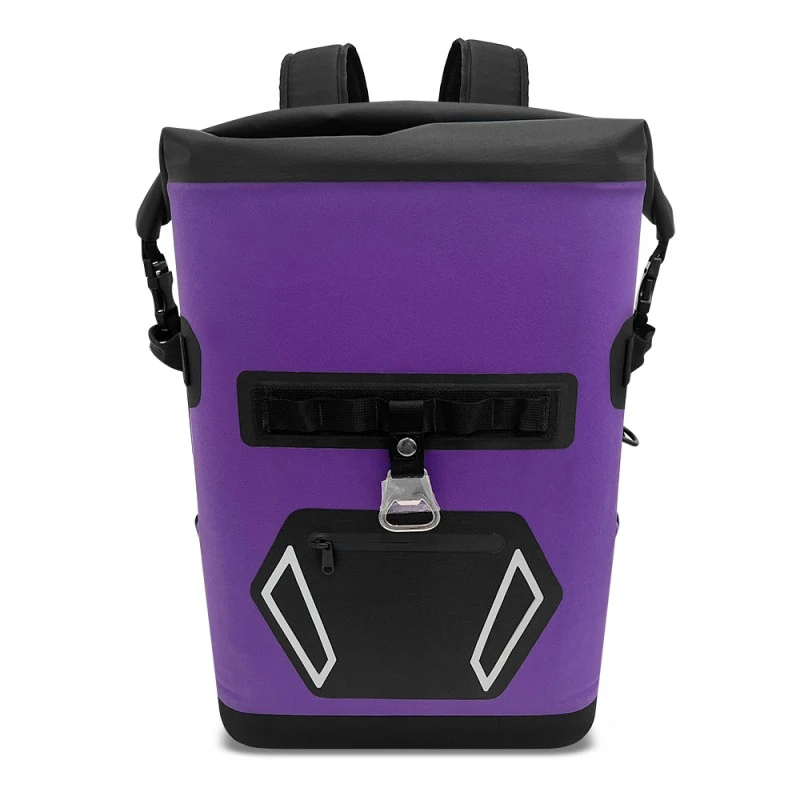
22L IPX7 Cooler Backpack (SL-I280) | Welded seamless, IPX7 immersion-rated, 50 mm high-density XPE, 48 hr+, full harness | View |
|
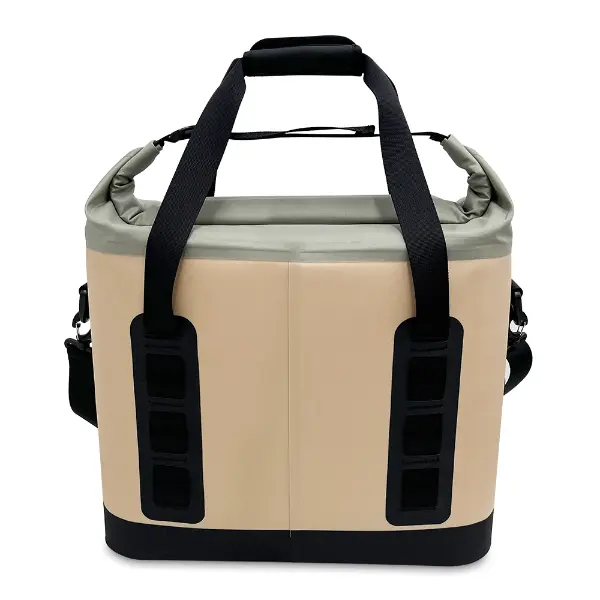
45L Roll-Top Cooler Backpack (SL-I270) | 45L, welded roll-top, 600D TPU, food-grade TPU liner, UTX buckles, up to 36 hr | View |
|
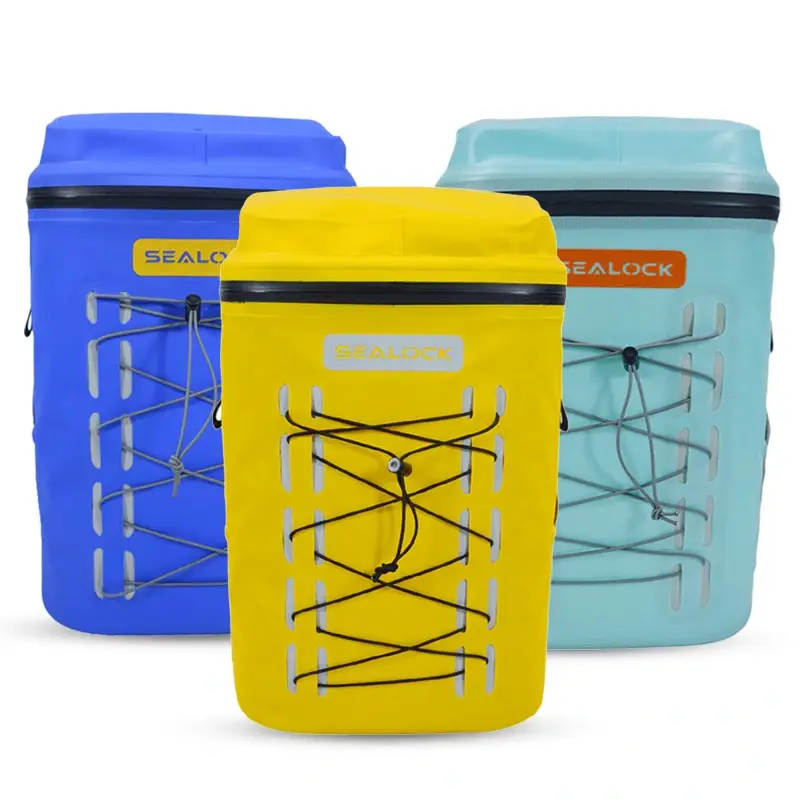
Roll-Top Leakproof Soft Cooler (SL-I288) | 20L tote/shoulder, 840D TPU, welded roll-top, airtight zip pocket, MOLLE, up to 48 hr | View |
|
Insulated Leakproof Cooler Backpack (SL-I075A) | 36-can, 840D PVC tarpaulin, EPE foam, PEVA liner — value entry, three stock colours | View |
Our customers include international brands such as Stanley, YETI, Hydro Flask, Osprey, Musto and Simms. The same lines and quality systems run a 300-piece order.
FAQ
Q: Do I have to pay for a cooler bag sample?
A: For a custom sample, normally yes — a one-off piece interrupts production and costs the factory more labour per unit than a hundred production pieces. Typical soft-goods sample fees run around $50–$200 per design, more for complex builds. A stock sample from an existing build is a different conversation. Ask us and we will tell you plainly which applies.
Q: Is the sample fee refundable?
A: The common arrangement is a credit against the bulk order rather than a refund — deducted from the deposit or balance once you proceed. Some factories waive it above a certain order size, others credit it only if the order lands within a stated window, commonly three to six months. Settle it in writing before paying, and note that if you do not proceed the fee generally stays with the factory.
Q: How long does a cooler bag sample take?
A: 7–15 days for a modified version of an existing build, longer for fully custom development where patterns and welding tooling must be engineered first. The bigger variable is revision rounds — a complete brief can cut two to four weeks off the total, while a vague one adds three to six.
Q: How many revision rounds are normal?
A: Two or three is unremarkable on a custom product, and more is not automatically a red flag — getting it right beats getting it fast, since a sample round costs days while a wrong bulk order costs the whole run. But if a factory cannot converge after two or three clear rounds, that tells you something about how bulk production will go.
Q: What should I test when the sample arrives?
A: Fill it with water, seal it and invert it over a sink, watching the base seam, corners, zipper ends and strap anchors. Load it with ice and time the cold-hold in your own conditions. Carry it loaded for ten minutes. Inspect the welds for even width and check no stitching passes through the sealed chamber. Cycle the closure thirty times. Wipe out the liner and smell it. Then measure it against your specification.
Q: Can I approve the sample from photos to save time?
A: Please do not. Photos cannot show colour, texture or weight accurately, and on a cooler they cannot show whether it leaks, how long it holds cold, or how it carries loaded. Get the physical sample in your hands, test it, then sign and date it — and have your purchase order state that bulk production must conform to that approved sample.
Sealock — YiFuLong Outdoor Gear Co., Ltd.
Send your specification, a sketch, or a photo of a bag you want built. We will quote the sample, the lead time and the bulk price together — and tell you honestly if what you want and what you are budgeting do not reconcile.
Email: info@sealock.com.hk · Phone: +86-13632981825 · Samples 7–15 days · MOQ 300 pcs
Sample fees, credit arrangements and lead times cited here reflect publicly available sourcing-industry sources as of mid-2026 and vary by factory, product and complexity; our own terms are confirmed per enquiry. Customs treatment of commercial samples differs by country — declare values accurately and confirm applicable thresholds with your customs broker.