News

Recycled RPET Cooler Bags: A GRS Sourcing Guide for Eco Brands 2026

2026-06-18 0 Leave me a message

Two worries stop most brands from putting a recycled cooler bag in their line. The first is that recycled fabric will feel cheap and wear out faster than virgin polyester. The second is that the supplier's "eco-friendly" claim is just greenwashing — a green logo with nothing verifiable behind it. Both are reasonable concerns, and both have clear answers, which is what this guide is for.

The short version: the durability worry is mostly a myth, and the greenwashing worry is exactly why the Global Recycled Standard (GRS) exists. Get those two things straight — the material performance and the certification trail — and a recycled cooler bag becomes a defensible product decision rather than a marketing gamble. Below is what RPET and GRS actually certify, what they do not, and the documents to demand before you order.

Worry 1: "Recycled fabric won't be tough enough"

Factor RPET (Recycled) Virgin Polyester
Strength & abrasion Comparable at same denier Comparable at same denier
Printability Excellent Excellent
Relative cost Higher (+5%–15%) Base / lower
Recycled content Up to 100% post-consumer 0%
Sustainability story High — diverts bottles from waste Low — virgin petroleum input
GRS eligible Yes No

The table makes the trade-off clear: RPET costs a little more and performs the same, while giving you a recycled story and GRS eligibility that virgin polyester cannot offer. The rest of this section unpacks each row.

RPET — recycled PET — is polyester spun from post-consumer plastic bottles instead of virgin petroleum. The key fact for a buyer is that the recycling origin does not, by itself, weaken the fabric. At a given denier, RPET matches virgin polyester on the properties that matter for a cooler bag:

Property 600D Virgin Polyester 600D RPET
Tensile strength Baseline Comparable at same denier
Abrasion resistance Baseline Comparable at same denier
Printability Excellent Excellent — screen, heat transfer, sublimation
Water repellency Via coating/treatment Same — can be treated identically

The practical takeaway: if a recycled cooler bag underperforms, the cause is almost always a low fabric weight (a thin denier chosen to cut cost) or weak construction — not the recycled origin. So specify RPET by denier exactly as you would virgin polyester (e.g. 600D or 840D), and judge the sample on the same criteria. Don't accept a thinner fabric just because it is "eco." The recycled story should add value on top of the same performance, not excuse a downgrade.

How many bottles does each bag recycle?

The recycled story becomes concrete when you can state a bottle count. The figures below are estimates based on a standard 500 ml PET bottle (~15–16 g of RPET) and typical shell weights — actual counts vary with fabric denier, bag size, and how much of the bag is RPET versus liner and foam. Use them as marketing-ready ranges, and confirm the exact number for your spec with the factory.

Product Size Est. 500 ml Bottles Recycled
Lunch bag (~5–6L) ~6–9 bottles
20L cooler ~15–20 bottles
30L cooler ~22–28 bottles
40L+ cooler backpack ~30–38 bottles

Estimates only, for full-RPET shell construction. Request a verified per-unit figure for your exact bag before printing it on packaging.

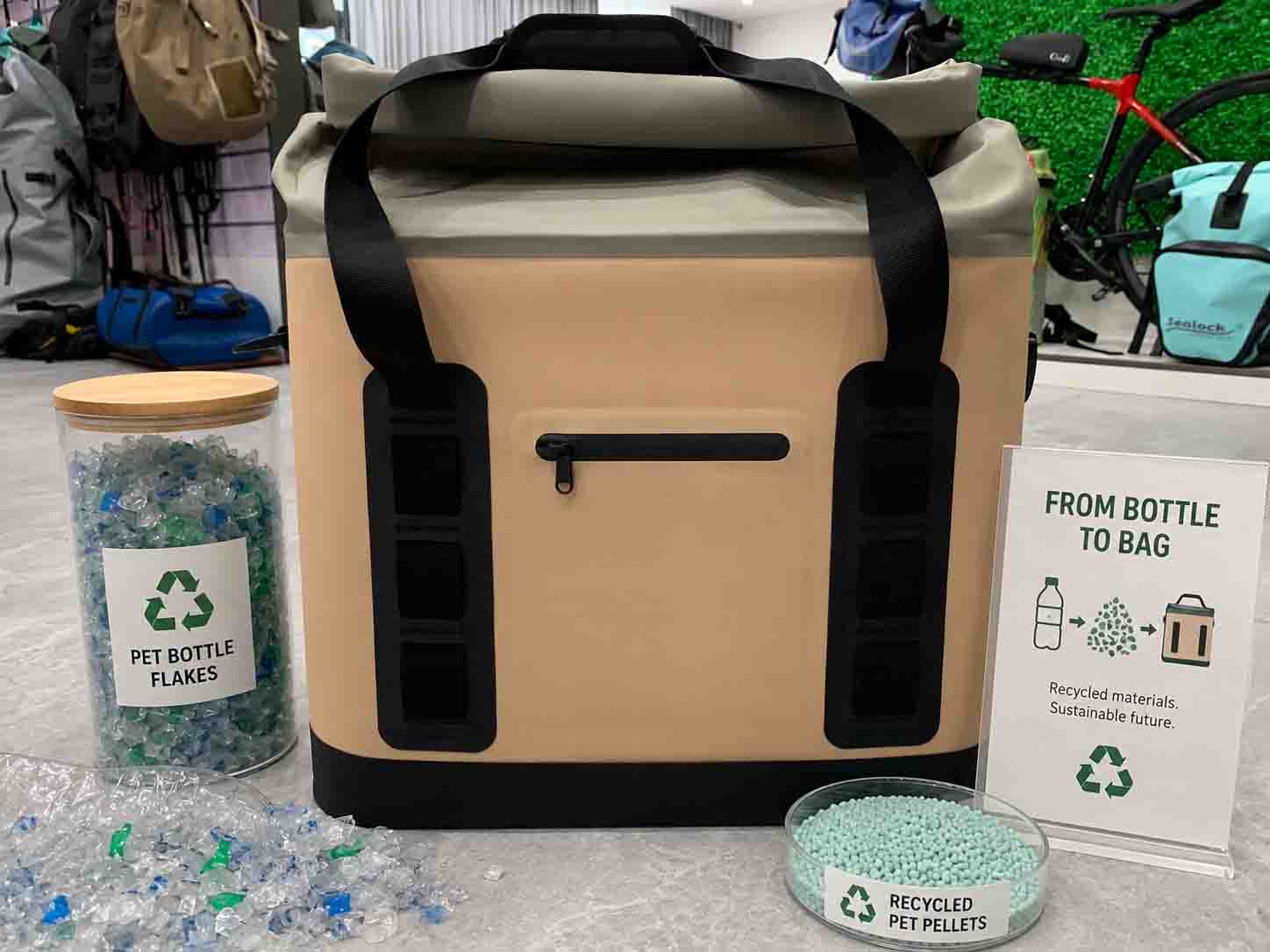
RPET cooler bag shown with recycled PET bottle flakes illustrating the recycled fabric source

Figure 1: RPET shell fabric is spun from recycled bottles — at the same denier it performs like virgin polyester, with the recycled content added on top.

Worry 2: "How do I know the eco claim is real?" — enter GRS

The greenwashing concern is legitimate, because "made from recycled materials" with nothing behind it is unenforceable and risky to put on a label. The Global Recycled Standard (GRS) is the mechanism that turns a claim into verifiable fact. It does three things:

Verifies recycled content

Third-party confirmation of the percentage of recycled material in the fabric — not a self-declaration.

Provides traceability

Tracks the material along the chain — from recycler to mill to bag factory — so the recycled content is documented at each step, not assumed.

Adds social & environmental criteria

Requires that the processing met defined environmental and labour conditions — so the certificate speaks to how it was made, not only what it is made of.

What GRS does not do is equally important to understand: it is not a food-safety certificate and not an insulation-performance rating. A GRS-certified shell can still pair with a non-compliant liner or under-spec foam. So treat GRS as the recycled-content proof and verify food contact (FDA / EU LFGB) and ice-retention separately. The two are independent specs that you confirm independently.

How to verify a GRS claim before you order

A genuine GRS supply chain produces specific documents. A greenwashed one stops at a logo. Ask for these, in this order:

☐ GRS Scope Certificate — shows the supplier (mill/factory) is certified to handle GRS material and names the products and materials covered. Check it is current and covers cooler bag fabric.

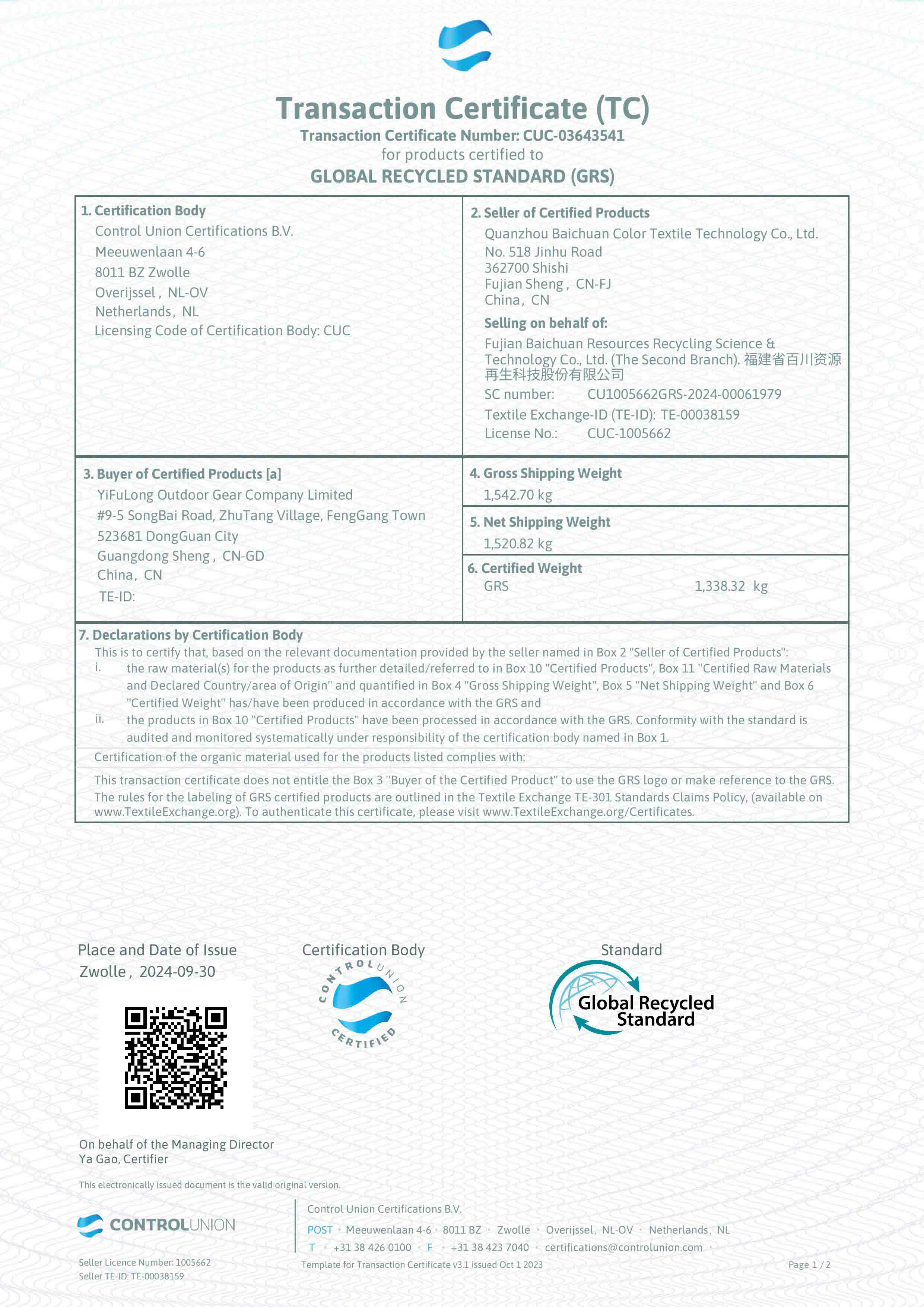
☐ GRS Transaction Certificate — issued for a specific shipment, this is the one that ties recycled material to your order. A Scope Certificate alone proves capability; the Transaction Certificate proves your goods used it.

☐ Stated recycled percentage — confirm the exact recycled content (e.g. 100% RPET shell) and that it matches what you intend to claim on your packaging.

☐ Material match — verify the certified fabric is the one in your actual sample, by denier and construction, not a different RPET grade.

Greenwashing red flags to watch for

When a "recycled" claim is hollow, it shows up in predictable ways. Any one of these means slow down and ask for documents before ordering:

 Only shows a generic recycle logo, with no certificate behind it.

 Can provide a Scope Certificate but no Transaction Certificate for your order.

 No recycled percentage stated — just "eco-friendly" or "green."

 Certificate is expired, or names a different material than your fabric.

 "Recycled" claim covers only the hangtag or packaging, not the bag itself.

GRS transaction certificate

Figure 2: The GRS Transaction Certificate ties recycled material to your specific shipment

Turning the recycled story into a sellable feature

Once the material and certificate are solid, the recycled origin becomes a marketing asset rather than a cost. Two low-effort moves make it visible to the end customer: a sewn-in or printed hangtag stating the origin (for example, "made from recycled bottles"), and using the verified GRS claim in your product copy — which you can only do credibly because the Transaction Certificate backs it. Because RPET prints as well as virgin polyester, none of this compromises your branding options covered in our soft cooler range.

What the recycled option actually costs

"Eco" should not mean a blank cheque. Here is the realistic cost picture so you can budget before you commit:

Shell Material Relative Fabric Cost
Virgin polyester Base
GRS-certified RPET +5% to +15% on fabric

Note the premium is on the fabric, not the whole bag — since shell fabric is only part of the unit cost, the impact on the finished price is smaller than the percentage suggests. Certified RPET is also ordered in lots, so lock the recycled grade and GRS requirement in the PO from the start rather than switching late. At a 300-piece baseline order, confirming the RPET grade up front keeps the certified material procured against your run.

If you want to build a recycled line you can market without greenwashing risk, the fastest path is to confirm the RPET denier and ask for the GRS documentation up front. You can request a GRS-backed sample and the supporting certificates through our insulated bag catalog.

Sustainable Materials Division — Insulated Bags: This guide is published by the engineering center of SEALOCK COOLER (Dongguan Yifulong Outdoor Products Co., Ltd.). We manufacture soft cooler bags in GRS-certified recycled fabrics alongside conventional materials, serving global retail and outdoor brands for over 20 years.

Through our Dongguan, China R&D headquarters and Phase II facility in Ben Cat, Binh Duong, Vietnam, we provide a tariff-hedged dual-track supply chain audited across SMETA 4-Pillar, BSCI, ISO 9001, GRS, and HIGG Index. Liner air-tightness is verified by a 0.05 Bar (0.7 PSI) low-pressure test on every batch. For GRS-certified RPET cooler bags at our 300-piece baseline MOQ, with Scope and Transaction certificates supplied, contact our international trade desk: request a Sealock GRS sourcing pack & quote.

Related News
Leave me a message
X
We use cookies to offer you a better browsing experience, analyze site traffic and personalize content. By using this site, you agree to our use of cookies.Privacy Policy
RejectAccept