News

Engineering Sweat-Proof and Leak-Proof Soft Coolers for the Premium Retail Market

2026-05-18 0 Leave me a message

Executive Summary

A $200 soft cooler backpack doesn't give a customer much tolerance for failure. At that price point, the expectation is straightforward: ice stays frozen, nothing leaks, and the bag doesn't damage whatever surface it sits on. These aren't aspirational requirements—they're the baseline the product needs to deliver consistently to justify the retail price and avoid the return rates that make a premium product launch financially painful.

The gap between a cooler that meets those expectations and one that doesn't isn't primarily a design problem. It's a manufacturing and materials problem. This article covers the three performance dimensions where standard construction fails in premium market conditions—condensation, leakage, and ice retention—and the engineering specifications that address each one.

Scenario 1: Condensation Damage — The Physics of a Sweating Cooler

A customer buys a flagship soft cooler for a weekend on a yacht. They load it with ice and drinks and set it on the teak deck. The cooler was manufactured with low-density foam insulation—adequate by the standards of the factory that quoted it, but not adequate as a thermal break. The cold from the ice transmits through the foam to the outer shell faster than the insulation can resist it. The outer surface drops below the dew point of the humid marine air. Moisture condenses on the exterior, pools at the bottom, and leaves a water ring on the teak. The customer returns the product and writes a review that does real damage to the brand's positioning in the marine market.

This failure mode is predictable from the insulation specification and isn't unusual. It shows up wherever coolers are used on expensive surfaces—yacht decks, hardwood floors, leather car interiors—and customers are paying enough attention to notice. The mechanism is straightforward: condensation forms on any surface that is cold enough to drop below the local dew point. In a marine or summer outdoor environment, the dew point is high. A cooler whose outer shell gets cold because the insulation isn't doing its job will sweat under those conditions reliably.

The Engineering Solution: Thermal Break Through Foam Density

The solution is not a surface treatment or a coating—it's building an insulation layer thick and dense enough that the outer shell never gets cold. When the thermal break is adequate, the cold stays inside, the outer surface remains at ambient temperature, and there's no cold surface for atmospheric moisture to condense onto.

High-density closed-cell foam—specifically NBR (nitrile butadiene rubber) grade or equivalent premium closed-cell EVA—is the relevant specification. The cellular structure matters as much as the material: in closed-cell foam, each gas bubble is fully sealed from its neighbors, which means heat transfer through convection within the foam is eliminated. Conductive heat transfer through the foam matrix is limited by the low thermal conductivity of the sealed gas fill in each cell. The result is a material with meaningfully higher R-value per unit thickness than open-cell alternatives.

For sweat-proof performance in marine conditions, foam thickness is a specification variable that should be engineered against the actual ambient conditions the product will encounter—humidity level, expected ambient temperature, and internal temperature target—not selected from a standard catalog option. A manufacturer treating foam thickness as a fixed design choice rather than a calculated thermal specification is not doing this work.

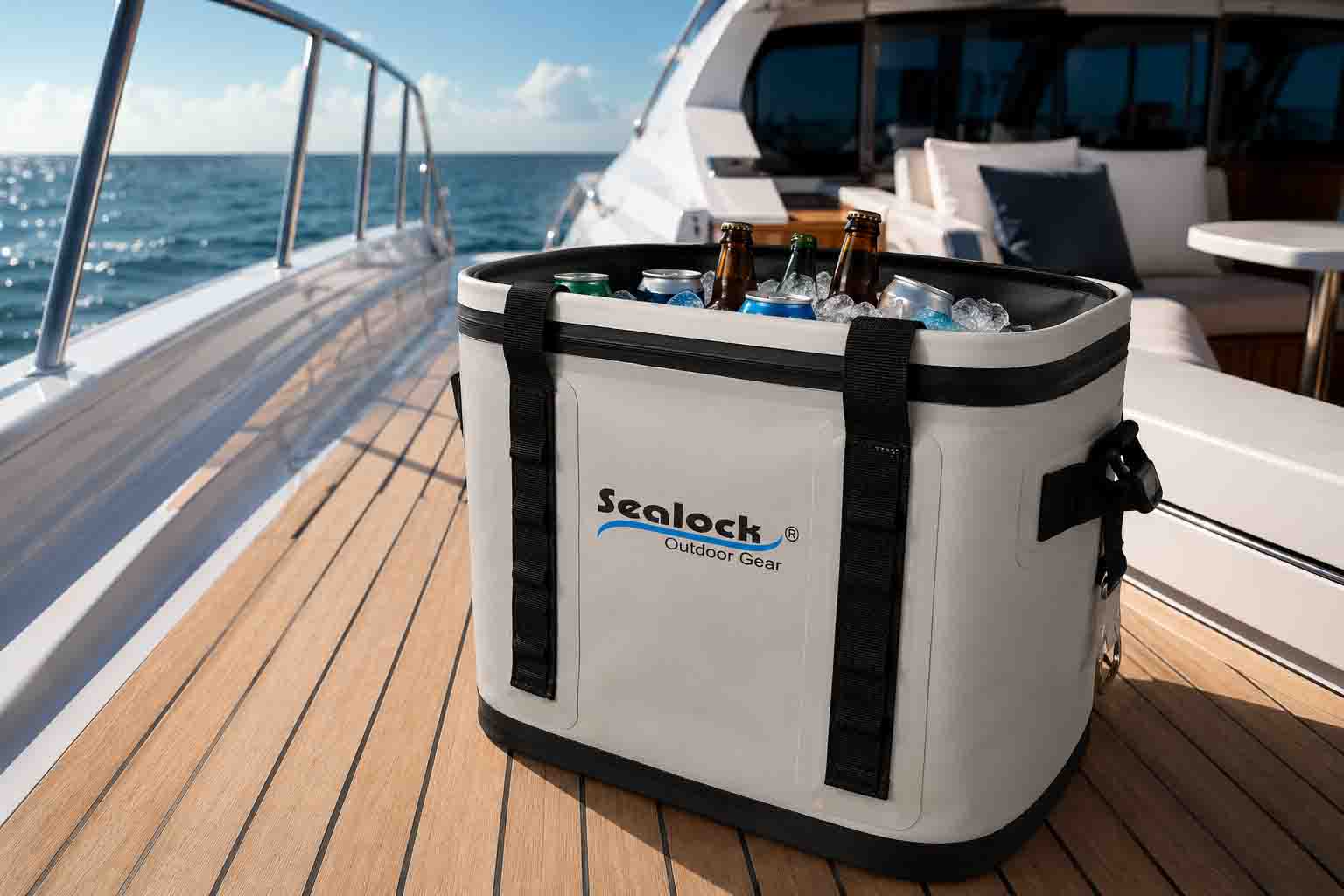
A sweat-proof OEM premium soft cooler backpack sitting dry on a yacht's teak deck, demonstrating zero condensation.

Scenario 2: Trunk Flood — Leak Failure Under Real Use Conditions

A family throws a branded cooler backpack into an SUV trunk for a beach trip. Ice has been in the bag since morning; some has melted. On the highway, a sharp turn tips the bag onto its side. Melted ice water finds the stitched seams at the base and sides of the liner. The seam tape that covered the needle holes has been through enough thermal cycling and flex stress to have lifted at the corners. Water breaches the seam, saturates the insulation, and pools in the trunk. The surrounding luggage is soaked. The car interior is damaged. The customer calls the brand's customer service line while still in the parking lot at the beach.

The failure here is structural, not incidental. Stitched seam construction creates needle perforations through the liner at every stitch point. Seam tape addresses this initially but degrades under the specific conditions of normal cooler use: sustained moisture exposure from the inside, thermal cycling between cold interior and warm exterior, and mechanical flex from handling and transport. As tape bond edges lift, the perforations underneath become active water pathways. A bag that passed its initial quality check can develop this failure mode after weeks of regular use, which means the return doesn't arrive until the customer is frustrated enough to bother.

The Engineering Solution: RF Welded Interior With Airtight Closure

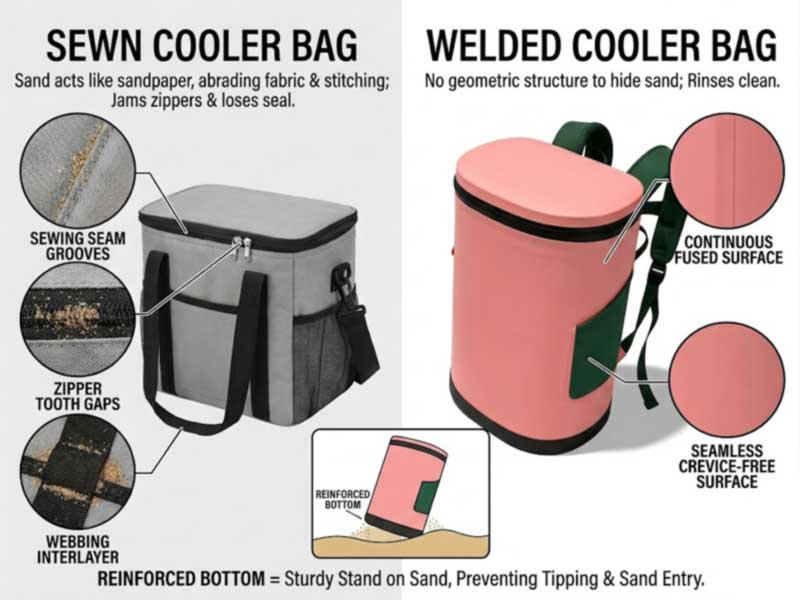
RF welding replaces the stitched seam structure with a molecularly continuous liner. When TPU panels are joined at 27.12 MHz, the electromagnetic field generates internal heat at the join interface, the material fuses at the molecular level under pneumatic pressure, and the boundary between the original panels disappears structurally. The resulting interior is a single watertight basin—no needle holes, no tape, no edges that can lift under moisture and flex stress. Melted ice water pools at the bottom of the liner and stays there. It doesn't migrate through any seam because there is no seam penetration pathway.

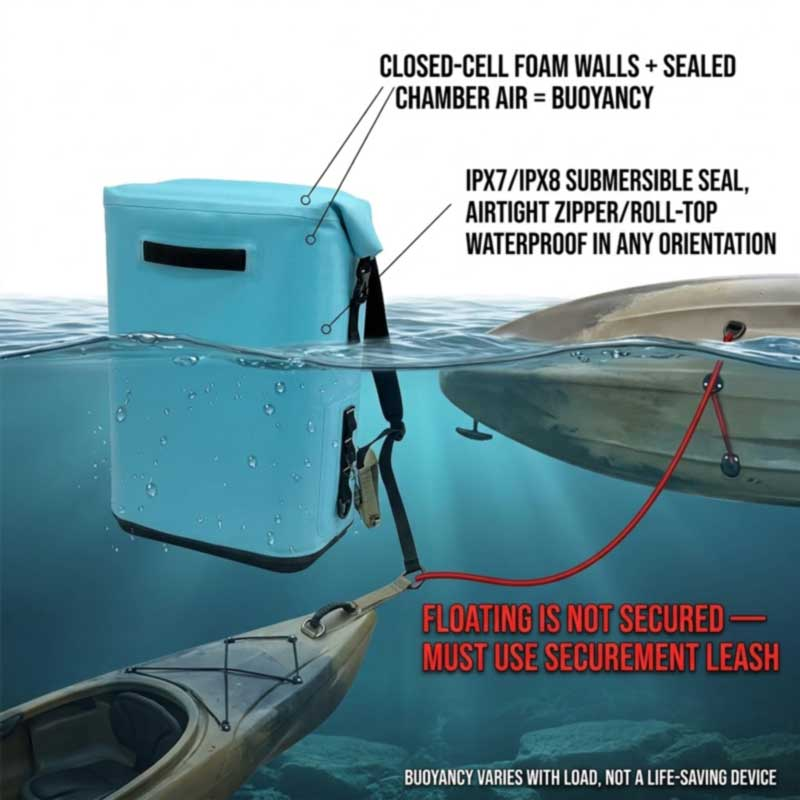
The closure system needs to match the liner construction. An RF welded bag with a standard coil zipper is not leak-proof when tipped—standard zippers allow water passage under pressure at the teeth. True airtight and watertight zipper systems use interlocking polymer teeth sealed by a continuous gasket along the track. When engaged, the closure is mechanically hermetic: water pressure from an inverted, fully loaded cooler doesn't find a pathway through the zipper teeth because the gasket seal is continuous across the full closure length. A cooler built with RF welded seams and an airtight zipper can be inverted completely without leaking, which is the test condition that confirms the construction actually holds under real use dynamics rather than just static submersion.

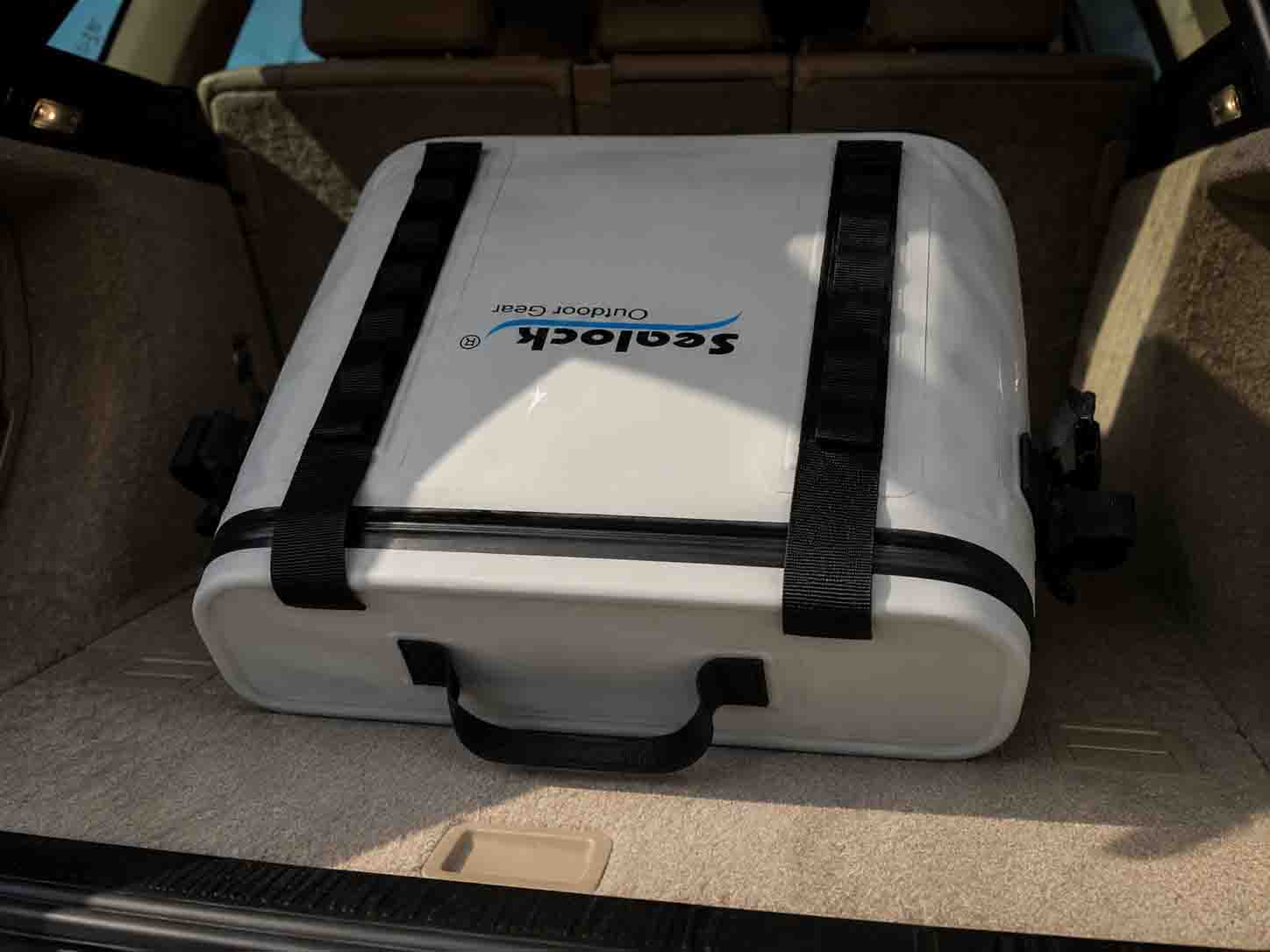
An inverted OEM soft cooler demonstrating 100% leak-proof performance with an airtight zipper in a car trunk.

Scenario 3: Ice Retention Shortfall — When the Foam Specification Gets Substituted

A brand's marketing team advertises 72-hour ice retention based on the OEM's quoted specification. The product launches, the initial reviews are positive, and then the summer heat arrives. Customers on 90°F beach days are reporting ice gone within 14 hours. The brand's social media team is managing a growing thread of customers accusing the product of false advertising. An internal investigation reveals the factory quietly substituted a cheaper open-cell foam blend for the closed-cell specification to protect their margin on a high-volume run. The substitution wasn't detectable on visual inspection of the finished product.

This failure mode is more common than brands realize, and it's not always intentional fraud—sometimes it's a factory sourcing substitute materials during a supply shortage without flagging the change. The practical problem is that open-cell foam and closed-cell foam look similar in a finished cooler, the substitution doesn't produce visible defects, and the performance difference only becomes apparent when the product is used in the conditions it was rated for. By then, the production run has shipped and the return cycle has started.

The Engineering Solution: Specified and Verified Closed-Cell Foam

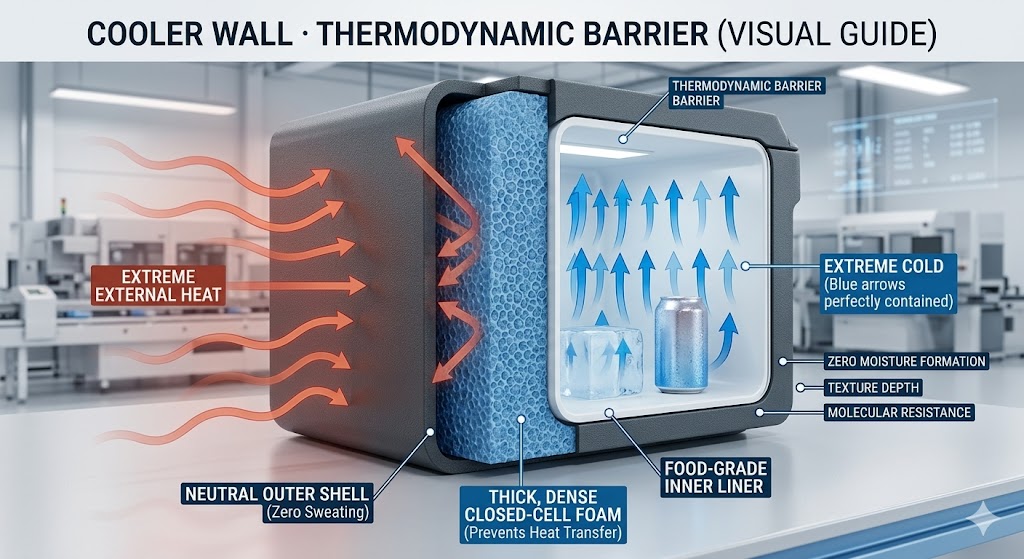
Closed-cell foam's thermal advantage over open-cell alternatives comes from the sealed gas bubble architecture. Each cell is an independent insulating unit—there's no air movement through the foam matrix, so convective heat transfer is eliminated. The gas fill of each sealed cell has low thermal conductivity, limiting conductive heat transfer as well. Open-cell foam, where the cells are interconnected, allows both air movement and moisture absorption, and wet open-cell foam loses most of its insulating value because water conducts heat far more efficiently than gas.

For a cooler that needs to deliver 72-hour ice retention at 90°F ambient, the foam density specification needs to be defined numerically—kilograms per cubic meter, not just "closed-cell"—and verified on incoming material batches rather than assumed to carry over from one production run to the next. A density test on a sample cut from incoming foam takes minutes and confirms the specification is being met at the material level before it's bonded into a finished product that can't easily be inspected afterward.

The interior liner specification contributes to thermal performance as well. FDA-approved food-grade TPU liners with reflective characteristics reduce radiant heat ingress from the direction of the payload. The combination of a verified closed-cell foam insulation layer, an RF welded hermetic interior that keeps the foam dry, and a reflective inner liner addresses the three heat transfer modes—conduction, convection, and radiation—that determine ice retention duration.

The audit question that matters: ask the OEM for incoming foam density test records from recent production runs. A factory that verifies foam specification on incoming material will have these records as part of standard IQC (Incoming Quality Control) documentation. A factory that doesn't perform incoming material verification on the foam specification is the one whose closed-cell quote might arrive as open-cell delivery.

3D cross-section showing how high-density closed-cell foam prevents condensation and ensures 72-hour ice retention.

Conclusion: The Return Rate Economics of Getting This Right

Premium soft cooler retail returns are expensive in ways that go beyond the refund itself. The customer who returns a $200 cooler because it sweated all over their boat deck or flooded their trunk is not quietly going away—they're leaving reviews, posting photos, and telling people in the communities where premium outdoor brands depend on word-of-mouth. The brand equity damage from a pattern of these failures in the first season after launch is significantly harder to recover from than the cost of getting the manufacturing specification right before the product ships.

The three engineering specifications that address the scenarios above—high-density closed-cell foam for sweat-proof thermal break performance, RF welded liner construction with airtight zipper hardware for genuine leak-proof integrity, and verified incoming foam density for reliable ice retention—are not independent upgrades. They work as a system. A cooler with the right foam but stitched seams will still leak when tipped. A cooler with RF welded seams and inadequate foam will still sweat on a yacht deck and fall short of its ice retention claim. The construction needs to address all three failure modes to hold up in premium market conditions.

When evaluating OEM partners for premium soft cooler development, the relevant questions are: What foam density do they specify, how is it measured, and can they provide incoming material test records? Are seams RF welded throughout the liner including the base corners, or only on panels where it's visible? What zipper system do they use for airtight closure, and how is it individually tested before going into production? These questions have direct operational answers for a factory that actually builds to this specification.


Frequently Asked Questions

Why do cheap soft coolers "sweat" or form condensation on the outside?

Condensation occurs when poor-quality, thin insulation allows the cold temperature from the ice to reach the outer shell. When humid air hits this cold surface, it turns into water. Premium OEM coolers use thick, high-density closed-cell foam to prevent the outer shell from getting cold, eliminating condensation entirely.

Are RF-welded soft coolers genuinely leak-proof if tipped upside down?

Yes, but only if paired with a true airtight/watertight zipper. RF welding eliminates needle holes in the fabric, while an airtight zipper mechanically seals the opening. Together, they create a 100% leak-proof environment, even when fully inverted.

What type of foam provides the best ice retention for B2B soft cooler manufacturing?

High-density Closed-Cell Foam (such as NBR or premium EVA) is the industry standard for 48 to 72-hour ice retention. Unlike open-cell foam (which absorbs moisture and loses thermal resistance), closed-cell foam traps gases in microscopic bubbles to permanently block heat transfer.

Related News
Leave me a message
X
We use cookies to offer you a better browsing experience, analyze site traffic and personalize content. By using this site, you agree to our use of cookies. Privacy Policy
Reject Accept