News

News

Stay informed on waterproofing tech and market trends. SEALOCK’s news hub shares insights from our China/Vietnam manufacturing centers.
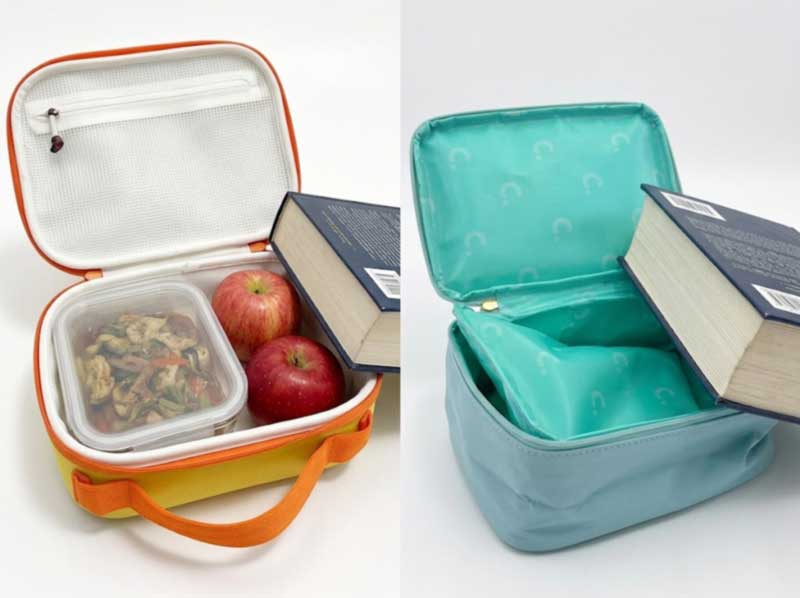
Best Lunch Bag: 7 Things a Lunch Box Maker Checks First22 2026-10

Best Lunch Bag: 7 Things a Lunch Box Maker Checks First

The best lunch bag is the one that still has your food below 40°F (4°C) when you open it at lunchtime, does not leak on the way, fits the containers you actually use and survives a year of daily handling. That sounds obvious, but the numbers show how often lunch bags miss it. In lunch cooler tests by Reviewed, bags that relied on ice packs kept their contents below 40°F for roughly 2.5 to 6.5 hours. If you pack at 7 a.m. and eat at 12:30, the weaker end of that range does not get you to lunch.
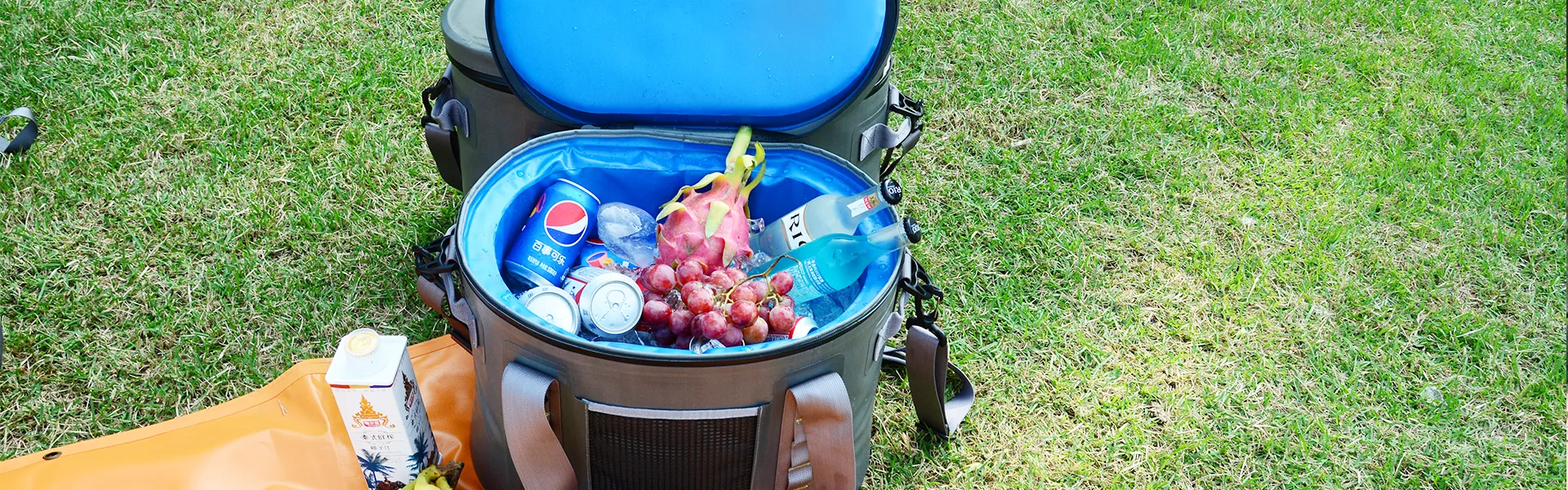
How to Pack a Cooler With Drinks and Food So the Ice Lasts19 2026-10

How to Pack a Cooler With Drinks and Food So the Ice Lasts

How you pack a cooler decides how long the ice lasts almost as much as which cooler you own. The same bag can keep food cold for two days or turn into lukewarm water by the afternoon, depending on what went in first, how cold it was, how much air was left inside and how often the lid was opened. This guide covers the packing order that works, how to pack drinks, how to keep food safe, and the points specific to soft coolers and cooler backpacks that most packing guides leave out. It is written by Sealock (YiFuLong Outdoor Gear Co., Ltd.), which has manufactured insulated soft coolers and cooler backpacks in China and Vietnam for over 20 years.
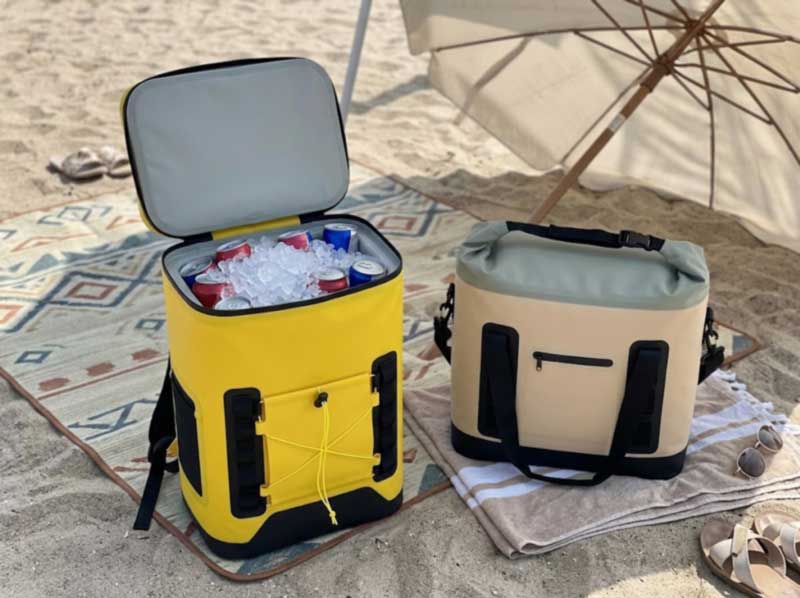
Best Soft Cooler for Ice Retention: What the Hours Mean15 2026-10

Best Soft Cooler for Ice Retention: What the Hours Mean

Every soft cooler on the market claims a number: 24 hours, 48 hours, "up to three days." Independent tests show how loosely those numbers relate to one another. In an indoor test published by Outdoor Life, each soft cooler was loaded with 7 pounds of ice at 68–72°F and timed until the ice was gone; results ran from about 35 hours to about 62 hours. In a test by Treeline Review, coolers left in direct sun above 90°F lost most of their ice in 10 to 24 hours. Same category of product, a spread of several times, and most of the difference comes from the conditions, not the cooler. This guide explains what actually decides a soft cooler's ice retention, how to read a retention claim, and which construction holds ice longest. It is written by Sealock (YiFuLong Outdoor Gear Co., Ltd.), which has manufactured insulated and waterproof bags in China and Vietnam for over 20 years and verifies cold-hold on its own coolers with multi-probe temperature logging.
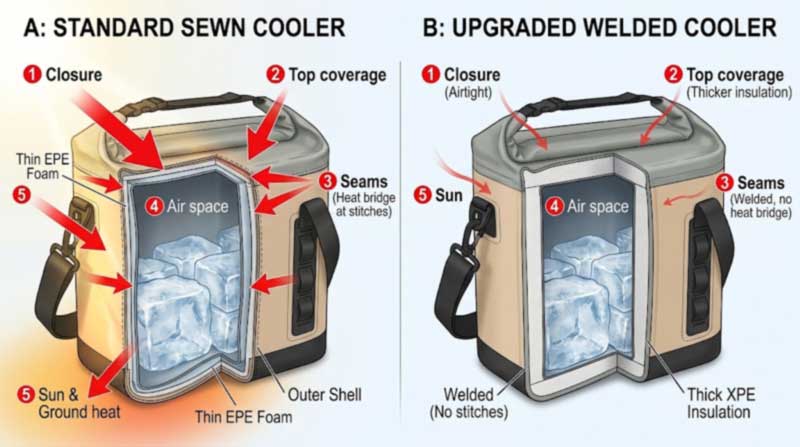
XPE Foam vs EPE: Why One Cooler Wall Stays Thick15 2026-10

XPE Foam vs EPE: Why One Cooler Wall Stays Thick

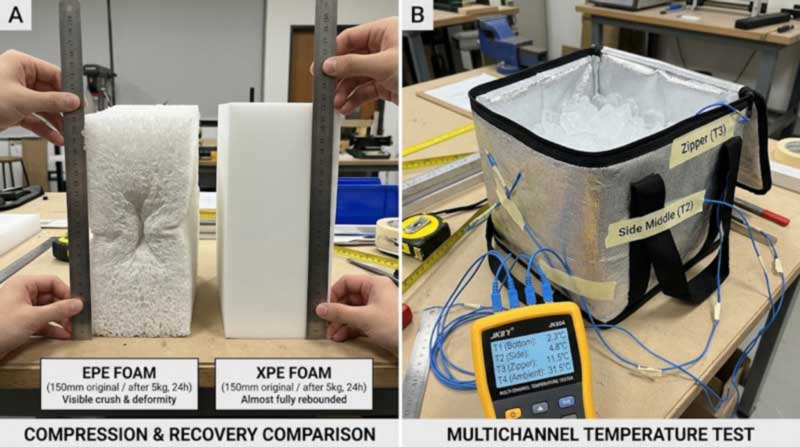
XPE foam is crosslinked, closed-cell polyethylene foam. In a soft cooler it sits between the outer shell and the food-grade liner and does the actual work of keeping the contents cold. It looks almost identical to EPE, the cheaper non-crosslinked polyethylene foam used in most promotional cooler bags, and on a spec sheet the two are often written simply as "PE foam." The difference shows up months later, when one cooler's base and back panel have flattened to half their original thickness and the other's have not. This guide explains what XPE is, how it differs from EPE, IXPE and EVA, what that means for cold-hold and durability, and how to specify foam so the sample you approve is the cooler your customers actually receive. It is written by Sealock (YiFuLong Outdoor Gear Co., Ltd.), which has built insulated bags with both high-frequency welded and sewn construction at its factories in Dongguan, China and Ho Chi Minh City, Vietnam for over 20 years.
Higg Index Explained: What FEM and FSLM Mean for Buyers14 2026-10

Higg Index Explained: What FEM and FSLM Mean for Buyers

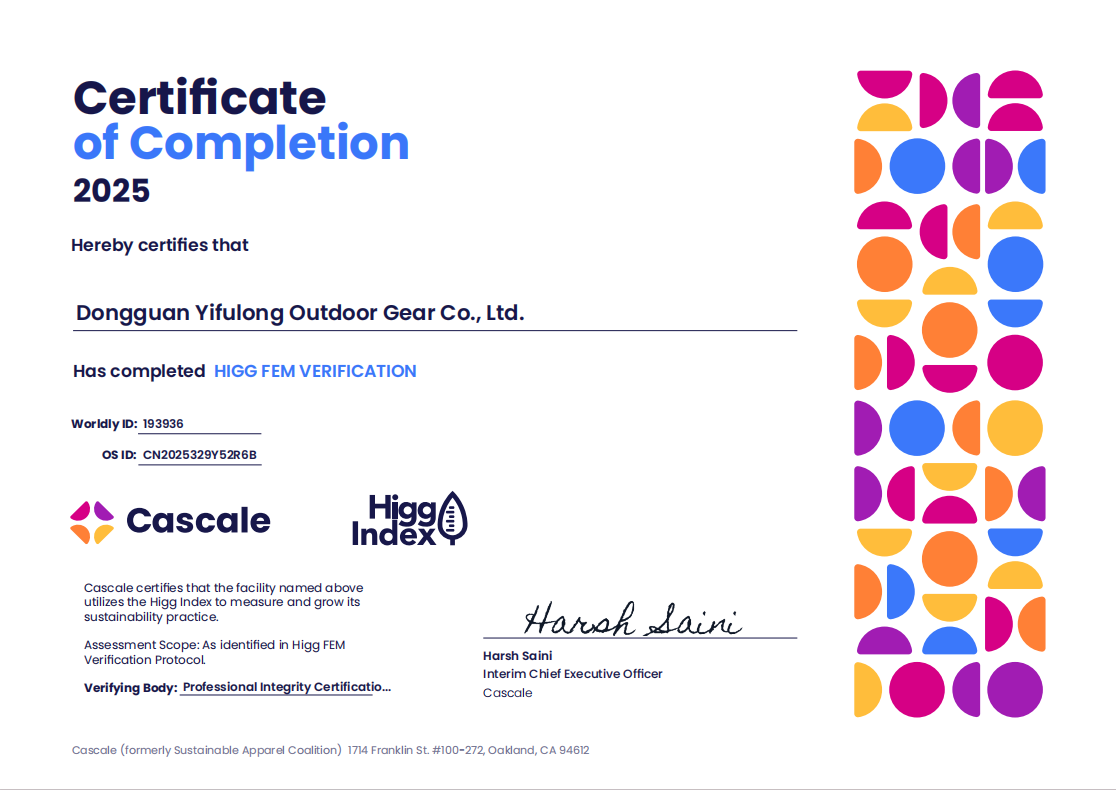
If you sell to a large retailer or an outdoor brand with sustainability targets, sooner or later someone will ask whether your factory "does Higg." The Higg Index is not one audit or one certificate. It is a set of measurement tools, and only two of them are completed by factories. This guide explains what the Higg Index is, what the Facility Environmental Module (FEM) and Facility Social & Labor Module (FSLM) actually measure, how self-assessed and verified results differ, and how a buyer should request and read a supplier's Higg data. It is written by a manufacturer, Sealock (YiFuLong Outdoor Gear Co., Ltd.), which has made insulated and waterproof bags in China and Vietnam since 2003 and participates in the Higg Index as a manufacturing facility.
SMETA Audit Explained: What Happens on the Factory Floor13 2026-10

SMETA Audit Explained: What Happens on the Factory Floor

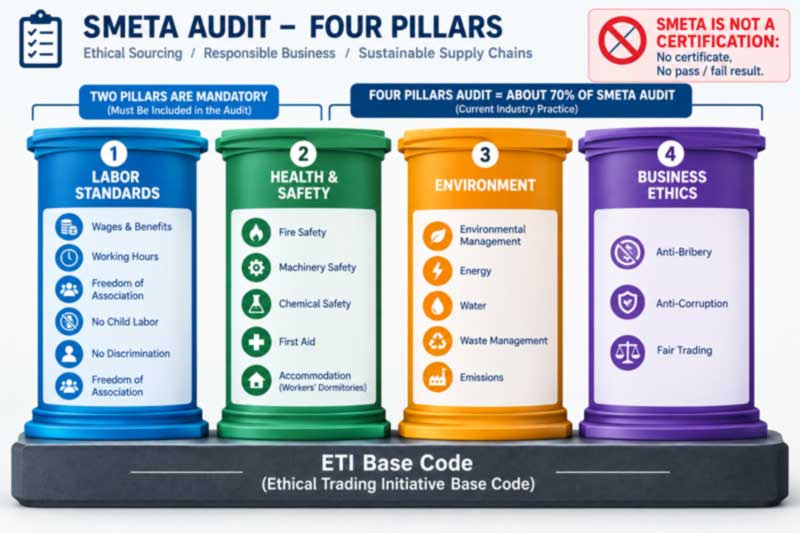
A SMETA audit is the most widely used social audit in global supply chains, and if you buy from a factory, sooner or later you will either request one or be sent one. Most explanations are written by audit companies. This one is written from the other side of the table, by a manufacturer that holds a four-pillar SMETA audit: what the audit is, what happens during it, what the report does and does not prove, and how a buyer should read one. Sealock (YiFuLong Outdoor Gear Co., Ltd.) has manufactured insulated and waterproof bags in China and Vietnam since 2003.
X
We use cookies to offer you a better browsing experience, analyze site traffic and personalize content. By using this site, you agree to our use of cookies. Privacy Policy
RejectAccept